Controlled Exposure Conditions for ISO 4892-2
ISO 4892-2 provides different exposure cycles rather than one universal setting. The actual configuration should be selected according to the applicable material specification, customer test method, or agreed test program.
Filter Type | Irradiance (300–400 nm) | Reference Wavelength Irradiance |
Daylight Filter | 60 ± 2 W/m² | 0.51 ± 0.02 W/(m²·nm) at 340 nm |
Window Glass Filter | 50 ± 2 W/m² | 1.10 ± 0.02 W/(m²·nm) at 420 nm |
Why Choose the ISO 4892-2 Accelerated Light Weathering UV Resistance Device
1. Full-Spectrum Daylight Simulation (290–800 nm)
Not limited to a single UV band — the system reproduces the complete solar spectrum (UV, visible, and infrared). Interchangeable Daylight and Window Glass filters let you simulate both harsh outdoor exposure and light filtered through automotive or architectural glass.
2. Closed-Loop Irradiance Compensation (No Data Drift)
Dual-band 340nm/420nm sensors feed a real-time feedback system that automatically increases lamp power as the xenon lamp ages — eliminating the irradiance drift common in conventional chambers and keeping data comparable across 1,000+ hour test cycles.
3. Combined Light–Water–Heat Stress (Faster Failure Detection)
High-intensity irradiation, high-pressure spray cooling, and precise BPT/BST temperature control work together, accelerating not just fading and yellowing but also cracking, chalking, and mechanical strength loss caused by thermal cycling and moisture ingress.
4. 360° Rotating Multi-Tier Rack (No Exposure Dead Zones)
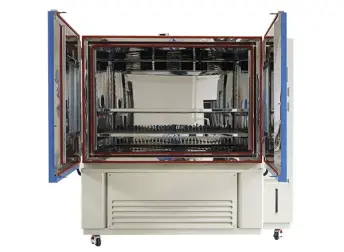
A multi-tier rotating specimen rack with top-down airflow ensures all 42 specimens receive identical irradiance, temperature, and humidity — removing the position-dependent variation that can invalidate test results in less uniform chambers.
5. Industrial-Grade Data Traceability (OEM Audit-Ready)
A multilingual color touchscreen with PLC control logs the full test curve in real time, triggers automatic alarms on deviation, and exports data via USB/Ethernet. Records are tamper-proof, meeting the traceability requirements of automotive OEMs, aerospace, and third-party test labs.
ISO 4892-2 Accelerated Light Weathering UV Resistance Device Specifications
Model | XL-S-750 |
Internal Dimension (mm) | 950*950*850 mm |
Overall Dimension (mm) | 1400*1400*1950 mm |
Specimen Holder Size(mm) | 95*200 |
Specimen Capacity | 42pcs |
Chamber Type | Rotating Holder |
Irradiation Source | 1 piece of 4500w water-cooled xenon arc lamp |
Irradiance Range | 35~150 W/㎡ |
Bandwidth Measurement | 300nm~400nm (340nm or 420nm) |
Chamber Temperature Range | Ambient ~ 100 ℃ ±2℃ |
Black Panel Temperature | BPT 35 ~ 85 ℃ ±2℃ |
Humidity Range | 50% ~ 98% RH |
Humidity Deviation | ± 5% RH |
Water Spray Cycle | 1~9999H59M (Adjustable) |
Controller | Programmable color LCD touch screen controller |
Water supply system | Automatic water supply, Water purification system |
Radiometer | UV Radiometer, Tolerance: ±5% |
Cooling System | Mechanical compression refrigeration system |
3-Year Warranty & Lifetime Technical Support
3-Year Manufacturer Warranty — Full functional coverage for 36 months.
Lifetime Free Technical Support — Technical assistance remains available after the warranty period.
48-Hour Spare Parts Express — Replacement components can be dispatched through DHL or FedEx according to service requirements.
Traceable Factory Calibration — Equipment can be supplied with factory calibration documentation and applicable traceability records.
24/7 Remote Assistance — Remote video support is available for installation, operation, troubleshooting, and maintenance.
Frequently Asked Questions
What is ISO 4892-2 used for?
It specifies laboratory exposure methods using xenon-arc light to reproduce daylight weathering effects, combined with controlled temperature, humidity, and wetting.
Is ISO 4892-2 a UV test standard?
No. It's a xenon-arc standard covering the full UV and visible spectrum, filtered to match daylight — not a UV-only method.
What is the difference between ISO 4892-2 and a UV fluorescent lamp test?
ISO 4892-2 uses filtered xenon-arc light to reproduce daylight, while ISO 4892-3 uses fluorescent UV lamps with a different spectrum. Which one applies depends on your material spec.
Can the XL-S-750 perform water spray testing?
Yes. Spray cycles are adjustable from 1 hour up to 9999H59M, covering the wetting methods required by ISO 4892-2.
Can the test conditions be customized?
Yes. Irradiance (35–150 W/m²), temperature, humidity, exposure duration, and filter type can all be configured to your test method.
Does ISO 4892-2 specify one fixed test condition?
No. It offers multiple exposure configurations via different filters and controls; the right cycle depends on your material and spec.
Can this chamber also run ASTM G155 or SAE J2527 tests?
Yes — both use xenon-arc sources. Contact us to confirm the filter and cycle for your specific method.
Request an ISO 4892-2 Xenon-Arc Weathering Solution
Need to reproduce controlled light weathering conditions for your material or product?
Contact LIB Industry for the technical specification, chamber configuration, test conditions, and customized xenon-arc weathering solution for your application.

 English
 русский
 français
 العربية
 Deutsch
 Español
 한국어
한국어 italiano
 tiếng việt
 ไทย
ไทย Indonesia
_20260921181238.webp)
_20260921181238.webp)
_20260921181238.webp)
_20260921181239.webp)