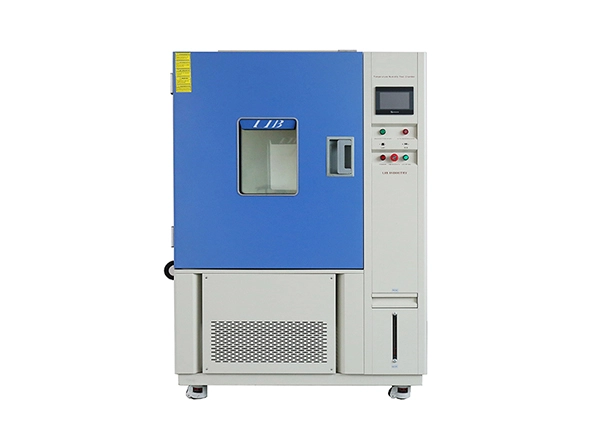
Concrete is the most widely used construction material in modern infrastructure, forming the backbone of bridges, tunnels, highways, marine structures, and high-rise buildings. While its compressive strength is well understood, long-term durability under environmental exposure remains the real engineering challenge.
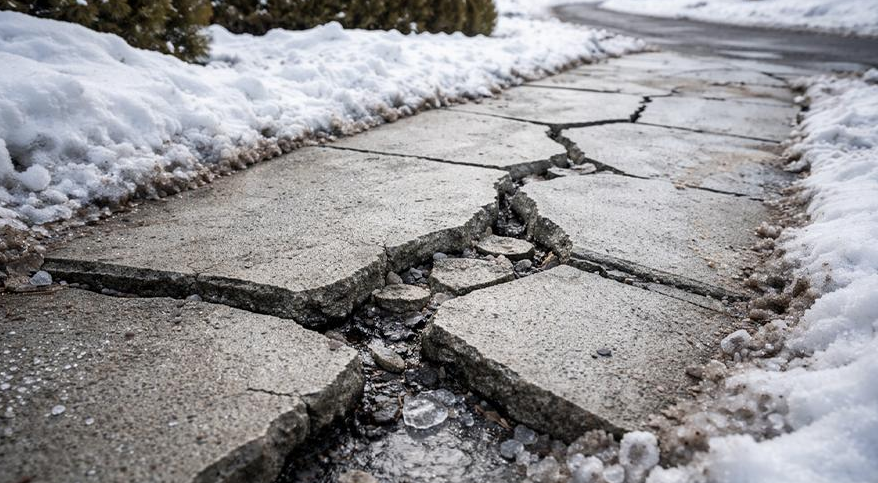
In real-world conditions, concrete is constantly exposed to:
Freeze–thaw cycles in cold regions
Moisture ingress and saturation
Temperature fluctuations causing microcracking
Long-term chemical and physical aging
These factors gradually reduce structural integrity, often long before the designed service life is reached.
Traditional structural design relies heavily on theoretical calculations. However, modern engineering demands experimental validation under controlled environmental conditions.
This is where the laboratory climatic chamber becomes essential. It enables engineers to reproduce years of environmental stress within weeks or months, transforming durability evaluation into a measurable, repeatable engineering process.
ISO 13823 provides the foundational principles for designing structures with long-term durability in mind. Instead of prescribing a single test method, it defines a general durability-based design philosophy.
A key principle is the durability limit state, which defines the point at which environmental exposure begins to significantly degrade structural performance.
Typical degradation mechanisms include:
Freeze–thaw damage
Moisture penetration
Carbonation
Material fatigue over time
Once this threshold is reached, deterioration becomes progressive and irreversible.
ISO 13823 supports service life prediction through cause-and-effect models:
Service Life = f(Environmental Load, Material Resistance, Time)
However, these models require real experimental input data to be reliable. Without laboratory validation, predictions remain theoretical rather than engineering-grade.
ASTM C666 is the most widely used standard for evaluating concrete resistance to rapid freeze–thaw cycles under saturated conditions.
Procedure A: Freezing and thawing in water
Procedure B: Freezing in air and thawing in water
Both procedures simulate severe environmental stress where internal ice formation leads to structural damage.
The primary evaluation metric is the Relative Dynamic Modulus of Elasticity (RDM):
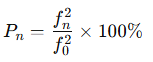
Where:
( f0 ): initial resonant frequency
( fn ): frequency after n cycles
Concrete is considered failed when:
RDM < 60%
Excessive mass loss (>5%)
Severe surface cracking
These thresholds provide clear pass/fail criteria for material qualification.
To accurately perform ASTM C666 testing, highly controlled environmental simulation is required. Conventional refrigeration equipment cannot meet the precision, uniformity, and long-term cycling demands of concrete durability testing.
This is where LIB industry provides critical engineering value.
|
|
|
| |
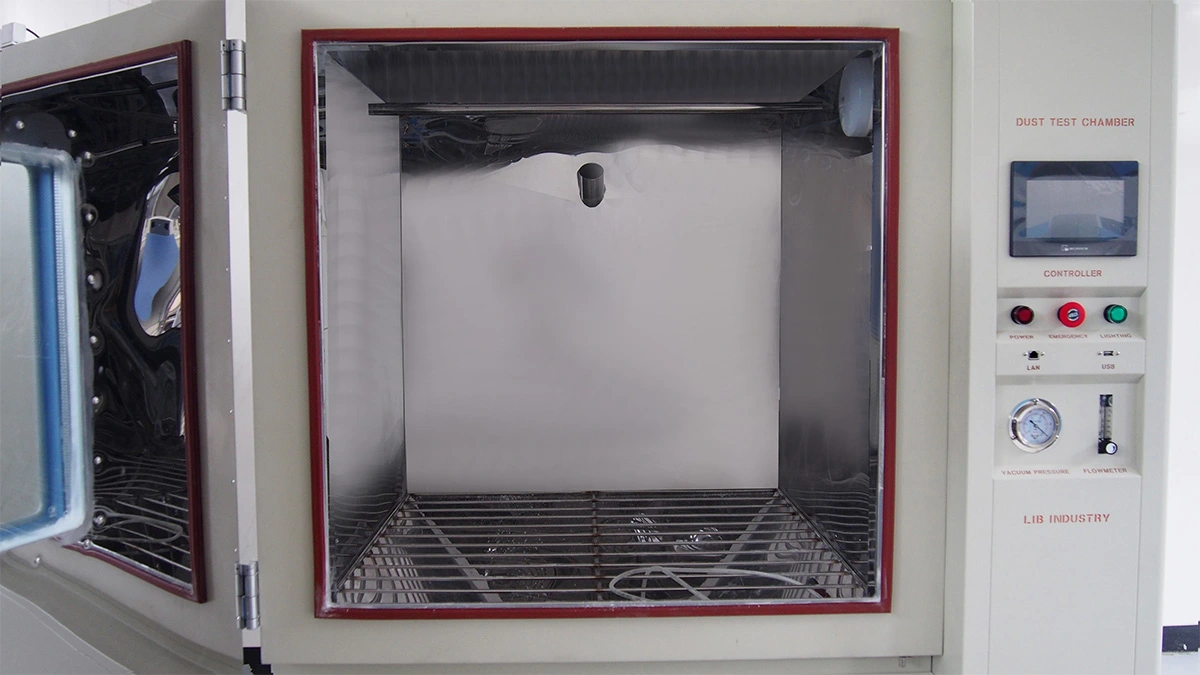
| Robust Workroom | Cable Hole | Temperature and Humidity Sensor | PID controller |
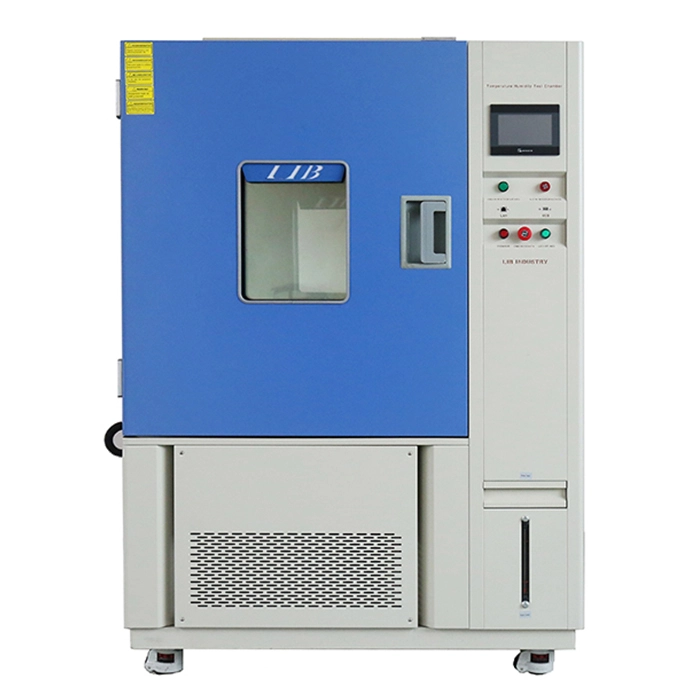
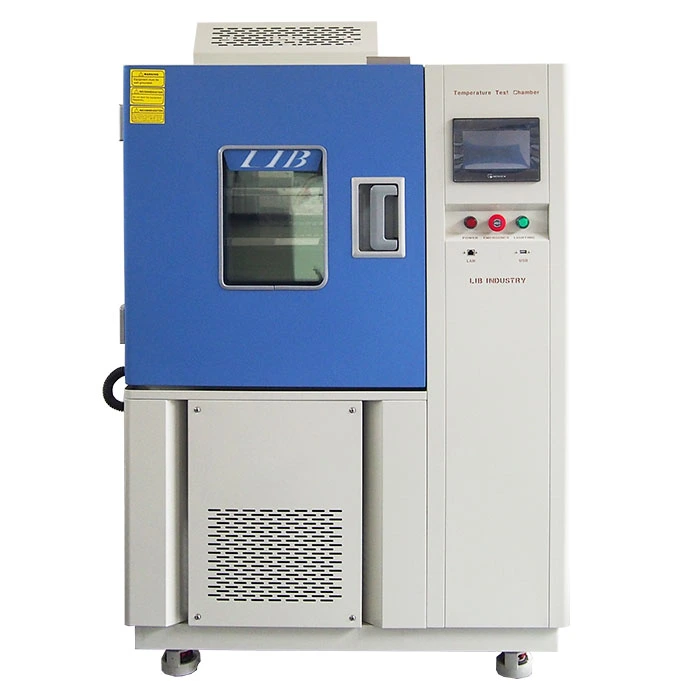
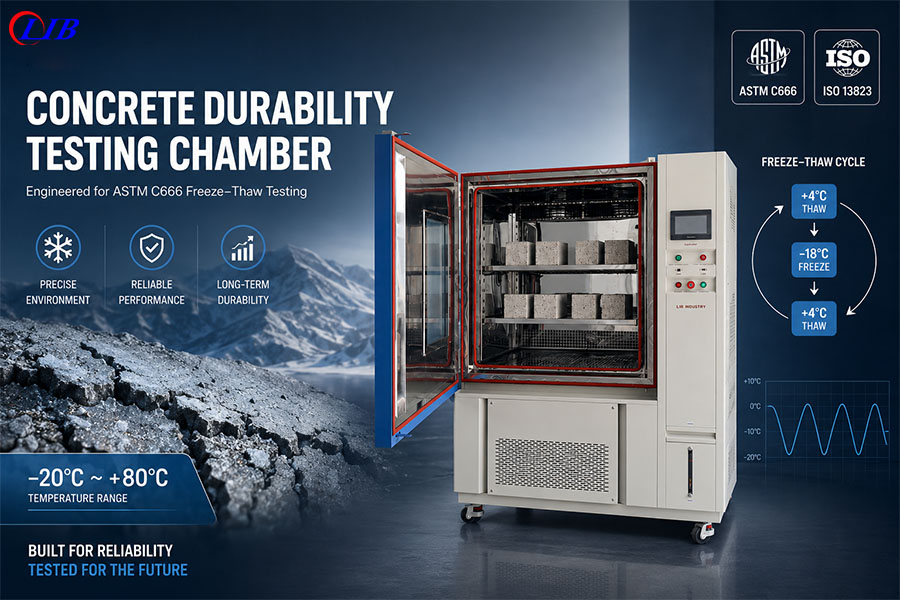
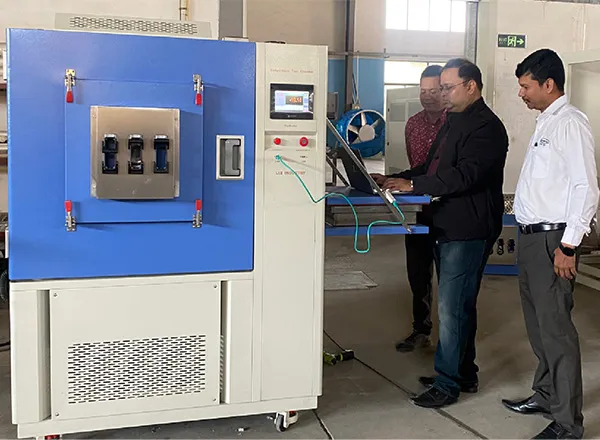
LIB industry temperature humidity laboratory climatic chamber systems are specifically designed for freeze–thaw durability testing of construction materials, ensuring compliance with international standards.
Programmable temperature range: +4°C to -18°C
Stable cycling with minimal overshoot
Fast transition control for accelerated testing
Multi-direction airflow system
Uniform environmental distribution across all specimens
Temperature deviation maintained within tight engineering limits
Designed for 300–600+ freeze–thaw cycles
24/7 automated test execution
Industrial-grade reliability for long-term experiments
SUS316 stainless steel interior
Resistant to moisture, alkalinity, and chemical exposure
Optimized for concrete leachate environments
Fully programmable ASTM C666 test profiles
Remote monitoring capability
Continuous data recording for RDM and temperature cycles
In modern laboratories, LIB industry systems serve as the core environmental simulation platform for concrete durability validation.
The ASTM C666 testing process is executed in a structured environmental cycle:
Concrete samples are prepared in standardized shapes and saturated with water before testing.
Samples are placed inside the LIB climatic chamber with controlled spacing for airflow balance.
Each cycle includes:
Freezing phase (-18°C exposure)
Stabilization phase
Thawing phase (+4°C or controlled environment)
The process is repeated for hundreds of cycles depending on test requirements.
Relative Dynamic Modulus (RDM)
Mass loss tracking
Surface crack evaluation
One of the most important engineering outcomes of laboratory testing is the integration of experimental results into structural design models.
ASTM C666 generates real degradation data
RDM decay curves are established
ISO 13823 service life models are calibrated
Structural durability predictions are refined
This process transforms laboratory testing into predictive engineering intelligence.
For advanced materials such as low-carbon concrete, this validation step is essential to ensure sustainability does not compromise durability.
LIB industry climatic chamber systems provide the controlled environment necessary to generate reliable and repeatable input data for this modeling process.
To ensure data accuracy, laboratories must follow strict operational procedures:
Calibrate temperature sensors against specimen core temperature
Maintain proper specimen spacing for airflow uniformity
Prevent condensation interference during long-term cycling
Perform regular maintenance to avoid mineral buildup
These practices ensure consistency across long-duration freeze–thaw experiments.
Concrete durability engineering requires a complete integration of design standards and physical validation.
ISO 13823 defines durability design principles
ASTM C666 defines freeze–thaw resistance testing methodology
Laboratory climatic chambers enable controlled environmental simulation
Through advanced systems developed by LIB industry, laboratories can achieve:
Standard-compliant testing
High repeatability
Reliable service life validation
Engineering-grade durability data
In modern infrastructure development, climatic chamber testing is no longer optional—it is a fundamental requirement for ensuring structural safety, performance, and long-term sustainability.
If you are conducting concrete durability research, material qualification, or infrastructure validation testing, reliable environmental simulation is essential.
LIB industry provides advanced laboratory climatic chamber systems designed specifically for ASTM C666 and ISO-compliant durability testing.
Contact us to discuss customized climatic chamber solutions for your concrete testing requirements.
3-Year Warranty
Lifetime Technical Support
Global Service Support
Fast Technical Response
Customized Design Solutions
A laboratory climatic chamber simulates controlled temperature and humidity conditions to accelerate concrete aging and evaluate durability under standardized testing methods such as ASTM C666.
ASTM C666 evaluates concrete resistance to freeze–thaw cycles, which is one of the most damaging environmental conditions for concrete structures in cold climates.
ISO 13823 provides the durability design framework, while laboratory testing supplies the experimental data needed to validate and calibrate service life prediction models.
LIB industry climatic chambers are engineered for precise freeze–thaw cycling, high uniformity, corrosion resistance, and long-term continuous operation required for standardized durability testing.
Depending on the standard requirements, testing may range from several weeks to months, involving hundreds of freeze–thaw cycles.
 English
 русский
 français
 العربية
 Deutsch
 Español
 한국어
한국어 italiano
 tiếng việt
 ไทย
ไทย Indonesia


.webp "340nm UV Light Aging Accelerated Machine For Glass Test")