
 A benchtop temperature humidity chamber is only as reliable as its maintenance strategy. In laboratory environments where ICH stability, electronics reliability, and coating durability tests are performed, even minor drift in humidity control can invalidate long-term results.
From pharmaceutical stability studies at 25°C/60% RH to semiconductor reliability testing at 85°C/85% RH, consistent environmental control is essential. However, many failures do not come from equipment breakdown—they originate from overlooked maintenance factors such as water quality degradation, wet wick aging, airflow imbalance, and calibration drift.
This guide explains the engineering fundamentals behind humidity stability and provides a structured maintenance approach to ensure long-term accuracy and repeatability.
In real laboratory conditions, humidity deviation rarely appears suddenly. Instead, it develops gradually through:
Slight changes in evaporation efficiency
Sensor drift over time
Reduced airflow uniformity
Contamination in water systems
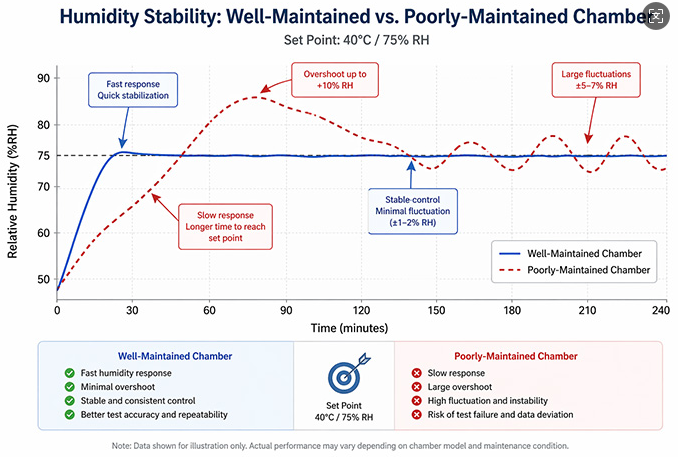
A benchtop environmental chamber may still heat and cool normally, but humidity control begins to lose precision—showing overshoot, slow stabilization, or inconsistent recovery after door opening.
This is especially critical in regulated or high-precision testing such as:
ICH stability conditions: 25°C ± 2°C / 60% RH ± 5% RH, 30°C ± 2°C / 65% RH ± 5% RH, 40°C ± 2°C / 75% RH ± 5% RH
Electronics reliability testing: 85°C / 85% RH for 1,000 hours (double 85)
Coating resistance testing: ASTM D2247 at 38°C / 100% RH
Even a small humidity drift can significantly affect corrosion rate, chemical stability, and material degradation behavior.
Humidity generation depends heavily on evaporation consistency. If water contains:
Dissolved minerals
Chlorine residues
Suspended particles
it will gradually form scale deposits on heating elements and humidification trays.
This leads to:
Reduced evaporation efficiency
Delayed humidity response
Sensor reading instability
Heater degradation over time
Even stainless steel components are not immune when exposed to poor water quality over long cycles.
Most environmental chamber systems require controlled-purity water such as:
Distilled water
Deionized (DI) water
Reverse osmosis (RO) water
Demineralized water
Typical resistivity requirements:
50 kΩ·cm to 1 MΩ·cm (standard range)
Some systems allow up to 2 MΩ·cm
Conductivity: 0.1–10 µS/cm depending on design
Important: Ultra-pure water is not always better. Water quality must match manufacturer specifications to avoid corrosion or instability in certain systems.
Scale buildup on humidifier heater
Biofilm or algae formation in tank
Blocked filters causing low-water alarms
Inconsistent evaporation rate
Corrosion in internal piping systems
For example, in 40°C/75% RH testing, scale buildup can significantly slow stabilization time even if the chamber reaches the setpoint visually.
In wet-bulb humidity control systems, the wick:
Supplies water to the sensor
Enables evaporation-based cooling
Directly influences RH calculation accuracy
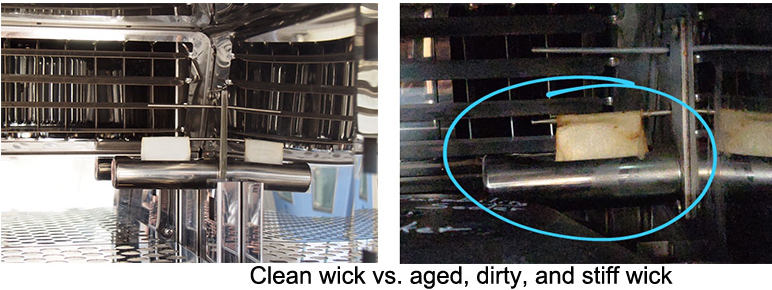
If the wick is contaminated or unevenly saturated, humidity readings become unreliable.
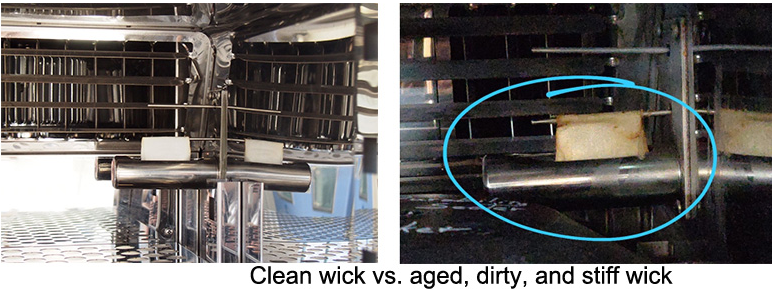
Replace the wet wick when you observe:
Discoloration or surface hardening
Reduced water absorption
Fiber damage or deformation
Slow response to humidity changes
Visible contamination or deposits
Ensure full contact between wick and sensor
Always use distilled or DI water for pre-wetting
Avoid direct hand contact with wick surface
Replace regularly under high-frequency testing conditions
A degraded wick is one of the most common hidden causes of unstable humidity control in benchtop climate systems.
Calibration ensures the displayed values match actual chamber conditions. Without it, even a stable-looking system may produce invalid test data.
Recommended calibration frequency:
Standard laboratory use: every 12 months
High-frequency or regulated testing: every 6 months
After relocation, repair, or abnormal results: immediate recalibration
| Application | Calibration Points |
|---|---|
| General lab testing | 25°C / 50% RH, 40°C / 80% RH |
| Pharmaceutical stability | 25°C / 60% RH, 30°C / 65% RH, 40°C / 75% RH |
| Electronics reliability | 40°C / 93% RH, 85°C / 85% RH |
| Coating tests | 38°C / 100% RH |
Always stabilize temperature before adjusting humidity
Use multi-point verification (low / medium / high)
Place sensors near actual sample load positions
Avoid empty-chamber-only calibration assumptions
Proper calibration directly determines whether test data is acceptable for certification or regulatory submission.
Most instability issues come from a limited number of root causes:
Poor water quality
Dirty or aged wick
Airflow obstruction
Sensor drift
Improper sample placement
Door sealing leakage
Always troubleshoot in this order:
Water system check
Wick inspection
Airflow and load layout
Calibration verification
Controller evaluation (last step)
In most cases, the issue is not controller failure but maintenance deviation.
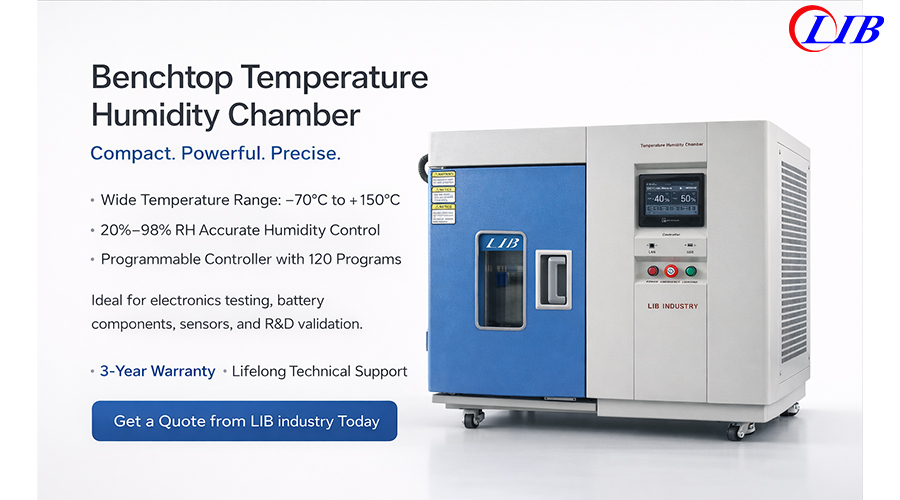
Stable humidity control depends not only on maintenance but also on system design.
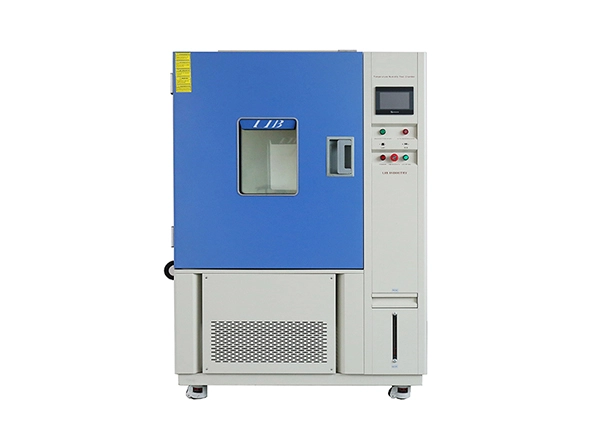
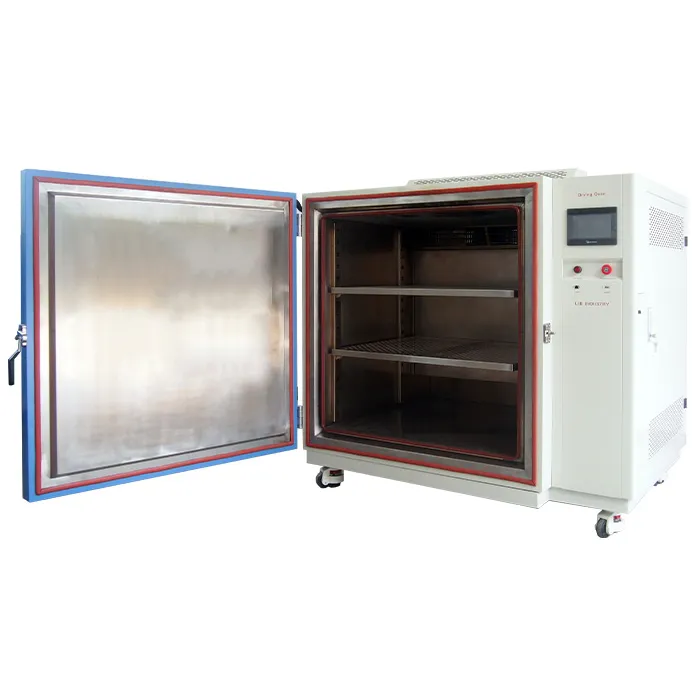
LIB industry tabletop temperature humidity chambers are engineered with:
SUS304 stainless steel working chamber
Programmable color touchscreen controller with Ethernet support
Forced-air circulation system for uniform distribution
Evaporative humidification system design
Temperature range: -70°C / -40°C / -20°C to +150°C
Humidity range: 20% to 98% RH
Temperature stability: ±0.5°C
Temperature deviation: ±2.0°C
Humidity deviation: ±2.5% RH
Heating rate: 3°C/min
Cooling rate: 1°C/min
Water shortage protection
Over-temperature protection
Over-current protection
High-pressure refrigerant protection
Ground leakage protection
Each mini temperature humidity chamber undergoes multi-day pre-shipment testing and calibration to ensure baseline stability before delivery.
Water level inspection
Wick saturation condition
Door seal integrity
Internal cleanliness
Humidity response stability
Water clarity inspection
Alarm log review
Stabilization time monitoring
Water tank cleaning
Humidification tray cleaning
Filter inspection
Airflow path check
Drain system flushing (if required)
For idle systems longer than 3 days, drain and dry the water system to prevent microbial growth and scaling.
A benchtop temperature humidity chamber maintains accuracy only when three systems are controlled in balance:
Water quality
Sensor calibration
Airflow uniformity
Most humidity instability issues begin long before visible failure. The chamber may still operate normally, but test reliability gradually deteriorates.
For laboratories conducting ICH stability testing, 85°C/85% RH reliability tests, or ASTM D2247 coating evaluations, maintenance is not optional—it is part of the testing system itself.
Distilled, deionized, RO, or demineralized water within manufacturer-specified conductivity or resistivity ranges.
Typically every 12 months, or every 6 months for high-frequency or regulated testing environments.
It directly affects wet-bulb measurement accuracy and therefore humidity control stability.
Common causes include poor water quality, wick degradation, airflow blockage, and sensor drift.
Use correct water, maintain wick condition, ensure airflow balance, and perform regular calibration.

 English
 русский
 français
 العربية
 Deutsch
 Español
 한국어
한국어 italiano
 tiếng việt
 ไทย
ไทย Indonesia

.webp "Coil Steel Sunshine Carbon Arc Weathering Tester")