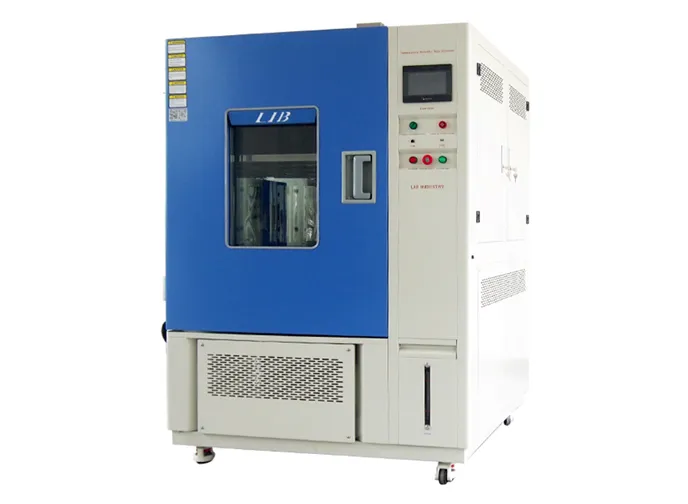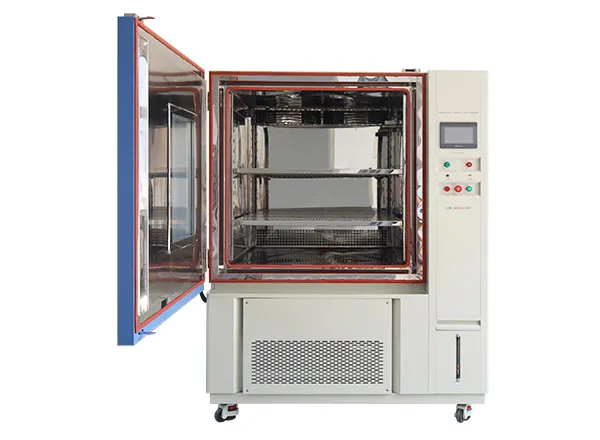
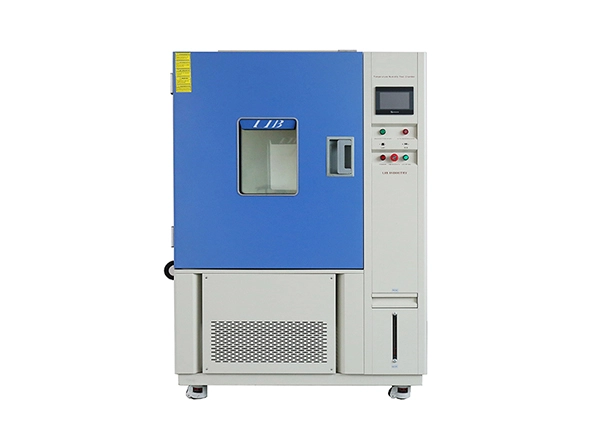
In the automotive field, coating strength matters a lot for vehicle life and looks. Coatings face tough weather. This can wear them down over time. It leads to rust and other harm. Testing helps forecast and check coating performance. One good way to test coating strength against rust is Cyclic Corrosion Testing (CCT). This piece looks at how Cyclic Corrosion Test Chambers work in automotive coating tests. It gives clear details on the steps, rules, and perks of CCT for car makers.

Coatings are not only an aesthetic component of a vehicle but also serve as the first line of defense against corrosion on the vehicle's surface.
Automotive coatings act as a shield for the car body. They protect it from things like water, salt, heat changes, and chemicals. These coatings often have several layers. These include primers, basecoats, and clear coats. Each layer has its job. The clear coat blocks UV rays. The basecoat gives color and style. Primers help the coating stick better. They also boost rust protection on the metal below.
In places with lots of moisture or salt in the air, coatings must stop rust. So, picking strong coatings with good rust protection is key. It keeps the car's structure and looks intact.
Coatings in cars can fail in several ways. These include:
· Corrosion undercutting: This happens when water reaches the metal under the coating. It causes rust to spread below the surface.
· Blistering: Bubbles form under the coating. Water or heat builds pressure and causes this.
· Chalking: The coating surface gets dull and powdery. Long sun and weather exposure often leads to this.
· Peeling: The coating lifts off the base. Bad sticking or wrong application causes it.
To avoid these problems, test coatings well before using them in real life.
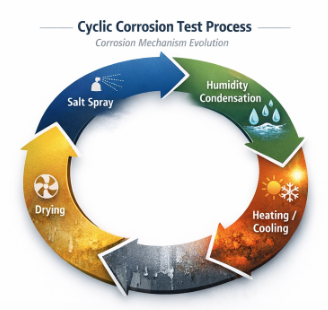 Cyclic Corrosion Testing (CCT) is a lab method. It copies real weather to check automotive coating rust strength. The test cycle changes heat, wetness, and salt spray. This matches hard weather effects on car coatings.
Salt Spray Testing (SST) has been common for rust checks for years. But CCT gives a fuller picture. The big differences between CCT and SST are:
· Environmental Simulation: SST just uses steady salt fog on the sample. CCT copies real life with heat shifts and wetness changes. It gives a better match to car use.
· Durability Prediction: CCT forecasts long-term coating work better. It uses many weather factors that cause rust. SST does not copy full weather steps well.
CCT beats old methods in many ways. For example:
· Realistic Testing Conditions: CCT copies true weather shifts. So, it gives solid data on field performance.
· Faster Results: CCT speeds up wear. Makers can check coating life quickly.
· Versatility: CCT works for many coating kinds. These include electrophoretic, spray, and plated finishes.
To ensure consistent and reliable corrosion evaluation, automotive manufacturers follow internationally recognized standards such as ASTM G85 and ISO 11997. These standards define the key parameters for cyclic corrosion testing (CCT), enabling accurate comparison of coating performance.
Parameter | ASTM G85 | ISO 11997 |
Test Duration | 24 hours to several weeks depending on test severity | Typically ≥ 1000 hours for long-term evaluation |
Test Cycles | Salt spray + condensation + drying cycles | Salt spray + high humidity (95%) + drying cycles |
Temperature Range | 35°C to 50°C | 40°C to 60°C |
Salt Solution | 5% NaCl solution | 5% NaCl solution |
Test Environment | Alternating wet and dry conditions | Cyclic humidity, salt exposure, and drying |
Evaluation Criteria | Blistering, corrosion, adhesion loss | Corrosion degree, blistering, adhesion degradation |
Key Takeaways
· ASTM G85 is more flexible and widely used for various corrosion scenarios
· ISO 11997 focuses on long-term automotive coating performance
· Both standards simulate real-world environments such as road salt, coastal climates, and temperature fluctuations
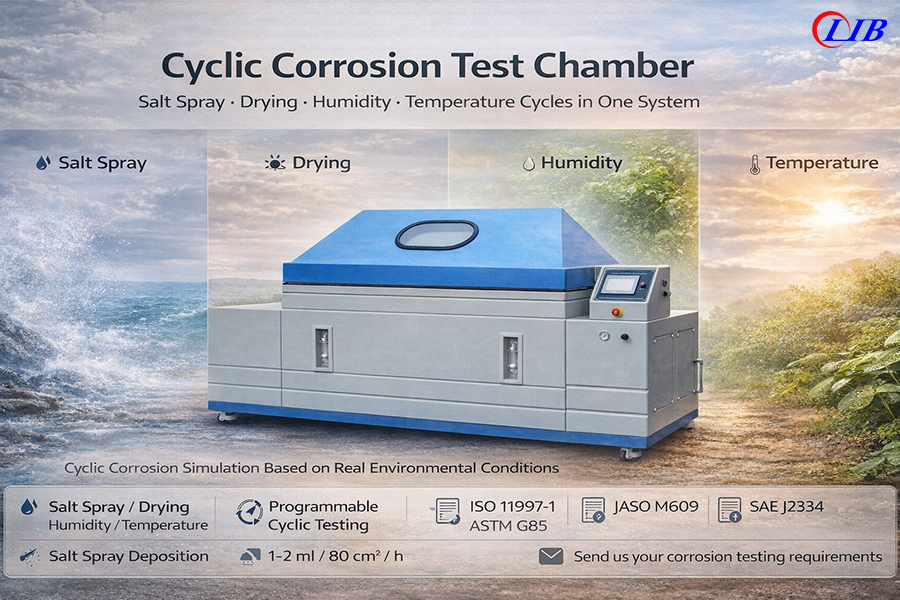
Cyclic Corrosion Test Chambers make set spaces that copy real weather. These include heat changes, wetness, and salt spray. The chambers run in loops. They switch weather to speed rust and check coating strength fully.
CCT weather loops often have these parts:
· Humidity: High wetness time to match wet weather.
· Salt Mist Exposure: Salt water spray on the sample. It copies sea or factory air.
· Drying: The chamber dries the sample. It matches heat shifts and sun drying.
Loops repeat to match many seasons or years fast. This gives key views on coating rust strength.
Main details to watch in CCT are:
· Temperature: Often from -20°C to 60°C. It fits test needs.
· Relative Humidity: Between 95% and 100%. It copies wet settings.
· Salt Concentration: Control salt level to match real weather.
Adjust these based on the coating and weather to copy.
When conducting automotive coating tests, the following specific steps are essential.
Good sample prep is vital for true CCT results. Clean samples to remove dirt. Cut them to size. Apply coating in a set way for evenness.
Usual steps for a CCT test are:
1. Load the Samples: Put ready car parts in the chamber.
2. Set Environmental Parameters: Set the chamber for needed weather.
3. Run the Cycles: Start the loops. Check samples now and then.
4. Assessment: At the end, check for rust, bubbles, or other issues.
In the test, gather data on coating work. Note rust amount and look changes. Then, study this to see how well the coating holds in real use.
Variety of test specimens which can be used, environmental control precision, inner chamber size, operation method, and recordation method of test results.
· Size and Capacity: Is the Chamber size and ultimate use large enough to allow all Automotive test parts to be placed inside for testing.
· ·Control Systems: Most chambers come equipped with temperature, humidity and salt concentration controls. For true accuracy and reproducibility, choose a chamber that can precisely regulate these factors.
· Ease of Use: A chamber which is easy to use, set up and monitor during testing.
· World standards compliance SAE J2334, ASTM G85 testing, ISO 11997.
We select our chamber on the basis of requirements indicated below to provide consistent and repeatable testing results for automotive coatings.
Model | SC-010 | SC-016 | SC-020 |
Internal dimensions (mm) | 1300*1000*600 | 1600*900*720 | 2000*1000*800 |
Overall dimensions (mm) | 2000*1300*1600 | 2300*1300*1700 | 2700*1300*1900 |
Interior Volume (L) | 780 | 1280 | 1800 |
Temperature Range | +10 ℃ ~ +90 ℃ | ||
Humidity Range | 30% ~ 98% RH | ||
Salt Fog Deposition | 1~2ml / 80cm2 · h | ||
Cooling system | Mechanical compression refrigeration system | ||
Water supply system | Water purification system | ||
Air Preheating | Saturated air barrel (31Liter) | ||
Spraying System | Atomizer tower and Spray nozzles | ||
Salt Fog Collected | Fog collector and fog measure cylinder | ||
Controller | Programmable color LCD touch screen controller, Ethernet connection | ||
Safety Device | Humidifier Dry-combustion Protection; Over-temperature Protection; Over-current Protection; Water Shortage Protection; Earth leakage Protection | ||
Material | Glass fiber reinforced plastics | ||
Standard Configuration | 8 round bars | ||
|
|
| Corrosion-Resisitant Workroom | Modular grooves are used for holding samples |
salt spray tower |
cylinder |
spray collector |
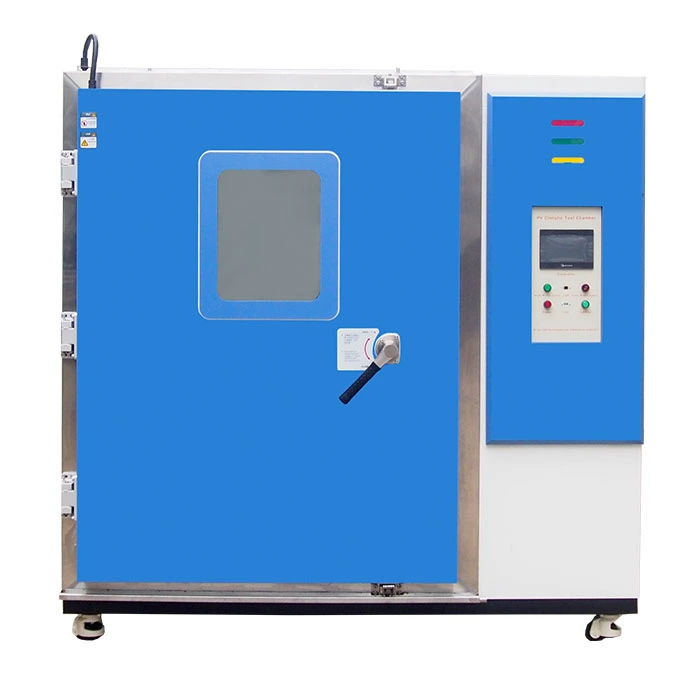
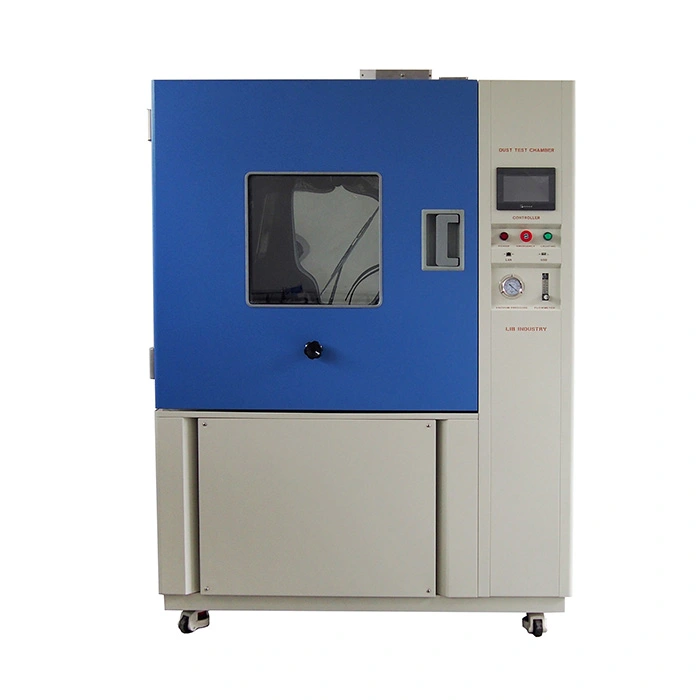
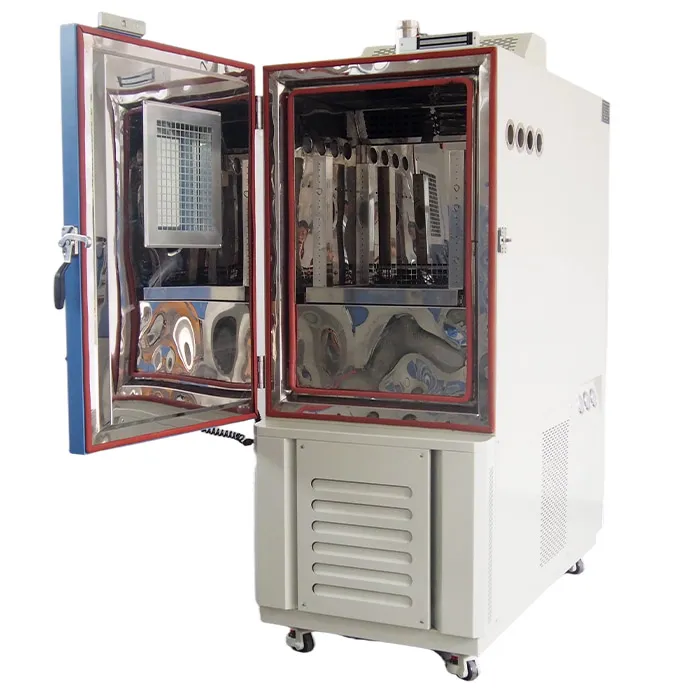
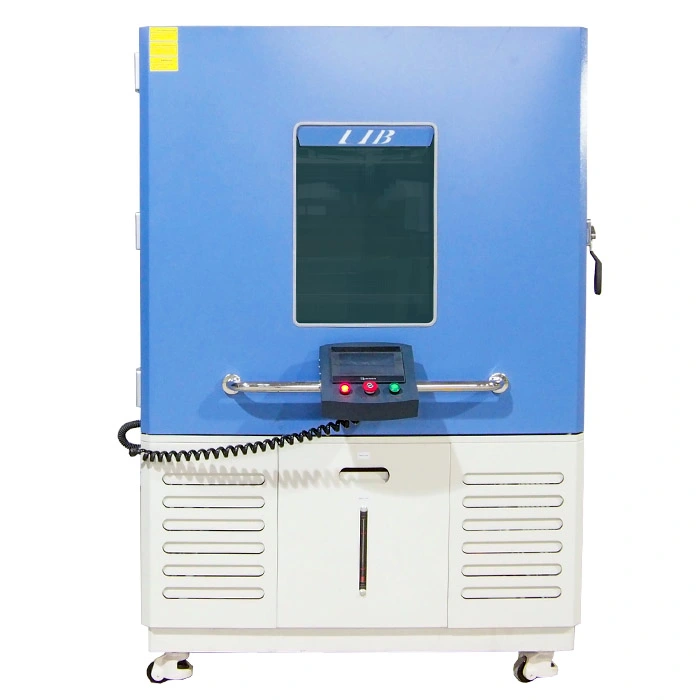
The LIB Cyclic Corrosion Test Chambers are designed to provide a realistic test environment for conducting corrosion tests on automotive coatings. These chambers replicate real world environments, and the effects of varying temperature and humidity, as well as salt mist, on coatings.
The LIB Cyclic Corrosion Test Chambers are designed to simulate real world environments, subjecting automotive coatings to a variety of stresses for original equipment manufacturers and other users. The chamber environments replicate temperature and humidity cycling and salt mist spraying simulating a variety of conditions including coastal regions and other industrial environments where automotive coatings are to be used.
Data from LIB test chambers provides long term durability / performance information for automotive coatings. Simulating the multiple environmental and mechanical stresses to which these coatings, paints and similar finishes might be subjected in real use helps the manufacturer select the coating with the optimum corrosion protection and durability characteristics whether they will be used in salt laden coastal areas, hot desert climates, humid tropics or elsewhere around the world.
LIB chambers surpass traditional Salt Spray Testing. They include variables like temperature cycling and humidity changes. Unlike salt spray tests with constant mist, LIB chambers duplicate a broad spectrum of real conditions. As such, they provide a more precise and dependable evaluation of coating durability.
Xi’an LIB Environmental Simulation Industry leads in quality test chambers. They know cyclic corrosion testing well. LIB chambers meet world rules and give true, repeatable results. Their focus on quality and new ideas makes them a sure choice for car makers. These makers want better coating strength and life.
Cyclic Corrosion Testing helps check automotive coating rust strength. It copies real weather. CCT lets makers guess coating work over time. They can pick materials wisely. LIB's Cyclic Corrosion Test Chambers give true and sure tests. This ensures car coatings meet top marks for strength and work.
Cyclic corrosion testing copies real weather shifts like heat and wetness. It gives a fuller check than salt spray testing. That one just uses steady salt mist on coatings.
Test length varies. But common ones run from days to weeks. It depends on loop count and hard conditions copied.
Yes, these chambers work for many items. These include metals, coatings, and products needing rust checks.
Main ones are chamber size, weather control, simple use, and match to world test rules.
LIB salt spray cyclic corrosion test chambers copy real weather, control details exactly, and give sure results. This helps makers guess coating strength and work better.
 English
 русский
 français
 العربية
 Deutsch
 Español
 한국어
한국어 italiano
 tiếng việt
 ไทย
ไทย Indonesia