Solar panels are built to last 25 years or more. They go on roofs, desert plants, beach spots, water-based PV setups, and big power sites. Before a panel gets to those places, it faces lab tests. These tests mimic heat, dampness, cold snaps, UV rays, electric strain, physical pressure, and safety dangers.
Choosing PV laboratory testing equipment is not only a purchasing decision. It affects certification schedules, repeatability of test data, sample throughput, and the lab’s ability to handle full-size PV modules. For IEC 61215 and IEC 61730 compliance, the right test chamber must match the test method, module size, temperature range, humidity control, uniformity, data recording, and long-duration stability.
IEC 61215 and IEC 61730 are often discussed together, but they answer different questions. IEC 61215 focuses on design qualification and long-term reliability. IEC 61730 focuses on safety, including electric shock, fire risk, mechanical stress, and environmental stress.
For PV makers, site builders, and test labs, both rules count. A panel might show strong power right after build. But it could fail later due to water entry, UV wear, heat growth, or cover breakdown. Lab tests cut that chance before wide use.
IEC 61215 test equipment is used to check whether a PV module can withstand outdoor aging. The standard includes performance measurement, insulation tests, UV preconditioning, thermal cycling, humidity freeze, damp heat, mechanical load, hail impact, bypass diode thermal testing, and wet leakage current testing.
The environmental tests are especially important because they expose weak materials and process defects. Common findings include:
· Encapsulant yellowing or delamination
· Cell microcracks after thermal stress
· Corrosion of interconnect ribbons
· Backsheet cracking
· Junction box sealing failure
· Power loss after damp heat or freeze-thaw cycles
IEC 61730 test chamber selection is linked to module safety qualification. It checks whether the module construction can reduce risks of fire, electric shock, and personal injury under expected use conditions.
Environmental preconditioning is important because insulation and material safety can change after heat, cold, humidity, and UV exposure. A module that passes an initial insulation test may show leakage current issues after damp heat or humidity freeze. For that reason, safety tests are often arranged before and after environmental stress.
A complete PV module testing equipment setup usually includes environmental chambers, UV preconditioning equipment, electrical safety testers, mechanical load systems, hail testers, solar simulators, and data acquisition tools. For many laboratories, the most demanding investment is the environmental test chamber because it must run long tests with stable conditions.
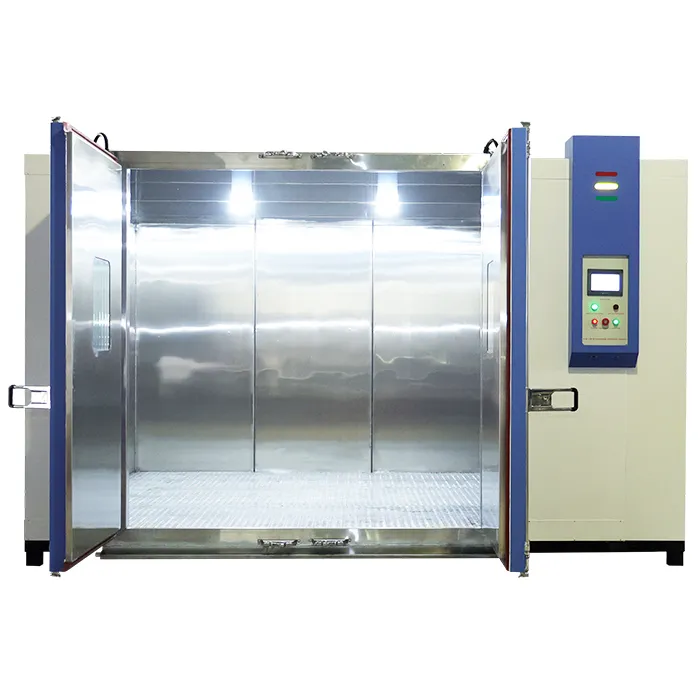
A PV outside test chamber should fit whole panels, not just small bits. Big panels need smooth air flow, steady damp, safe wire spots, firm racks, and space to keep air moving.
Common chamber needs cover:
Test item | Main parameter | Equipment requirement |
Damp heat | 85°C, 85%RH, 1,000 h | Stable humidity, corrosion-resistant interior, continuous water supply |
Thermal cycling | -40°C to +85°C, 200 cycles | Reliable refrigeration, controlled ramping, module current connection when required |
Humidity freeze | +85°C/85%RH to -40°C, 10 cycles | Combined humidity and low-temperature control |
UV preconditioning | 15 kWh/m² UV dose, 280–385 nm; at least 5 kWh/m² from 280–320 nm | Stable irradiance, temperature control around module surface |
Wet leakage preparation | Post-aging module exposure | Safe handling after moisture and thermal stress |
When picking a solar panel outside chamber, the temp range should hit at least -40°C to +85°C. A broader one like -60°C to +100°C gives labs extra room for varied PV, electric, and trust programs. Damp control from 20% to 98%RH aids wet heat, damp cold, and wider test work.
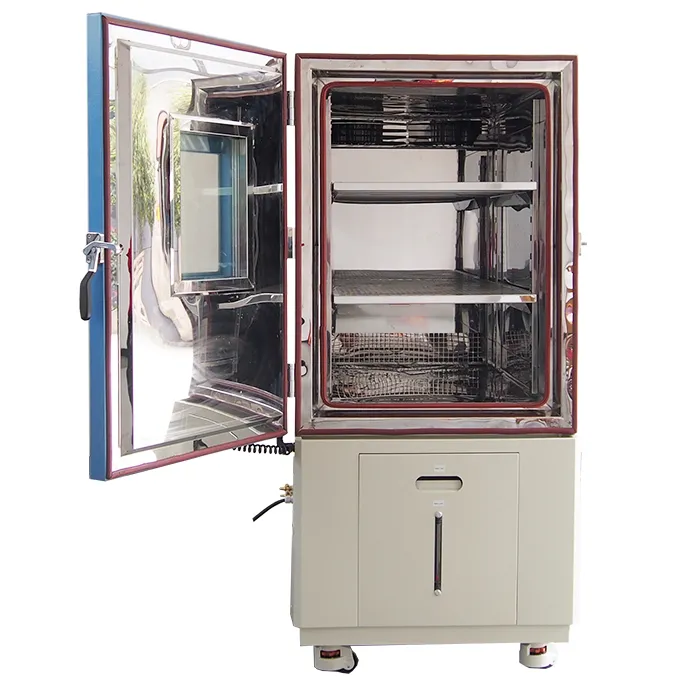
Damp heat is one of the most direct tests for moisture resistance. The module is exposed to 85°C and 85%RH for 1,000 hours. This test is hard on encapsulation, edge seals, junction boxes, backsheets, and conductive parts. During a long run, small humidity drift can lead to inconsistent aging. A strong PV module damp heat test chamber should hold the condition without frequent interruptions.
Thermal cycling creates repeated expansion and contraction. The common IEC 61215 thermal cycling condition is 200 cycles between -40°C and +85°C. This can expose solder joint fatigue, ribbon stress, glass-to-frame movement, and cell cracks.
Humidity freeze combines heat, moisture, and freezing stress. A common test condition is 10 cycles from +85°C at 85%RH down to -40°C. It is useful for finding failures caused by trapped moisture, poor lamination, and sealing weakness.
UV preconditioning is performed before other environmental tests. It exposes polymer materials to ultraviolet radiation so that downstream tests show a more realistic aging response. A PV laboratory should confirm wavelength bands, irradiance uniformity, black panel temperature, and specimen position before purchasing UV preconditioning test chamber equipment.
IEC 61730 compliance needs more than a temperature humidity chamber. The lab must evaluate safety-related failure paths. Environmental preconditioning is part of the process, but electrical, mechanical, and fire-related tests complete the safety picture.
An IEC 61730 test chamber is often used for conditioning modules before insulation, leakage, and safety checks. The chamber should support long exposure, stable control, and safe cable routing. For Class II modules and high system voltage modules, electrical safety after aging is especially important.
Environmental stress can reveal problems that are not visible at the start:
· Moisture paths between live parts and the frame
· Reduced insulation resistance after damp heat
· Cracks near junction boxes or cable exits
· Tracking risk on contaminated or aged surfaces
· Adhesive weakness after repeated expansion
For labs testing high-voltage modules, equipment should allow safe sample handling after humid exposure. Water drainage, interior corrosion resistance, insulation monitoring ports, and emergency protection all matter.
IEC 61730 includes electrical shock hazard, fire hazard, mechanical stress, and environmental stress categories. The exact sequence depends on the module construction and certification plan, but typical safety-related equipment may include:
Safety test area | Typical focus | Equipment used |
Insulation and dielectric withstand | Breakdown, tracking, clearance, insulation strength | Hi-pot tester, insulation tester |
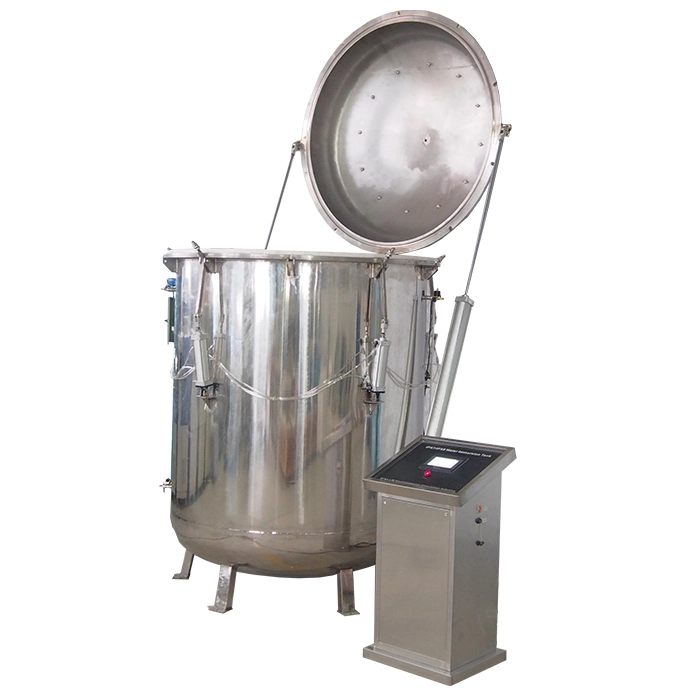
Wet leakage current | Leakage under wet conditions | Immersion or spray setup, electrical measurement system |
Mechanical stress | Frame, glass, mounting, cell crack risk | Static and dynamic mechanical load tester |
Fire-related evaluation | Burning behavior and flame spread risk | Fire test system under applicable local rules |
Environmental preconditioning | Aging before safety checks | Temperature humidity chamber, thermal cycling chamber, UV chamber |
For a 1,000 V maximum system voltage module, dielectric test voltage may reach several thousand volts depending on protection class and test method. For Class II construction, safety planning must consider higher insulation requirements than basic performance testing alone.
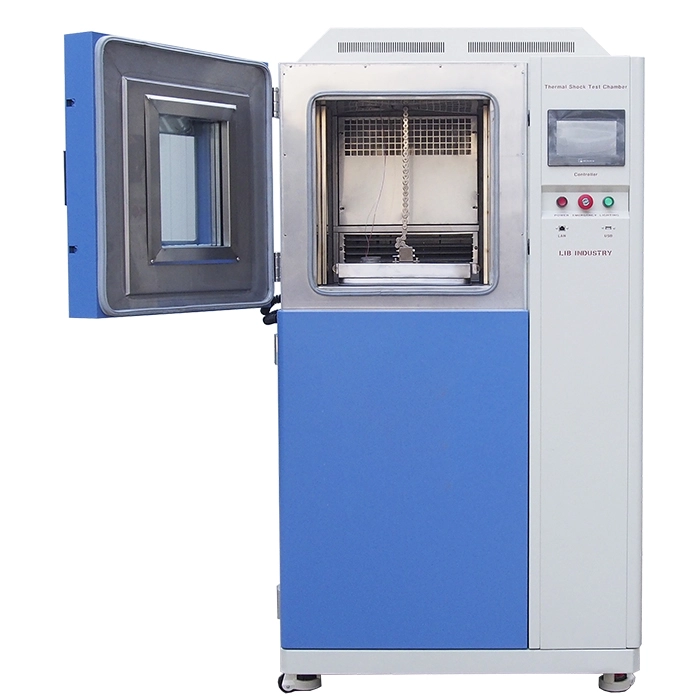
PV laboratories are increasingly asked to test module electronics, junction boxes, trackers, outdoor control units, connectors, sensors, and power-related components. These products may need temperature shock testing beyond standard IEC 61215 cycling.
MIL-STD-810H Method 503.7 checks whether a product can withstand sudden changes in surrounding air temperature. It is not the same as slow thermal cycling. The method is used when products may move quickly between hot and cold environments or experience abrupt exposure changes.
Key Method 503.7 points include:
· Transfer between hot and cold atmospheres in no more than 1 minute
· Stabilization at each temperature extreme
· Multi-cycle shock programs, commonly at least 3 cycles for Procedure I-C
· Return to controlled ambient conditions after testing
· Visual inspection and operational checks after exposure
For PV-linked items, common fail ways hold cracked fill material, loose weld joins, seal leaks, link bends, show fails, and spotty electric work.
IEC 61215 heat shifting is a panel trust test with set shifts between -40°C and +85°C over many rounds. It strains long-term wear.
MIL-STD-810H Method 503.7 is a shock test. The move time is quick, often no more than 1 minute. The aim is to make a fast temp gap. This fits for outside PV electrics sent from cold hold to hot spots, set in desert boxes, or hit by quick weather turns.
A temp shock chamber should have hot and cold areas with quick back-up, good air flow, right sensors, and a move tool that keeps shift time in the test plan. For heavy PV-linked sets, basket load skill and temp back-up after move are key.
Usual fails hold seal breaks, broken weld joins, water-linked short paths, loose holds, hard plastics, and loss of set in sensors.
The best equipment choice depends on samples, standards, workload, and available space. A lab testing small PV materials has different needs from a certification lab testing full-size glass-glass modules.
Before choosing a PV environmental test chamber, confirm the largest module size, sample quantity per batch, rack layout, and airflow path. A chamber that fits one panel may not support batch testing, while a chamber that fits many panels may need stronger humidity generation and refrigeration capacity.
Important checks include:
· Internal space for full-size modules and safe spacing
· Temperature range covering -40°C to +85°C or wider
· Humidity range covering 85%RH at 85°C for damp heat
· Temperature deviation and fluctuation across the working space
· Door sealing for long 1,000-hour tests
· SUS304 stainless steel interior for high-humidity durability
· Water purification and automatic water supply
· Cable ports for electrical monitoring during tests
Ramp rate affects test scheduling, but stability is more important than speed for IEC work. For PV module testing equipment, uncontrolled overshoot can create stress outside the test method. Long-duration data logging is also essential. Labs need temperature, humidity, alarms, door opening events, and test curves for audit records.
Safety features should include over-temperature protection, compressor protection, water shortage alarms, leakage protection, and emergency stop functions. For PV modules with live circuits, the chamber should support safe cable routing and clear isolation practices.
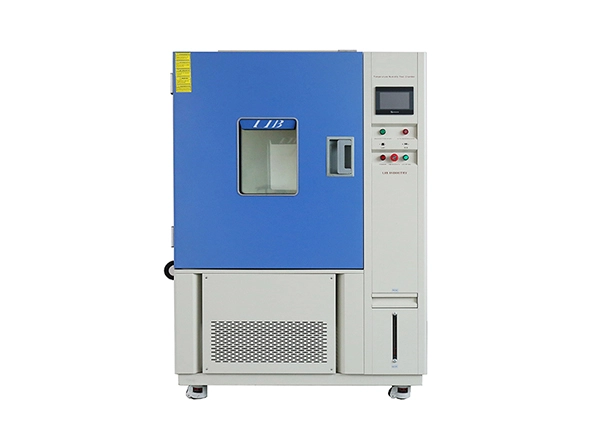
PV testing labs need equipment that can run for weeks without unstable data or unplanned downtime. LIB PV laboratory testing equipment is built around environmental simulation for full-size solar modules, materials, and PV-related products.
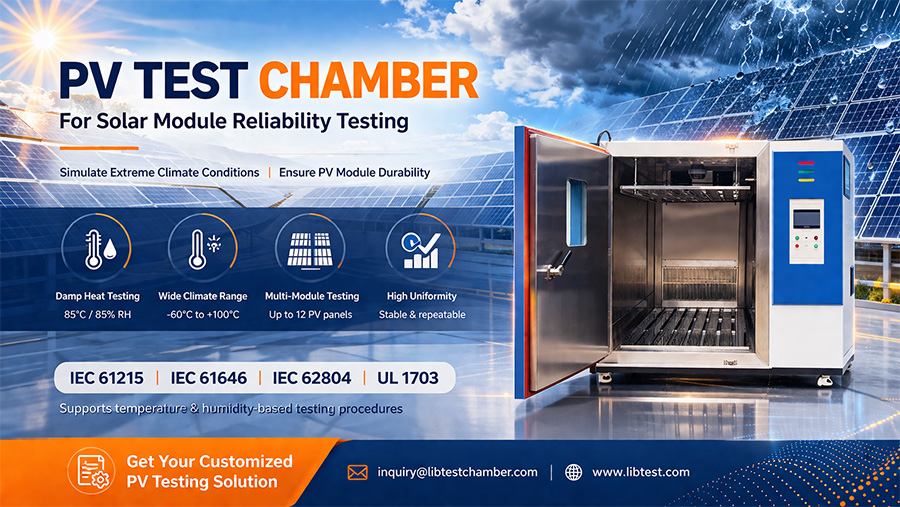
LIB PV environmental chambers can provide a wide simulation range for solar module reliability testing, including low-temperature, high-temperature, and humidity conditions. A range such as -60°C to +100°C and 20% to 98%RH gives laboratories room for IEC tests, internal R&D, accelerated aging, and non-standard customer programs.
Precise temperature and humidity control helps maintain repeatable data during damp heat, humidity freeze, and thermal cycling. For long 85°C/85%RH tests, stable operation reduces retesting risk and protects lab schedules.
PV modules face more than heat and humidity outdoors. Desert plants deal with dust. Floating and coastal projects face moisture and corrosion. Rooftop installations may see UV, rain, and temperature swings in the same service life.
LIB supports customized environmental simulation options such as lighting, rainfall, dust, and other test conditions. This allows solar laboratories to build test capability in stages, from a single temperature humidity chamber to a broader PV environmental simulation system.
IEC tests are not short demonstrations. Damp heat runs for 1,000 hours. Thermal cycling needs hundreds of repeated transitions. Humidity freeze requires stable switching between wet heat and freezing. During these cycles, chamber construction, airflow, sealing, sensor accuracy, and control logic all influence test repeatability.
For buyers, the practical value is simple: fewer unstable runs, fewer sample disputes, clearer records, and better use of laboratory time.
Xi’an LIB Environmental Simulation Industry has worked in environmental test chambers since 2009, covering design, manufacturing, sales, and service for global customers. Its product range includes temperature and climate chambers, corrosion chambers, dust and water ingress chambers, weathering chambers, walk-in chambers, and special environmental simulation systems.
For PV laboratories, this background is useful because IEC 61215 and IEC 61730 compliance often require more than one chamber. A complete lab may need damp heat, thermal cycling, UV preconditioning, dust, rain, and custom environmental equipment. LIB can support standard chambers and customized test spaces according to module size, test purpose, and lab layout.
The company also provides installation guidance, commissioning, training, maintenance support, and long-term after-sales service. For laboratories that run long PV certification cycles, supplier support is not a minor detail. It affects uptime, calibration planning, operator training, and the ability to respond quickly when a test schedule is tight.
Choosing PV laboratory testing equipment for IEC 61215 and IEC 61730 compliance starts with the test standard, not the chamber catalog. The equipment must match the real test conditions: 85°C/85%RH for 1,000-hour damp heat, -40°C to +85°C thermal cycling, humidity freeze from wet heat to freezing conditions, UV preconditioning dose control, and safety checks after environmental aging.
A good PV environmental test chamber should offer stable temperature and humidity control, enough internal space for full-size modules, reliable airflow, safe cable access, strong sealing, corrosion-resistant materials, and clear data records. For laboratories testing PV-related electronics or outdoor components, MIL-STD-810H Method 503.7 temperature shock capability may also be needed.
A typical IEC 61215 setup includes a PV environmental test chamber, damp heat chamber, thermal cycling chamber, humidity freeze test equipment, UV preconditioning chamber, solar simulator, insulation tester, wet leakage current tester, mechanical load tester, hail test equipment, and data recording system.
The chamber may be similar, especially for temperature, humidity, and UV preconditioning. The difference is the test purpose. IEC 61215 focuses on long-term module reliability, while IEC 61730 focuses on safety risks such as electric shock, fire, insulation failure, and mechanical hazards.
MIL-STD-810H Method 503.7 is useful for PV-related electronics and outdoor components that may face sudden temperature changes. It checks rapid transfer between hot and cold conditions, usually within 1 minute, which is much faster than IEC 61215 thermal cycling.
Buyers should confirm module dimensions, batch capacity, IEC test items, temperature range, humidity range, ramp rate, chamber uniformity, sensor accuracy, cable ports, safety protection, data logging, water supply, installation space, calibration plan, and after-sales support.
 English
 русский
 français
 العربية
 Deutsch
 Español
 한국어
한국어 italiano
 tiếng việt
 ไทย
ไทย Indonesia