 Water rarely enters a product in a dramatic way first. In many real applications, failure begins with slow dripping from a ceiling, condensation from HVAC systems, water running along a cable, or droplets falling onto a control panel during cleaning. For electrical enclosures, connectors, indoor luminaires, medical devices, smart home products, and industrial electronics, even small drops can lead to corrosion, insulation failure, false signals, or unsafe operation.
An IPX1 IPX2 water drip test apparatus is designed for this type of risk. It creates controlled dripping water conditions so engineers can evaluate whether an enclosure protects internal components from harmful water ingress under IEC 60529 test requirements. Although the test itself appears simple, factors such as flow rate, sample position, tilt angle, and drip distribution all affect the final result.
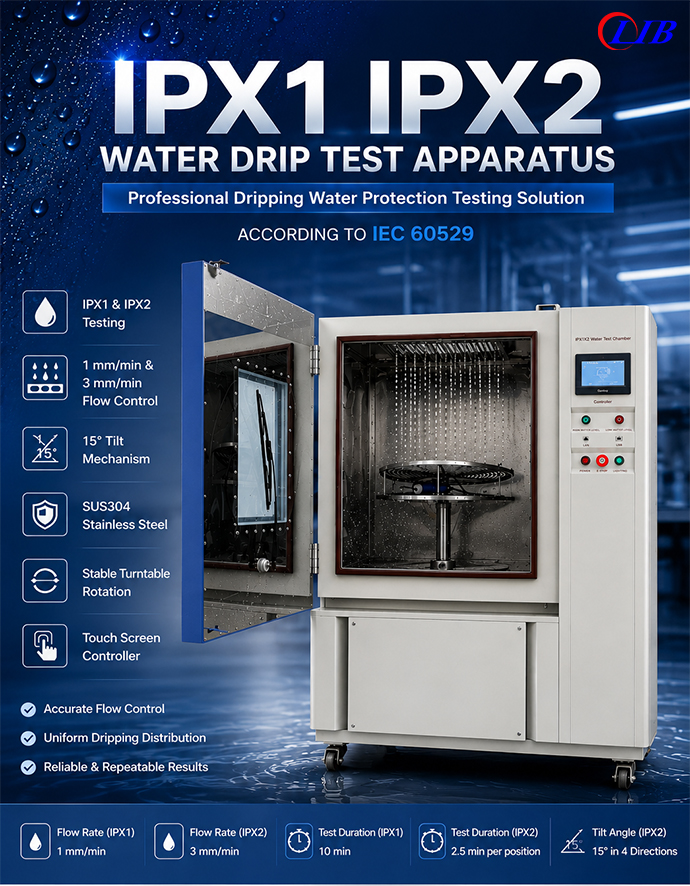
An IPX1 IPX2 water drip test apparatus is a controlled dripping water system used to evaluate the first two waterproof protection levels of the IP code. Water passes through evenly distributed holes in a drip tray positioned above the sample, creating vertical water droplets over the equipment under test.
Unlike spray, jet, or immersion testing, IPX1 and IPX2 focus on low-pressure falling drops. These tests simulate conditions such as roof leakage, condensation, or slight angled dripping during normal service.
A typical system includes:
Drip tray with uniform holes
Adjustable water flow control
Turntable for the sample
15° tilt mechanism for IPX2 testing
Water circulation and filtration system
Programmable controller
Stainless steel workroom structure
Stable and repeatable water distribution is critical. Blocked drip holes, uneven flow, or unstable pressure can lead to inaccurate results and inconsistent pass/fail judgments.
Test Level | Water Exposure | Sample Position | Flow Rate | Test Duration |
IPX1 | Vertically falling drops | Normal operating position, rotating | 1 mm/min | 10 minutes |
IPX2 | Vertically falling drops on tilted enclosure | 15° tilt in four directions | 3 mm/min | 2.5 min per position |
IPX1 evaluates protection against vertically falling water while the product remains in its normal operating position. IPX2 is more demanding because the enclosure is tilted 15° in four directions, allowing water to collect around seams, vents, cable entries, buttons, and gasket interfaces.
A product that passes IPX1 may still fail IPX2 if water travels along enclosure joints or connector paths during the tilted exposure.
IEC 60529 defines the IP code system for enclosure protection. For IPX1 and IPX2:
Water falls vertically onto the sample
IPX1 uses 1 mm/min water intensity
IPX2 uses 3 mm/min water intensity
IPX2 requires testing in four tilted positions
Acceptance is based on whether water causes harmful effects
“Harmful effect” depends on the product standard and application. Small traces of water in drainage areas may be acceptable, while water reaching live parts, PCBs, terminals, sensors, or insulation barriers is usually considered a failure.
Before testing, the equipment under test should be inspected and documented, including enclosure condition, seals, cable entries, and operating status. The sample is then placed in its normal operating position on the turntable.
For IPX1 testing, the apparatus is set to 1 mm/min water flow, and the sample rotates at about 1 r/min for 10 minutes. The purpose is to simulate vertical dripping water exposure under normal installation conditions.
For IPX2 testing, the sample is tilted 15° from its normal position and exposed in four different directions. The water flow rate increases to 3 mm/min, with each position tested for 2.5 minutes.
After exposure, the product is inspected for harmful ingress. Engineers typically check live parts, connector cavities, PCB areas, displays, insulation surfaces, switches, and cable entry points. Functional checks are often performed before and after opening the enclosure.
Reliable test results depend heavily on proper setup. The drip tray should provide uniform water distribution through clean, unobstructed holes. Stable water supply and flow control are important because pressure fluctuations can affect the exposure level.
The sample should be positioned as close as possible to its real installation condition. Cable direction, mounting orientation, and drainage paths can significantly influence water behavior during testing.
Professional systems usually include:
Water filtration to reduce drip hole blockage
Adjustable sample height
Stable turntable rotation
Programmable flow and timing control
SUS304 stainless steel internal structures
These features help improve repeatability during continuous laboratory use.
Even though the procedure is relatively simple, testing errors are common.
Typical problems include:
Using IPX1 flow rate during IPX2 testing
Testing IPX2 in only one tilted direction
Starting the timer before flow stabilizes
Ignoring blocked drip holes
Incorrect cable routing that creates unrealistic water paths
Skipping functional inspection after exposure
One common issue in connector testing is water tracking along the cable. If the cable is routed differently from the real installation condition, the test result may not reflect actual field performance.
A good apparatus should provide stable, repeatable, and easy-to-control testing conditions rather than simply generating dripping water.
Important selection points include:
Accurate 1 mm/min and 3 mm/min flow control
Uniform 0.4 mm drip holes
Stable turntable rotation around 1 r/min
Reliable 15° tilt function
Adjustable sample positioning
Water circulation and filtration system
SUS304 stainless steel construction
Touch screen programmable controller
Observation window for monitoring
Safety protections for leakage and water shortage
For laboratories running repeated tests across multiple products or production batches, automation helps reduce operator error and improves consistency.
In practical product development, IPX1 and IPX2 testing are often only the first step of enclosure verification. Many products also require higher waterproof levels or dust ingress protection according to IEC 60529 and related standards.
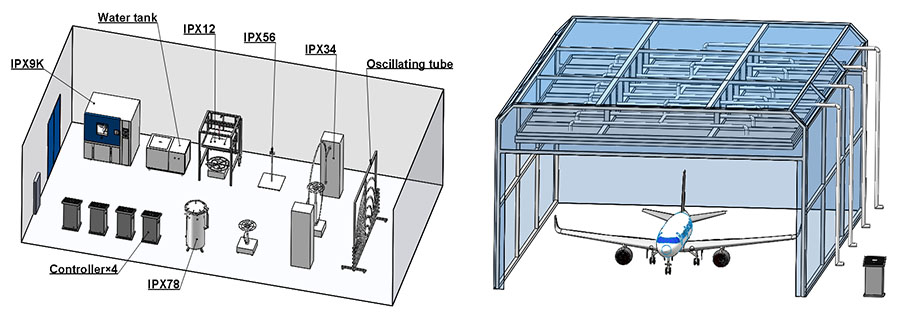
LIB industry provides a complete range of IP dust and waterproof test equipment, including:
Waterproof Test Equipment
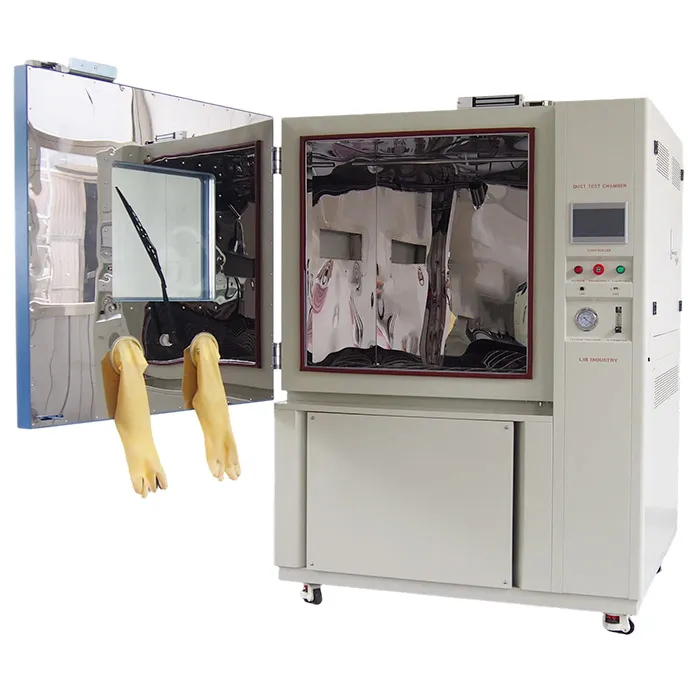
Dust Ingress Test EquipmentLIB industry also manufactures dust protection test chambers for IP5X and IP6X testing. Typical systems include:
|  |
LIB industry IPX1 IPX2 water drip test apparatus is designed for stable dripping simulation and long-term laboratory use. The system supports IPX1 testing at 1 mm/min for 10 minutes and IPX2 testing at 3 mm/min with four 15° positions.
The apparatus uses:
0.4 mm drip holes with 20 mm spacing
Adjustable turntable structure
Programmable color touch screen control
Water circulation and purification system
SUS304 stainless steel workroom and water-contact parts
For connector and electronics manufacturers, stable flow control and repeatable positioning help engineers compare sealing designs and production consistency more effectively.
LIB industry focuses on reliable environmental testing equipment for waterproof, dustproof, climate, and corrosion testing.
Why choose LIB industry:
Stable and accurate IEC 60529 testing
SUS304 stainless steel construction
Custom chamber sizes available
Easy-to-use touch screen controller
Reliable performance for continuous laboratory testing
Professional technical support
3-year warranty
Lifetime service support
Whether testing connectors, electronics, lighting products, or industrial equipment, LIB industry helps customers improve product reliability with complete IP waterproof and dust testing solutions.
Contact LIB industry for customized environmental testing equipment and professional technical support.
Common products include electrical enclosures, connectors, LED lighting, smart home devices, medical equipment, sensors, power adapters, and indoor electronic products exposed to condensation or dripping water.
Yes. LIB industry supplies full IP waterproof and dust ingress testing systems, including IPX1–IPX8 waterproof equipment, IP5X/IP6X dust chambers, sand and dust chambers, and integrated environmental reliability testing systems.
Improper cable positioning can create unrealistic water paths and produce inaccurate results. Test setup should match the intended installation condition whenever possible.
 English
 русский
 français
 العربية
 Deutsch
 Español
 한국어
한국어 italiano
 tiếng việt
 ไทย
ไทย Indonesia