Automotive connectors live in places where water does not arrive gently. A connector near the engine bay, battery pack, wheel arch, bumper sensor, or underbody harness may face hot spray, road dirt, detergent, salt, and pressure washing at close range. A seal that survives rain or short immersion can still leak when a narrow jet hits the cable entry at high pressure.
That is why automotive connector IP6K9K testing is widely used for parts exposed to pressure washing and harsh road service. It checks whether connector housings, gaskets, backshells, cable glands, and terminal cavities can resist both strong water jets and high-temperature, high-pressure spray.
IP67 and IP69K are often discussed together, but they do not describe the same threat. IP67 is an immersion test. It checks whether an enclosure can resist water ingress when submerged under defined depth and time conditions. This is useful for puddles, flooding, or short water exposure.
IP69K connector test conditions are different. They simulate high pressure washdown test exposure, where hot water strikes the connector from close range. The test is severe because pressure, heat, impact angle, and rotating exposure all attack the sealing system at the same time.
Test rating | Main exposure | Typical test condition | What it reveals |
IP67 | Temporary immersion | Water immersion under defined depth and duration | Static sealing against standing water |
IPX6K | Powerful water jet | 1000 kPa, 75 L/min ±5%, 6.3 mm nozzle, 2.5–3 m distance | Resistance to strong spray and road splash |
IPX9K | Hot high-pressure spray | 80–100 bar, 80°C±5°C, 14–16 L/min, 100–150 mm distance | Resistance to pressure washing and steam-jet cleaning |
immersion test |
high pressure spray test |
A connector can pass immersion and fail under hot spray. The reason is simple: immersion loads the seal slowly; pressure washing hits weak points with force.
Connector failures after washing usually begin at small interface changes. The leak path may be a cable gland, a housing seam, a latch area, a poorly seated seal, or a capillary gap along the wire insulation.
Hot water makes the risk higher. At around 80°C, elastomer seals soften, plastics expand, and trapped air inside the connector may change pressure. When the jet moves across the connector face, water can be driven into a gap that would not leak during rain. After cooling, a slight vacuum effect may pull moisture deeper into the cavity.
Common failure modes include:
· Swollen or displaced silicone seals after repeated hot spray.
· Water tracking along cable entries or twisted wire bundles.
· Micro-gaps around housing welds, covers, and latch windows.
· Reduced insulation resistance after moisture reaches terminals.
· Corrosion after detergent, salt, or road grime remains inside the connector.
For low-voltage sensors, a small leak may cause signal drift. For EV high-voltage connectors, water ingress can trigger insulation faults, safety shutdowns, or expensive diagnostic work.
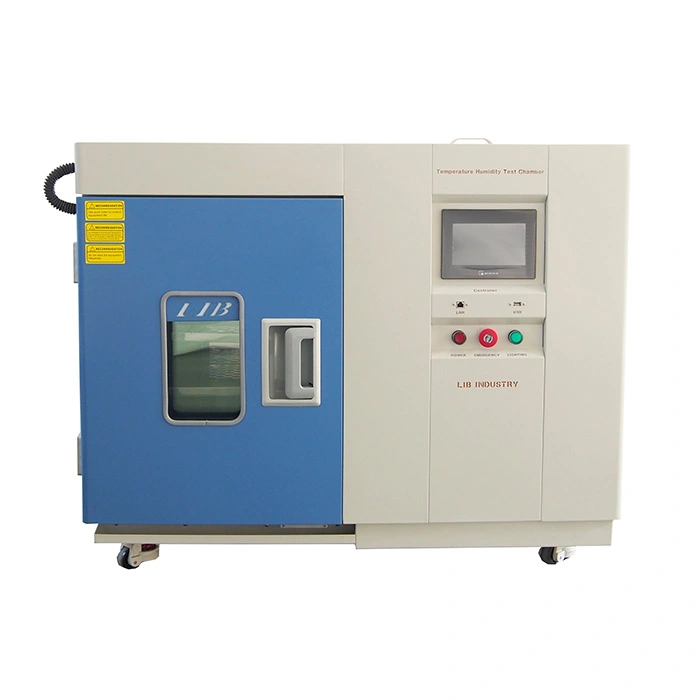
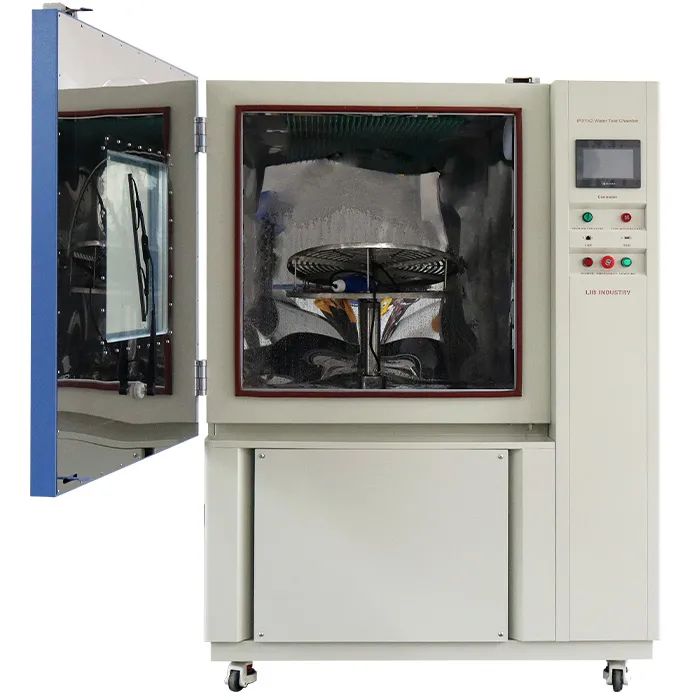
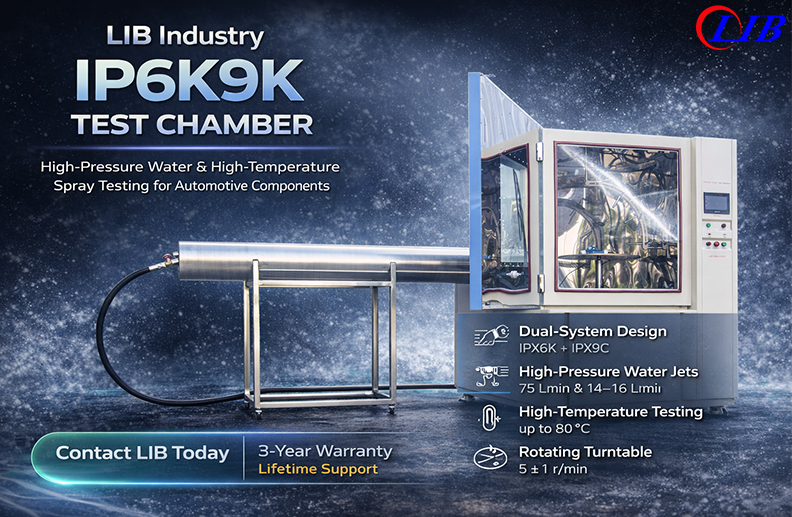
A repeatable test needs more than a pump and a spray nozzle. Pressure, flow, temperature, distance, rotation, and spray angle must stay within the required range. LIB IP6K9K high pressure equipment is built for both IPX6K and IPX9K water ingress tests, so engineers can test strong water jets and hot high-pressure cleaning in one controlled system.
For IPX6K testing, the connector is exposed to a powerful water jet with a 6.3 mm nozzle. A typical setup uses 1000 kPa water pressure, a 75 L/min ±5% flow rate, and a spray distance between 2.5 m and 3 m. This reproduces heavy road splash, cleaning spray, and water impact on exterior harness areas.
This test is useful before IPX9K because it shows whether the basic seal design can resist high-flow water from a practical service distance.
For IPX9K testing, the water jet becomes hotter, closer, and much more aggressive. The test condition uses 8000–10000 kPa, equal to 8–10 MPa or 80–100 bar. Flow rate is 14–16 L/min. Water temperature is commonly 80°C±5°C.
This combination attacks the connector in two ways. Pressure tries to force water through the smallest gap. Heat changes the behavior of plastic and rubber around the sealing line. A connector that passes this test has stronger evidence for pressure wash reliability in real vehicle service.
.png "Automotive_Connector_IP6K9K_Testing_for_Washdown_Reliability_(2).png")
IPX9K spray is applied at four angles: 0°, 30°, 60°, and 90°. Each position is sprayed for 30 seconds, giving a total spray time of 120 seconds. The nozzle distance is normally 100–150 mm from the test surface, while the platform rotates at about 5±1 rpm.
This matters for connectors because real washdown does not strike only the front face. The jet can hit from the side, under the latch, around the boot, or directly into the cable exit.
Testing both levels in one chamber helps keep the workflow clean. Engineers can run IPX6K to check high-flow jet resistance, then switch to IPX9K for hot high-pressure spray without moving the project to a separate rig. Stable nozzle control, pressure regulation, water heating, circulation, filtration, and automated programs reduce the chance of test variation between batches.
Not every connector on a vehicle faces the same washdown risk. The need for ISO 20653 connector testing rises sharply when the connector is mounted in a wet, dirty, hot, or exposed zone.
.png "Automotive_Connector_IP6K9K_Testing_for_Washdown_Reliability_(1).png")
Engine compartment connectors may face hot water after service cleaning. Heat cycling already ages seals, so IP69K waterproof connector testing gives useful data on whether the seal still holds when hot spray reaches the housing.
Underbody connectors collect mud, salt, gravel dust, and detergent residue. A pressure washer often aims directly at these areas. Chassis connector sealing tests should pay close attention to the backshell, cable outlet, and mounting direction.
EV high-voltage connector waterproof tests require careful inspection after spray exposure. Even minor moisture inside the connector can affect insulation resistance. IPX9K testing is valuable for battery pack interfaces, charging-related connectors, motor drive harnesses, and underbody high-voltage routing.
Radar, camera, parking sensor, and lighting connectors are often mounted near bumpers or exterior trim. These parts may face direct spray at close range during car washing. A pressure washdown test helps find leakage before field returns begin.
Wire harness connector waterproof testing should include the full assembly condition, not only the plastic connector body. Wire bend radius, cable tie position, seal compression, and boot fit can all change the leak path.
A good test report should show more than pass or fail. It should record the test conditions, sample orientation, electrical state, inspection method, and post-test findings.
Before testing, check the gasket surface, compression marks, burrs, flash, and seal seating. After testing, open the connector only according to the agreed inspection method. Look for droplets, moisture tracks, discoloration, or water trapped near the terminal cavity.
The cable entry is one of the most common weak points. Inspect the wire seal, backshell clamp, grommet, and housing joint. Small gaps can become leak paths when the 80–100 bar jet is aimed from the side.
Post-test electrical checks often include contact resistance, insulation resistance, dielectric strength, and functional signal checks. For powered sensor connectors, engineers may also run the IPX9K test in a connected state to see whether the system reports intermittent faults during spray impact.
Repeatability depends on stable settings. A practical report should include:
· Water pressure: 8000–10000 kPa for IPX9K.
· Water temperature: 80°C±5°C.
· Flow rate: 14–16 L/min.
· Spray distance: 100–150 mm.
· Spray angles: 0°, 30°, 60°, and 90°.
· Exposure time: 30 seconds at each angle.
· Platform speed: about 5±1 rpm.
These numbers make the result useful for design reviews, supplier approval, and quality audits.
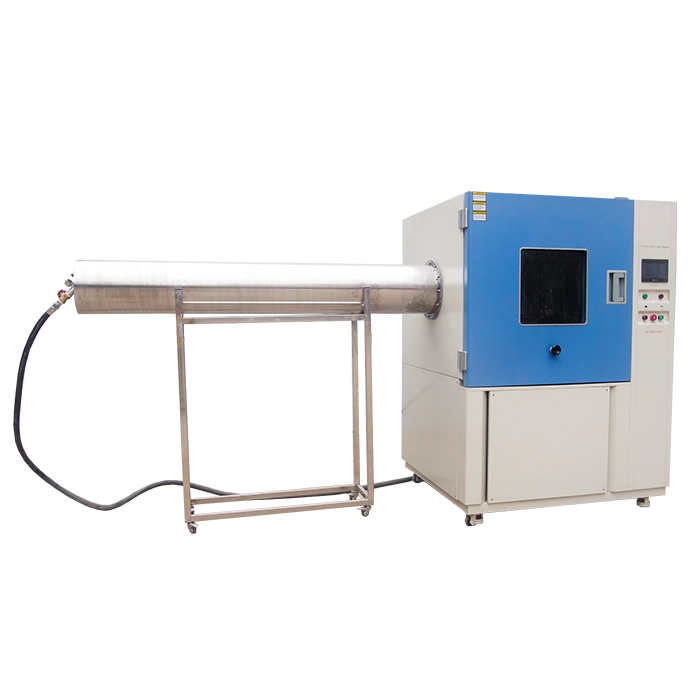 | 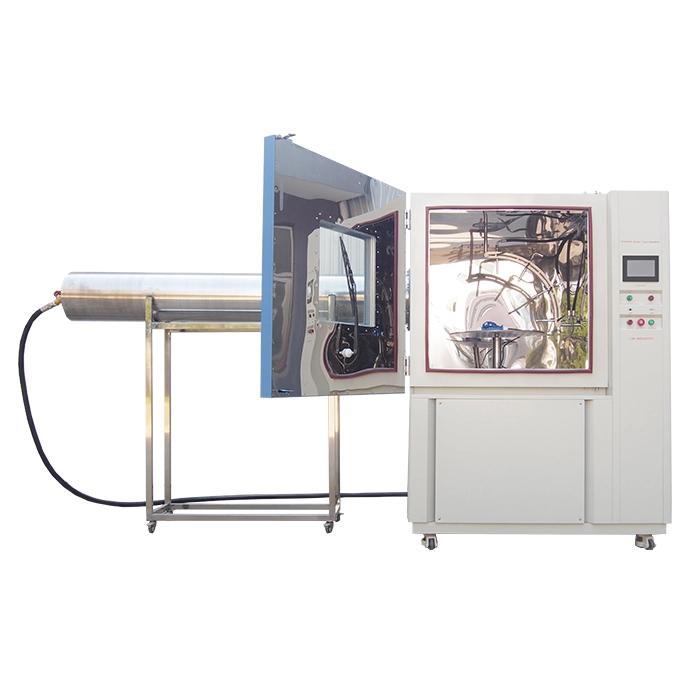 |
Connector testing labs need stable test conditions, simple operation, and reliable records. LIB IP6K9K high pressure equipment supports both severe water jet and hot pressure spray tests, giving automotive teams a practical way to validate connector sealing before vehicle launch.
The system supports IPX6K and IPX9K modes in one unit. For connector projects, this saves floor space and reduces the need to move samples between different machines. A lab can test road splash resistance and pressure washing resistance in a linked process.
Accurate IP69K connector test results depend on nozzle distance, spray angle, pressure, and time. Controlled programs help the operator keep each test consistent, especially when testing several connector variants or comparing seal design changes.
A water circulation and filtration design helps keep spray performance stable during repeated tests. This is useful for labs running connectors, sensors, lamps, control modules, and harness assemblies on a regular schedule.
Automated control supports repeatable pressure, flow, heating, rotation, and timing. For engineering teams, this reduces manual error and makes test records easier to compare across sample batches.
Xi’an LIB Environmental Simulation Industry manufactures environmental test chambers for automotive, electronics, aerospace, defense, medical, telecom, battery, and materials testing. Its product range covers temperature and humidity chambers, corrosion chambers, dust and water IP chambers, weathering chambers, walk-in chambers, and custom test systems.
As an IP6K9K high pressure equipment supplier, LIB provides equipment for ISO 20653 connector testing and related water ingress validation. The company supports design, manufacturing, delivery, installation, training, calibration documentation, and after-sales service. For teams building automotive connector test capacity, this mix of equipment and service is valuable because the chamber must stay accurate after installation, not only during factory acceptance.
Pressure washing is a short event, but it can expose a weak connector design in seconds. IP67 immersion testing alone cannot show how a connector behaves when 80°C water hits the housing at 80–100 bar from 100–150 mm away.
Automotive connector IP6K9K testing gives engineers a stronger view of real washdown risk. It checks seal compression, cable entry design, housing gaps, latch areas, and electrical behavior after hot high-pressure spray. With LIB IP6K9K high pressure equipment, labs can run IPX6K and IPX9K tests under controlled conditions and make sealing decisions before failures reach the vehicle.
The best test is an IPX9K or IP69K connector test under ISO 20653-related conditions. It uses hot high-pressure water spray at 80–100 bar, 80°C±5°C, 14–16 L/min, and four spray angles from a short distance.
IP67 is useful for temporary immersion, but it is not enough for connectors exposed to pressure washing. IP69K checks hot high-pressure spray, which creates a different sealing challenge.
Yes. LIB IP6K9K High Pressure Equipment is designed for both IPX6K strong water jet testing and IPX9K high-temperature, high-pressure spray testing in one system.
Common parts include sensor housings, camera modules, lighting assemblies, control units, battery pack interfaces, charging-related components, underbody electronics, and wire harness assemblies exposed to direct washdown.
LIB industry provides a complete range of environmental test solutions, including IP dust test chambers for IEC 60529 IP5X/IP6X, IP rain and water spray test systems (IPX1–IPX9K), sand and dust test chambers forMIL-STD-810 blowing dust simulation, and temperature and humidity test chambers for climatic reliability testing.
 English
 русский
 français
 العربية
 Deutsch
 Español
 한국어
한국어 italiano
 tiếng việt
 ไทย
ไทย Indonesia
.png "Automotive_Connector_IP6K9K_Testing_for_Washdown_Reliability_(4).png")
.png "Automotive_Connector_IP6K9K_Testing_for_Washdown_Reliability_(3).png")