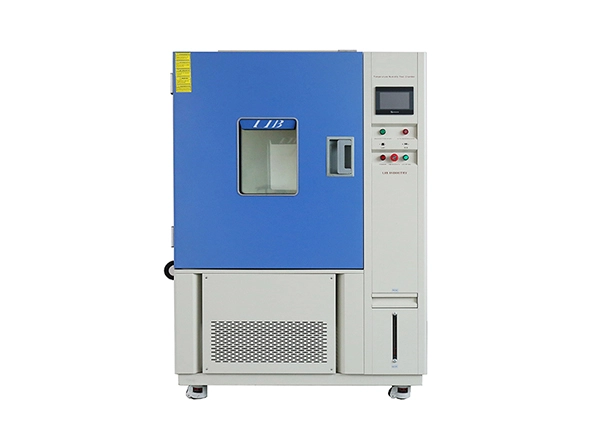
In laboratory environments, environmental testing is not simply about simulating temperature and humidity conditions. The ultimate goal is to generate reliable, repeatable, and standards-compliant test data that can be trusted for product development, certification, and quality validation.
International standards such as IEC, ISO, MIL, and ASTM place strict requirements on temperature and humidity accuracy, stability, uniformity, and long-term performance. As a result, the climatic test chamber used in a laboratory is no longer just auxiliary equipment—it becomes a core part of the laboratory’s compliance infrastructure.
A temperature humidity laboratory climatic test chamber must therefore be engineered not only to reach certain setpoints, but to maintain controlled environmental conditions consistently and verifiably throughout the entire test lifecycle.
At first glance, many temperature humidity chambers may appear similar. However, the difference between a general-purpose environmental chamber and a laboratory-grade climatic test chamber lies in design intent.
Laboratory climatic test chambers are developed to support:
Standards-based testing procedures
Long-duration and repeatable experiments
Multi-sample consistency
Audit-ready data integrity
Rather than focusing solely on nominal temperature or humidity ranges, laboratory-grade chambers prioritize control precision, environmental uniformity, and operational stability—all of which directly affect test validity.
The core performance of a temperature humidity laboratory climatic test chamber is defined by how effectively it can create a stable, uniform, and repeatable environment under real laboratory conditions.
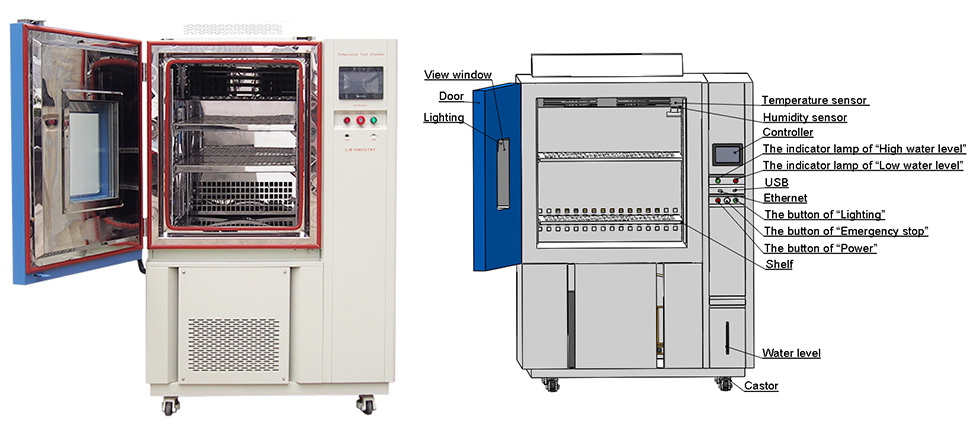 | ||||
| Model | TH-100 | TH-225 | TH-500 | TH-1000 |
Interior Volume | 100L | 225L | 500L | 1000L |
Heat load | 1000W | |||
Temperature Range | A : -20℃ ~ +150 ℃ B : -40℃ ~ +150 ℃ C: -70℃ ~ +150 ℃ | |||
Temperature Fluctuation | ± 0.5 ℃ | |||
Temperature Deviation | ± 2.0 ℃ | |||
Humidity Range | 20% ~ 98% RH | |||
Humidity Deviation | ± 2.5% RH | |||
Cooling Rate | 1 ℃ / min | |||
Heating Rate | 3 ℃ / min | |||
Controller | Programmable color LCD touch screen controller,PC Link, LAN interface for remote control | |||
Cooling system | Mechanical compression refrigeration system | |||
Refrigerant | Environmentally friendly refrigerant,compliant with the GWP standards requirements | |||
Water supply system | Automatic water supply; Water purification system | |||
Safety device | Humidifier dry-combustion protection; over-temperature protection; over-current protection; Refrigerant high-pressure protection; Water shortage protection, Earth leakage protection; | |||
Interior Material | SUS304 stainless steel | |||
Exterior Material | Steel Plate with protective coating | |||
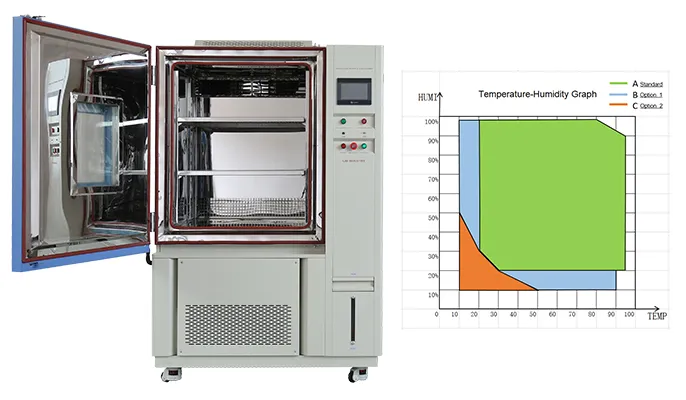
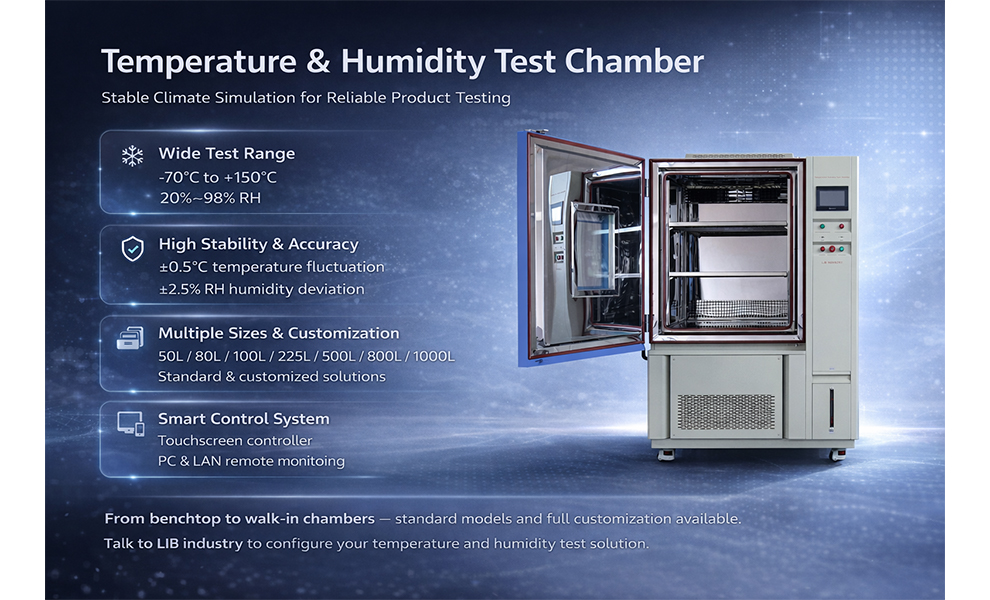
Laboratory testing often requires a wide operating range to cover diverse test standards and application scenarios. A laboratory climatic test chamber typically supports temperature ranges such as –20°C, –40°C, or –70°C up to +150°C, with humidity control from 20% RH to 98% RH, depending on configuration.
Beyond range, control accuracy is critical. High-precision sensors and advanced control algorithms allow the chamber to maintain:
Temperature accuracy within ±0.3°C to ±0.5°C
Humidity accuracy within ±2% to ±3% RH
Fast response combined with smooth transitions enables the chamber to handle:
Thermal cycling tests
Aging and endurance tests
Constant-condition exposure tests
This balance between responsiveness and stability ensures that test conditions follow defined profiles without overshoot or fluctuation, directly supporting test repeatability.
Uniformity is a fundamental requirement in laboratory testing. Even when setpoints are accurate, uneven temperature or humidity distribution inside the working space can lead to inconsistent sample exposure.
Laboratory climatic test chambers are designed with optimized airflow systems, including:
Carefully engineered air circulation paths
Balanced supply and return airflow
Controlled air velocity across the test space
These design features minimize temperature and humidity gradients, ensuring that all samples—regardless of position—experience the same environmental conditions.
For laboratories conducting comparative tests, batch testing, or multi-sample validation, uniform climate distribution is essential. Without it, test results may vary not because of product differences, but due to environmental inconsistency.
Many laboratory tests extend far beyond short-term exposure. Reliability testing, material aging, and qualification programs may require continuous operation over days, weeks, or repeated cycles.
A laboratory climatic test chamber is therefore engineered for long-term stability through:
Anti-drift control strategies
High-reliability temperature and humidity sensors
Robust refrigeration and humidification systems
While many chambers may perform well during short tests, laboratory-grade systems are designed to maintain accuracy and stability throughout extended operation and repeated test cycles.
Many chambers perform well short-term, but laboratory testing is a long-term challenge.
This long-term stability ensures that test results remain consistent from the first cycle to the last.
In modern laboratories, environmental control must be transparent and traceable. The control system of a laboratory climatic test chamber is designed to support both efficient operation and data integrity.
Key features include:
An intuitive controller interface suitable for laboratory workflows
Real-time display of temperature and humidity trends
Programmable test profiles and automatic operation
Data recording and export for test documentation
Rather than focusing on complexity, the intelligence of the system lies in its ability to support reproducibility, traceability, and audit readiness. Recorded environmental data can be used for internal quality management, external audits, and test verification.
The mechanical structure of a temperature humidity laboratory climatic test chamber plays a crucial role in performance consistency and durability.
Laboratory-grade chambers typically feature:
High-sealing chamber construction to reduce external environmental interference
Corrosion-resistant and aging-resistant inner materials, such as SUS 304 stainless steel
Thermal insulation designed to maintain stable internal conditions
Key components are selected based on long-term reliability rather than minimum specification, ensuring stable performance under continuous laboratory use.
The structure is engineered for accuracy, safety, and durability—because reliable data starts with reliable design.
|
|
|
| |
| Robust Workroom | Cable Hole | Temperature and Humidity Sensor | PID controller |
Laboratory testing requirements are rarely identical. To address diverse needs, laboratory climatic test chambers can be customized with:
Multiple chamber sizes and working volumes
Test ports for sensor wiring, power cables, or sample connections
Customized temperature and humidity profiles
Optional monitoring or safety features
This flexibility allows laboratories to adapt the chamber to specific standards, products, and test methodologies, without compromising performance or compliance.
Temperature humidity laboratory climatic test chambers are widely used across laboratory fields, including:
Material performance and aging studies
Electronic and automotive component testing
Battery and energy storage evaluation
Environmental reliability testing
Third-party testing and certification laboratories
In each application, the chamber serves as a controlled environment platform that supports standardized test procedures and consistent data generation.
For laboratories operating under quality management systems or accreditation frameworks, equipment must support audit and certification processes.
A laboratory climatic test chamber contributes to:
Data traceability and reproducibility
Consistent test conditions across projects
Reduced risk of test repetition due to equipment instability
By maintaining controlled and verifiable environmental conditions, the chamber helps laboratories meet internal quality requirements and external audit expectations.
Contact LIB industry inquiry@libtestchamber.com to configure a temperature humidity laboratory climatic test chamber tailored to your testing standards.
Our solution includes professional pre-sales consultation, on-site installation and commissioning, operator training, a 3-year warranty, lifelong technical support, and responsive English-speaking service, ensuring long-term reliability and worry-free laboratory operation.

 English
 русский
 français
 العربية
 Deutsch
 Español
 한국어
한국어 italiano
 tiếng việt
 ไทย
ไทย Indonesia