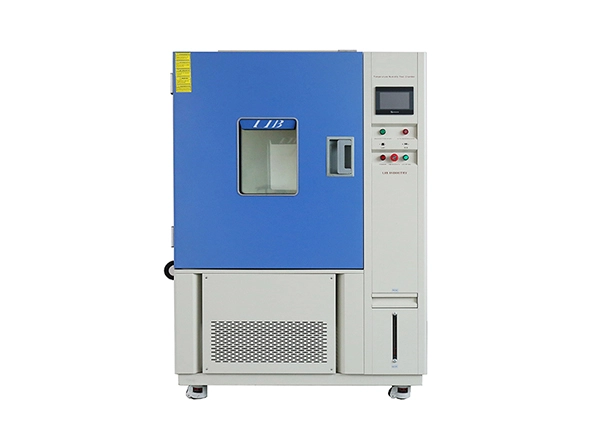
Environmental reliability is no longer a final-stage validation step. In modern product development, environmental simulation must begin at the prototype phase. Temperature fluctuation, humidity exposure, and cyclic stress directly influence material behavior and electronic stability.
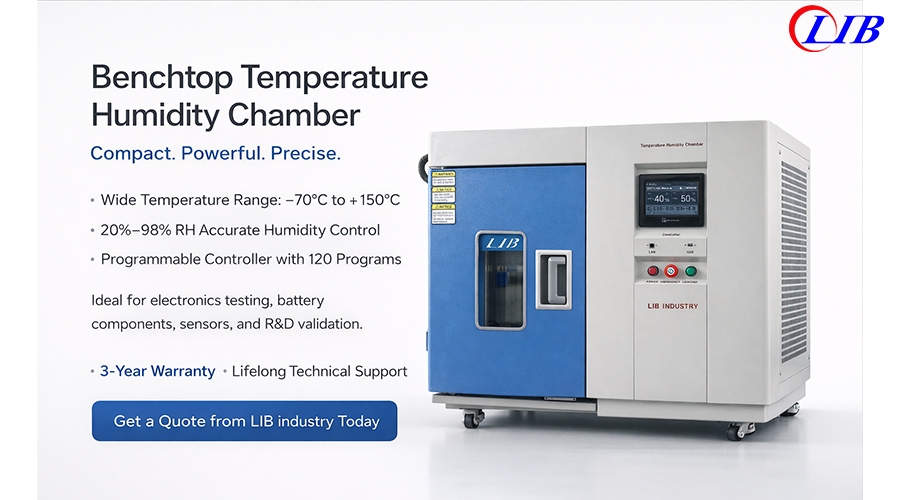
A benchtop environmental chamber enables R&D teams to conduct controlled environmental verification inside the laboratory—shortening development cycles while improving product robustness.
Early-stage R&D often emphasizes functional validation and performance metrics, but environmental stress is frequently overlooked.
Key risks include:
Temperature variation: thermal expansion, solder fatigue, PCB warpage, electronic drift
Humidity exposure: insulation degradation, corrosion, delamination, increased failure rates
Why early testing matters:
Detect design weaknesses before tooling and certification
Reduce rework, production instability, and warranty claims
Mitigate risks without adding extra cost
Integrating environmental simulation at the prototype stage ensures reliable, field-ready designs from the outset.
Professional R&D laboratories rely on internationally recognized standards to ensure data credibility and certification readiness.
Below are the most relevant standards for temperature and humidity testing.
These define cold and dry heat testing procedures.
What they evaluate:
Low-temperature operational stability
High-temperature endurance
Structural deformation risk
Why important for small electronics:
Miniaturized components are more sensitive to thermal stress due to compact solder joints and high-density PCB layouts.
A benchtop temperature humidity chamber allows precise exposure to specified temperature plateaus required by these standards.
Defines cyclic humidity testing under alternating temperature conditions.
What it evaluates:
Condensation effects
Moisture ingress
Corrosion initiation
Cyclic damp heat is especially critical for consumer electronics and automotive modules exposed to daily temperature shifts.
Specifies steady-state high humidity exposure.
What it evaluates:
Insulation degradation
Long-term moisture stability
Material swelling
Small electronic modules, sensors, and encapsulated components must pass constant humidity exposure before release.
A comprehensive environmental engineering framework used in defense and high-reliability industries.
What it evaluates:
Environmental durability
Thermal shock resistance
Humidity endurance
Even in commercial industries, it serves as a reliability benchmark.
Used widely in semiconductor testing.
What it evaluates:
Moisture sensitivity
High-temperature storage
Bias temperature stress
For component-level R&D, this standard is particularly relevant.
By selecting a Small Benchtop Humidity Chamber capable of executing these standard conditions, laboratories ensure their data transitions smoothly from R&D validation to certification and mass production.
Once testing logic and standards are understood, equipment selection becomes strategic.
A benchtop environmental chamber designed for R&D must deliver industrial-level precision within a compact footprint.
R&D labs rarely have dedicated environmental rooms. A benchtop system allows:
Installation directly on laboratory benches
Standard electrical connection
Minimal facility modification
This enables decentralized testing—engineers can validate prototypes immediately without waiting for centralized lab scheduling.
R&D requires fast iteration.
A high-quality benchtop chamber provides controlled ramp rates suitable for executing standard-defined cycles. Faster yet stable temperature transitions reduce validation timelines without compromising accuracy.
To comply with international standards, environmental stability is essential.
Typical R&D-grade performance includes:
Temperature fluctuation within ±0.5°C
Uniformity within ±2°C
Humidity deviation within ±2% RH
This ensures reproducible, audit-ready data.
Modern R&D rarely involves single static conditions.
A programmable controller enables:
Thermal cycling
Humidity plateau holding
Multi-step automated sequences
Repeated test profiles
The TH-50 and TH-80 benchtop environmental chambers from LIB Industry represent this category—compact yet engineered for professional compliance-level testing.
|
| |||||
| Model | td-50 | td-80 | ||||
| Internal dimension (mm) | 320x350x450 | 400x400x500 | ||||
| Overall dimension (mm) | 800x1050x950 | 900×1100×1000 | ||||
| Temperature range | -86 ℃ ~+150 ℃ | |||||
| Temperature fluctuations | ± 0.5 ℃ | |||||
| Humidity Range | 10%/20%~98 % | |||||
| Temperature deviation | ± 2.0 ℃ | |||||
| Temperature Sensor | PTR Platinum Resistance PT100Ω/MV A-class | |||||
| Temperature Resolution | ± 0.001 ℃ | |||||
| Exterior Material | Steel Plate with A protective coating | |||||
| Interior Material | SUS 304 stainless steel | |||||
|
|
|
| |
| Robust Workroom | Cable Hole | Temperature and Humidity Sensor | PID controller |
Environmental testing identifies:
Solder fatigue
Delamination
Thermal expansion mismatch
PCB reliability is highly temperature-dependent.
Miniature sensors are highly sensitive to:
Thermal drift
Condensation
Humidity-induced offset
Controlled environmental exposure ensures calibration stability.
Polymers and coatings experience:
Moisture absorption
Hardness change
Surface degradation
Temperature-humidity exposure accelerates aging studies.
Academic institutions use benchtop chambers for:
Experimental validation
Material science research
Prototype evaluation
Graduate-level reliability studies
Compact size makes them ideal for multi-project environments.
Choosing the correct chamber size depends on application stage and product dimensions.
irements:
| Type | Model / Internal Size | Temperature Range | Humidity Range | Max Heating / Cooling Rate | Ideal Use |
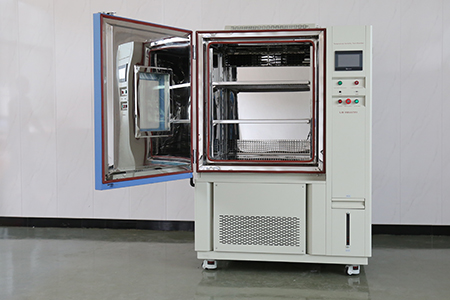
| Small Benchtop | TH-50 / TH-80 | –20℃/–40 °C/–70℃ ~ +150 °C | 20–98 % RH | Heating: 3 °C/min Cooling: 1 °C/min customizable | Small electronics, sensors, R&D testing |
| Standing Chamber | 100 L / 225 L / 500 L / 800 L / 1000 L | Mid-volume testing, production QA | |||
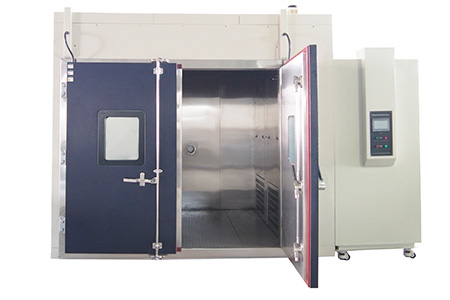
| Walk-In Chamber | Customizable > 5 m³ | Large components, automotive, aerospace, full-system environmental testing | |||
|
| ||||
Insights:
Benchtop chambers provide high-precision, fast-response solutions for small-scale lab testing.
Standing and walk-in chambers enable labs to expand testing capabilities for larger components or higher throughput.
This selection guide allows labs to plan for both current needs and future growth.
Environmental testing equipment is a long-term laboratory asset.
LIB Industry supports R&D laboratories with:
Three-year warranty coverage
Lifetime technical support
Remote troubleshooting assistance
Spare parts availability
Preventive maintenance guidance
This ensures operational continuity and long-term testing stability without disrupting development timelines.
Contact us today for expert guidance and a tailored solution to elevate your lab’s environmental testing capabilities.

 English
 русский
 français
 العربية
 Deutsch
 Español
 한국어
한국어 italiano
 tiếng việt
 ไทย
ไทย Indonesia



.webp "Wet Bulb Gauze for Temperature Humidity Chambers")