 Accelerated Shelf Life Testing (ASLT) is a laboratory technique used to estimate the lifespan of products by exposing them to intensified environmental conditions. Instead of waiting for natural degradation to occur, manufacturers accelerate aging processes through elevated temperature, humidity, and other stress factors.
The objective is to observe product deterioration in a compressed timeframe and use the collected data to predict real-world shelf life.
Common product characteristics evaluated during accelerated testing include: Physical appearance,color stability, mechanical strength, chemical composition, moisture resistance, packaging integrity, electrical performance. Accelerated testing is widely used during product development, quality validation, and regulatory compliance programs.
Many aging processes follow predictable chemical reaction patterns. According to the Arrhenius principle, increasing temperature accelerates chemical reactions that contribute to product degradation.
For example, a food product stored at 40°C may experience aging several times faster than the same product stored at room temperature. By analyzing degradation data obtained under accelerated conditions, manufacturers can estimate expected performance over much longer storage periods.
This scientific approach significantly reduces development cycles while providing valuable reliability information.
Accelerated shelf life testing equipment refers to environmental testing systems designed to create controlled conditions that accelerate product aging and degradation.
These systems allow laboratories to regulate factors such as:Temperature, Relative humidity, Air circulation, Light exposure, Environmental stability
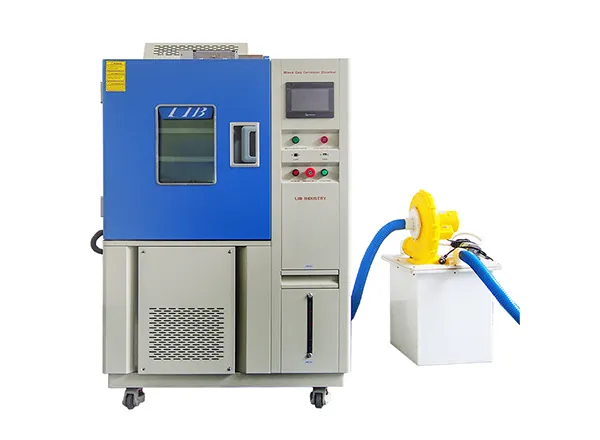
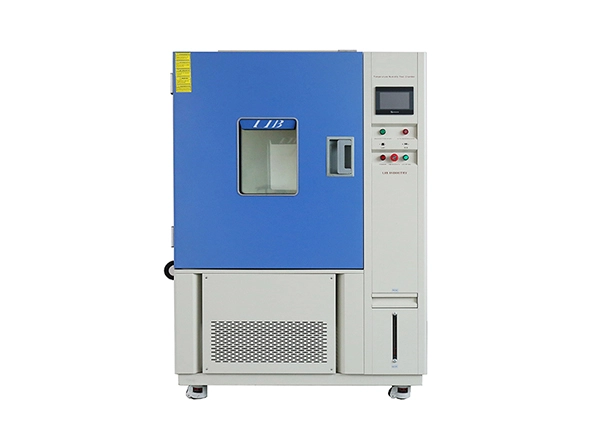
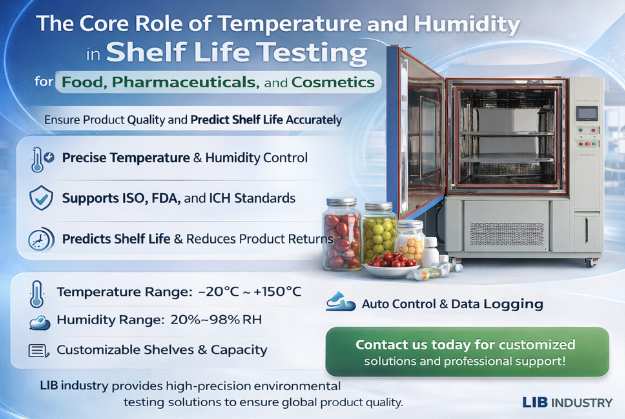
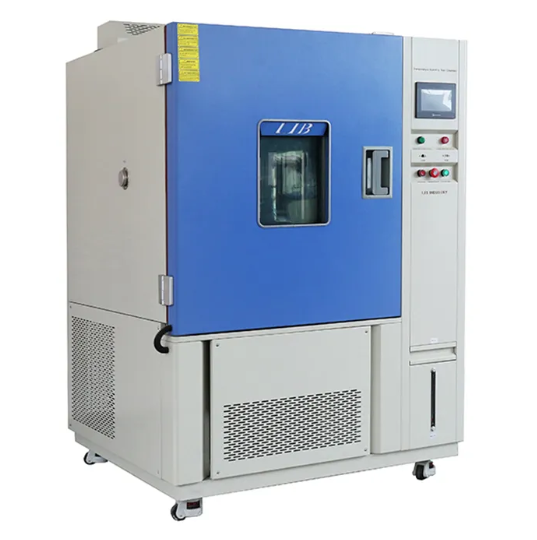
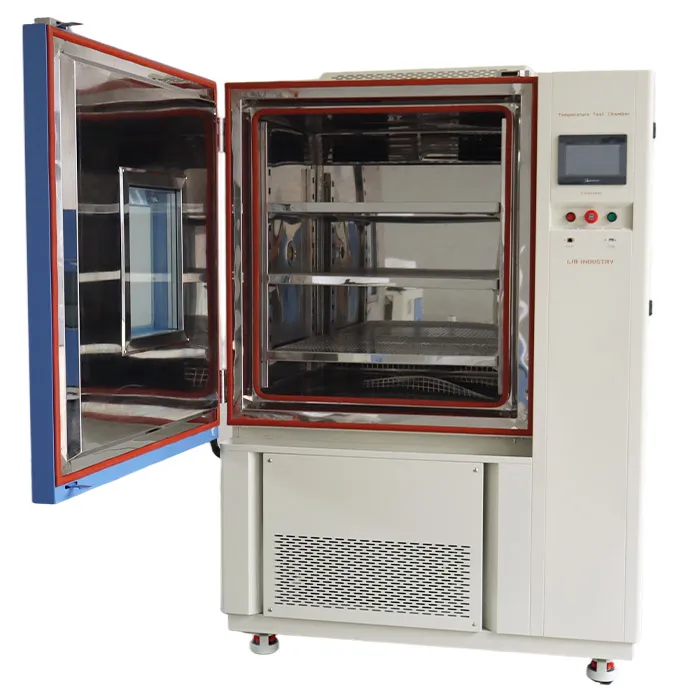
While several types of environmental chambers can support shelf life studies, temperature and humidity chambers remain the preferred solution for most applications.
 |
|
A temperature and humidity chamber creates stable environmental conditions that simulate long-term storage environments. By exposing products to elevated temperature and humidity levels, degradation mechanisms can be accelerated without introducing unrealistic stress factors.
Typical testing conditions include:
40°C / 75% RH
50°C / 75% RH
60°C / 85% RH
85°C / 85% RH
These conditions help manufacturers evaluate product stability within weeks rather than years.
For laboratories conducting routine shelf life studies, temperature and humidity chambers provide an excellent balance between testing efficiency, reliability, and cost-effectiveness.
Accelerated shelf life testing relies on the chamber’s ability to maintain stable and controlled environmental conditions over time.
Temperature is one of the most critical factors in product aging. Higher temperatures accelerate key degradation mechanisms such as chemical reactions, oxidation, material breakdown, polymer aging, and ingredient decomposition.
For example, pharmaceutical stability studies are often conducted at 40°C, while electronic components may require higher stress temperatures depending on application needs.
Stable temperature control is essential to ensure repeatable and reliable results.
Humidity directly affects product durability and stability. High moisture conditions can lead to corrosion, moisture absorption, packaging deformation, label deterioration, mold growth, and electrical failure.
Common accelerated conditions include 75% RH or 85% RH, which help simulate long-term moisture exposure in a shorter time.
In real environments, temperature and humidity act together. Environmental chambers allow simultaneous control of both factors to better simulate real storage conditions.
This combined testing is widely used for food packaging, pharmaceuticals, cosmetics, consumer electronics, and lithium batteries, providing a more realistic prediction of product shelf life.
Accelerated shelf life testing is widely applied across industries where product stability and durability are critical.
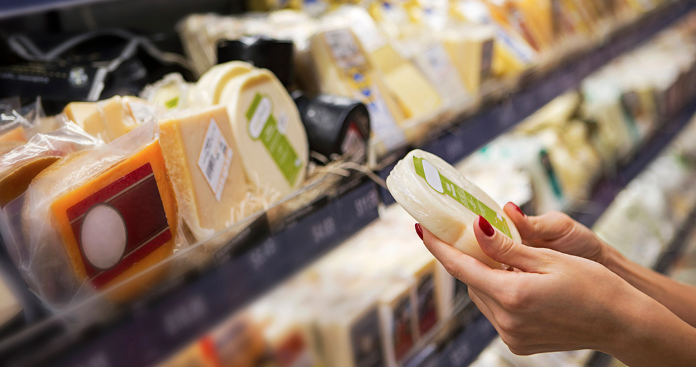
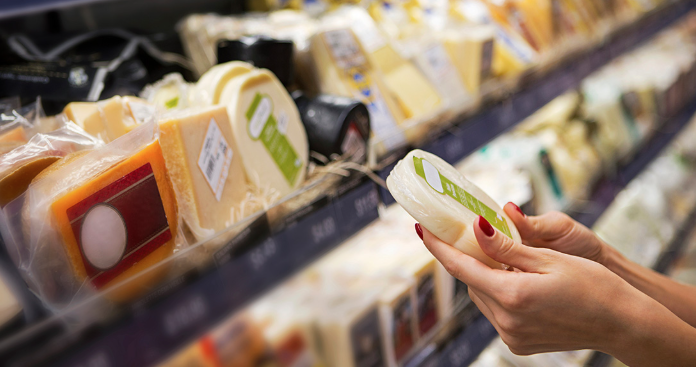
Used to determine expiration dates and evaluate packaging performance. Applications include snacks, dairy, beverages, supplements, and processed foods.
Supports stability studies, packaging validation, and formulation development to meet regulatory requirements.
Evaluates cream stability, color retention, fragrance changes, separation, and packaging compatibility.
Tests barrier performance, adhesive stability, deformation resistance, and label durability under environmental stress.
Used for PCB reliability, battery aging, connector corrosion, and semiconductor stability testing.
Different industries apply different accelerated conditions depending on product sensitivity and expected storage environment.
Application | Temperature | Humidity | Typical Duration |
Food Products | 40°C | 75% RH | 2–8 weeks |
Pharmaceuticals | 40°C | 75% RH | 4–12 weeks |
Cosmetics | 45°C | 75% RH | 2–10 weeks |
Packaging Materials | 50°C | 85% RH | 2–6 weeks |
Electronics | 60°C–85°C | 60–85% RH | 1–6 weeks |
These accelerated conditions allow laboratories to simulate months or even years of natural aging in a significantly shorter time.
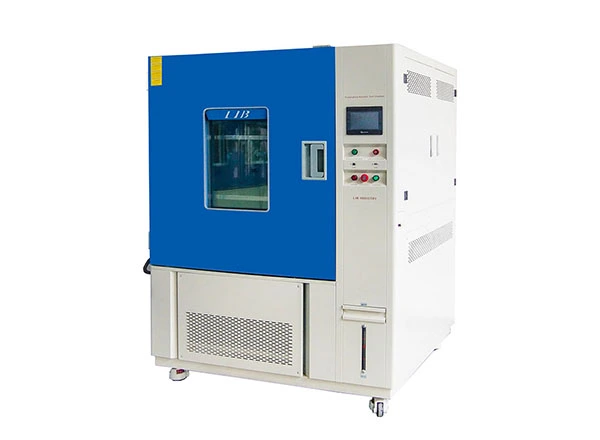
When selecting accelerated shelf life testing equipment, the goal is not only to “get a chamber,” but to ensure stable, repeatable, and standards-compliant results. LIB industry temperature and humidity chambers are designed specifically for this purpose, covering R&D, quality control, and industrial-scale validation.
|
|
|
| |
| Robust Workroom | Cable Hole | Temperature and Humidity Sensor | PID controller |
Different testing stages require different chamber capacities. LIB temperature and humidity chambers are available in a full range of configurations to support R&D, laboratory testing, and large-scale industrial validation.
Benchtop chambers (TH-50 / TH-80)
Ideal for early-stage R&D, formulation screening, and small sample accelerated testing.
Standard & large-capacity chambers (100L–1000L series, e.g., TH-100 / TH-225 / TH-500 / TH-800 / TH-1000)
Cover the most common requirements in laboratory and production environments. These models are widely used for routine accelerated shelf life testing, stability studies, and QC validation across multiple industries.
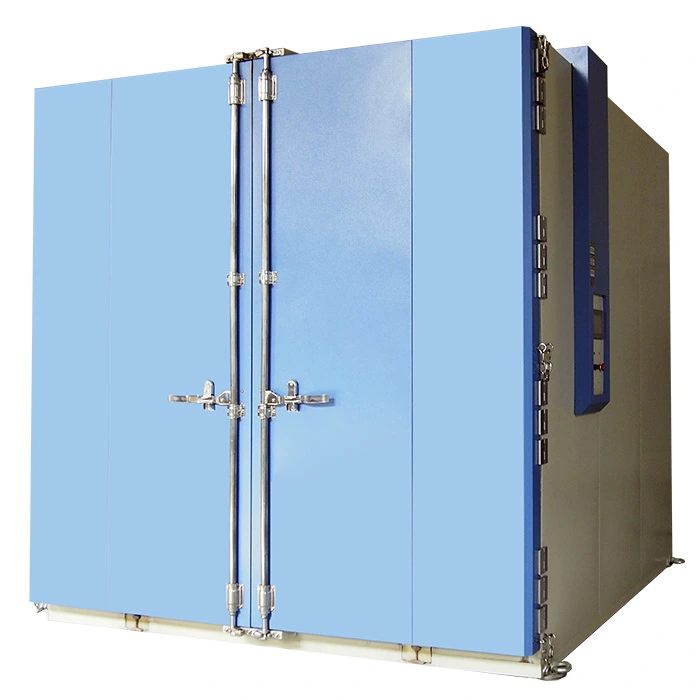
Walk-in chambers (customizable volume)
Designed for full-scale product testing, pallet-level packaging validation, and high-throughput industrial applications. Walk-in solutions allow testing of complete batches under uniform temperature and humidity conditions, making them ideal for automotive, electronics, and pharmaceutical industries.
All LIB chambers are engineered with uniform airflow circulation systems to ensure consistent temperature and humidity distribution across the entire workspace, improving repeatability and test accuracy.
LIB environmental chambers support multiple temperature configurations to match different testing standards and acceleration requirements:
-20°C to +150°C
-40°C to +150°C
-70°C to +150°C
This wide range allows users to simulate mild storage conditions or highly accelerated aging environments depending on product type and industry requirements.
Stable humidity control is critical for reliable shelf life prediction.
LIB temperature and humidity chambers offer:
20% to 98% RH wide control range
±2.0%–±2.5% RH stability
Fast humidity recovery after door opening
Uniform humidity distribution inside the chamber
This ensures consistent exposure conditions for all samples, reducing data deviation during long-term testing.
Modern accelerated testing requires full traceability and compliance with international standards.
LIB chambers are equipped with:
Real-time data logging system
USB and Ethernet data export
Multi-segment programmable testing profiles
Support for ISO, ASTM, IEC, and other testing standards
These features allow laboratories to generate reliable, audit-ready test reports for quality control and certification purposes.
Among all types of environmental simulation systems, temperature and humidity chambers are the most widely used accelerated shelf life testing equipment due to their reliability, stability, and broad application range.
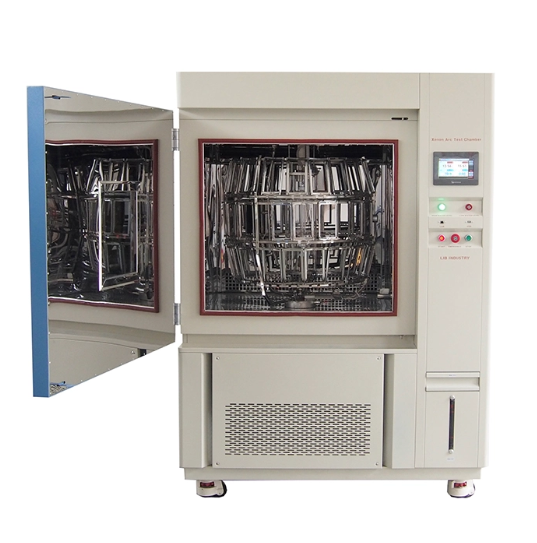
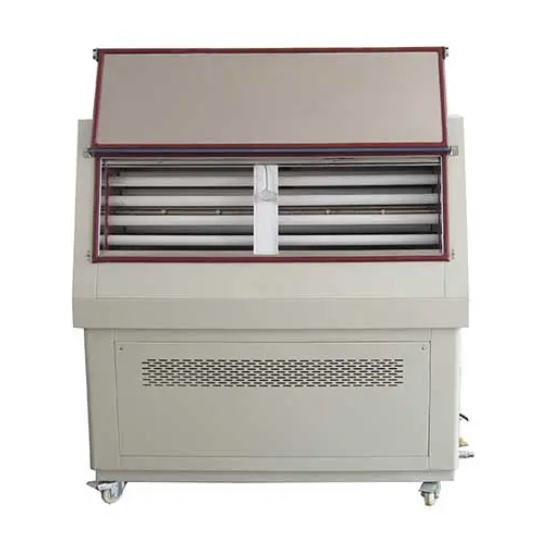
Accelerated Shelf Life Testing Equipment refers to environmental simulation systems that accelerate product aging by controlling temperature, humidity, and light conditions in a laboratory environment.
These systems help predict product shelf life in a shorter time by reproducing long-term degradation mechanisms under intensified conditions.
Accelerated shelf life testing equipment is essential for predicting product stability in a shortened time frame, and temperature and humidity chambers are the most widely used solution due to their high accuracy and real-world simulation capability.
LIB industry provides professional temperature and humidity chambers designed for reliable accelerated shelf life testing across multiple industries.
3-year warranty on all equipment
Lifetime technical support and maintenance
Fast response service for global customers
For reliable accelerated shelf life testing solutions, LIB industry is ready to support your laboratory needs with stable performance and long-term service assurance.
 English
 русский
 français
 العربية
 Deutsch
 Español
 한국어
한국어 italiano
 tiếng việt
 ไทย
ไทย Indonesia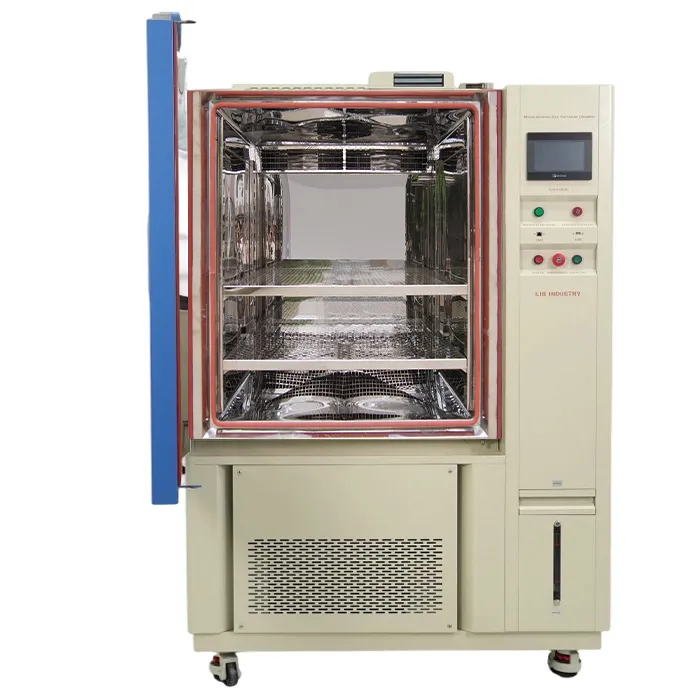


.webp "Wet Bulb Gauze for Temperature Humidity Chambers")