Coatings and paints may appear stable upon leaving the factory, but once deployed outdoors, they face harsh environmental challenges including solar radiation, high temperatures, dew, rain, and cyclic temperature fluctuations. Within months, architectural coatings can fade and chalk, automotive finishes can lose their premium gloss, and industrial powder coatings can crack along the edges.
For coating manufacturers, paint formulators, quality control teams, and product manufacturers, UV accelerated weathering test data is far more than just a laboratory report. It is the ultimate benchmark that determines whether a new formula is ready for market launch, whether a supplier's raw material batch is stable, and whether a product can truly withstand the test of time outdoors.
While natural outdoor exposure testing is a valuable part of weathering evaluation, real-world environmental variables are highly unpredictable. Factors like sunlight, heat, condensation, and rain might cause limited damage individually; however, their combined synergistic effects accelerate coating degradation exponentially. Many coatings that perform flawlessly in short-term visual checks can fail catastrophically after just a few wet/dry cycles.
Ultraviolet (UV) radiation directly degrades the resin binders within coatings, weakens the adhesion between the matrix and pigments, and alters the chemical properties of the colorants:
Architectural Coatings: Degradation typically manifests as severe color fading or surface chalking.
Automotive & Industrial Finishes: Early-stage failure is generally marked by a rapid loss of gloss.
Plastic Coatings & Composites: Consumers usually notice yellowing first, followed by surface micro-cracking in thin-film areas, edges, or raised profiles.
In actual outdoor environments, coatings on metal substrates are rarely exposed to purely dry sunlight. Instead, metal panels are baked under the hot sun during the day, cool down rapidly at night, and become covered in heavy dew by early morning. This continuous cycle of "heating-cooling-wetting-drying" repeats indefinitely.
Once the coating surface develops micro-defects from UV radiation, moisture (condensation) penetrates these microscopic fissures. Subsequent temperature rises then accelerate the underlying chemical hydrolysis. By the time blistering or delamination becomes visible to the naked eye, severe damage has already occurred. Therefore, a qualified weathering chamber must provide not only stable UV radiation but also precise control over temperature, condensation, and water spray systems.
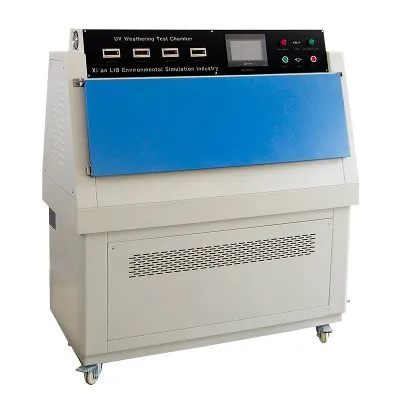
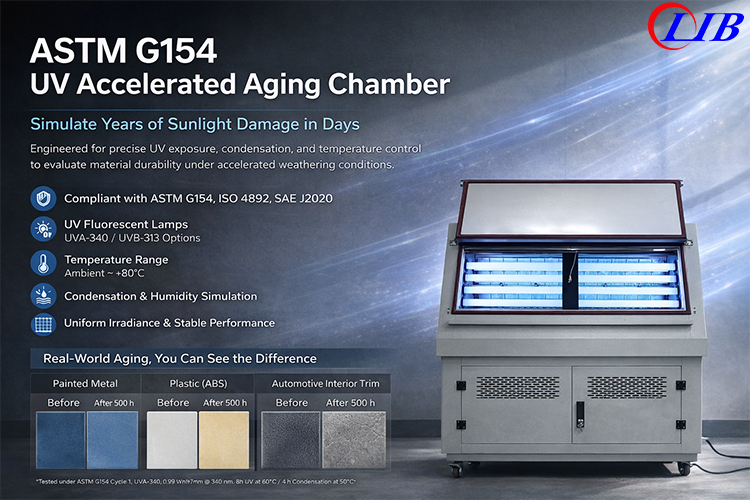
A UV accelerated aging chamber is a specialized laboratory environmental test instrument. By utilizing fluorescent UV lamps combined with integrated temperature, humidity, condensation, and cyclic water spray programs, it simulates the environmental damage that would naturally take months or even years to accumulate outdoors in a fraction of the time.
 |  |
Fluorescent UV lamps are engineered to replicate the short-wave UV spectrum of sunlight, which causes the most significant polymer degradation:
UVA-340 Lamps: These lamps provide an excellent simulation of critical short-wave sunlight (approximately 290nm to 360nm). They are the primary choice for standard screening and correlation studies in most coating laboratories.
UVB-313 Lamps: These lamps emit shorter UV wavelengths than those found in natural terrestrial sunlight. Providing a highly accelerated weathering effect, they are ideal for rapid screening or testing the ultimate durability limits of high-weatherability materials, though data interpretation requires caution.
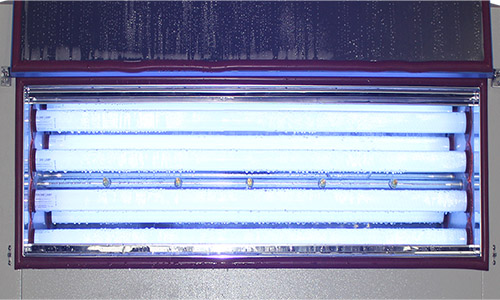
The LIB ASTM G154 UV Accelerated Aging Chamber is equipped with eight 40W professional fluorescent UV lamps (wavelength range 290–400 nm) and features a standard closed-loop irradiance control system (adjustable from 0.3 to 20 W/㎡). This system provides highly repeatable laboratory exposure conditions for coating panels, paint samples, plastic-coated parts, and other non-metallic materials.
While UV radiation acts as the primary catalyst for coating damage, subsequent exposure to condensation or water spray amplifies and quantifies these latent defects.
Water spray cycles simulate the thermal shock caused by sudden rainstorms, as well as the mechanical erosion that washes away degraded surface layers to expose fresh material. Certain powder coatings might pass 200 hours of gloss retention testing under dry UV exposure alone, yet rapidly develop edge cracking once a UV-condensation cycle is introduced. These failure modes are impossible to detect using basic lightboxes or static, short-term tracking.
ASTM G154 is the most widely adopted international standard for fluorescent UV exposure testing of non-metallic materials. It establishes standardized procedures for evaluating the weatherability of paints and coatings under controlled UV, temperature, and moisture conditions.
Key Takeaway: An ASTM G154 test is not intended to provide a direct correlation to an exact outdoor service life (e.g., "this test equals 3 years outdoors"). Instead, it delivers a highly repeatable, quantifiable comparative testing method used for screening product formulas, managing quality control, and vetting suppliers.
The ASTM G154 standard includes various exposure cycles based on material characteristics and compliance specifications. In the coatings industry, one of the most classic test cycles consists of:
Irradiance Phase: 8 hours of UV exposure using UVA-340 lamps, with Black Panel Temperature (BPT) maintained at approximately 60°C.
Condensation Phase: 4 hours of dark condensation (lamps off), with Black Panel Temperature held at approximately 50°C and relative humidity maintained at 95% RH or higher.
To ensure consistent test data across different production batches and laboratories, the aging chamber must achieve high-precision control over the following parameters:
Fluorescent UV lamp type and actual irradiance calibration/setting.
Black Panel Temperature (BPT) during both the exposure and condensation phases.
Water spray cycles (precise duration and interval settings).
Sample-to-lamp distance: Testing proves that even minor deviations from the standard 50mm distance can significantly compromise test repeatability.
Evaluating weathered coatings must go beyond subjective visual checks. Assessments should be quantified using instruments according to national and international standards:
Test Item | What It Measures / Quantifies | Focus Areas & Key Applications |
Color Change ($\Delta E$) | Quantifying fading or yellowing via colorimeters | Color stability for architectural walls, landscapes, and outdoor signage. |
Gloss Retention | Measuring percentage of gloss retained | Premium aesthetic durability for automotive finishes and decorative paints. |
Chalking Grade | Rating the breakdown of resin binders | Weatherproof layers for architectural latex paints and metal roofing panels. |
Cracking/Blistering | Assessing crack severity, blister density, and size | Industrial powder coatings, anti-corrosion paints, and heavy-duty coatings. |
Adhesion Test | Cross-hatch or pull-off adhesion loss post-aging | Delamination resistance for structural steel protective coatings and marine paints. |
Exterior latex paints, roof waterproof coatings, fluorocarbon coatings, and wood finishes are exposed to prolonged sunlight and rain. In low-latitude hot regions or high-humidity coastal zones, coating degradation occurs rapidly. Running 500-hour or 1,000-hour comparative tests allows R&D teams to select the most cost-effective pigment systems or resin modifications before market launch.
Automotive OEM finishes, refinish paints, and construction machinery coatings face stringent requirements for surface stability and service life. UV weathering testing is implemented as a mandatory metric for automotive OEM supplier qualification, Incoming Quality Control (IQC), and formula modification validation. If an industrial coating delaminates during a UV-condensation test, the substrate becomes exposed to the elements, leading to extensive corrosion.
Products such as patio umbrella frames,outdoor fitness equipment, plastic enclosures, and road signage often require testing multiple samples with varying coating thicknesses or resin ratios simultaneously in the same chamber.
> High-Efficiency Testing Solution:
> The LIB UV weathering chamber supports standard 75×150mm specimen holders, accommodating up to 56 samples within a single test series. This high-capacity design allows R&D personnel to perform precise side-by-side comparative testing under identical environmental variables.
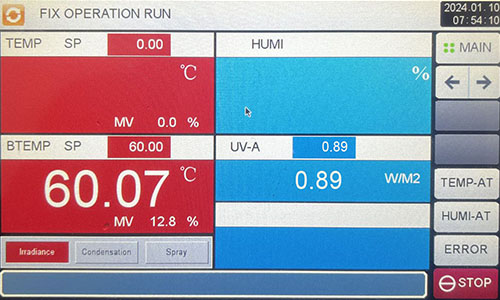
To obtain reliable and reproducible coating test data, all subsystems within a weathering chamber must deliver exceptional stability. Any drift in irradiance, temperature fluctuation, or uneven water distribution can invalidate your test results.
 |  |
| Lighting system | Control system |
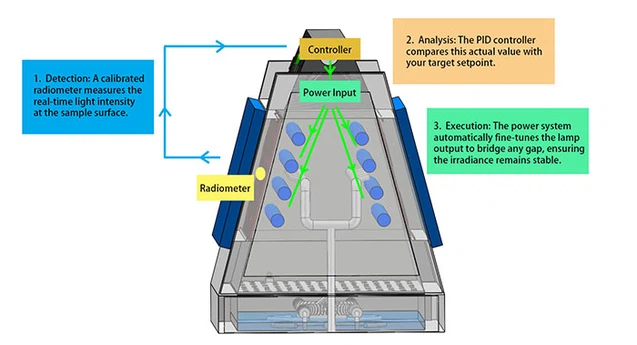
The LIB chamber continuously monitors UV energy output and automatically adjusts current via an intelligent controller to compensate for lamp degradation, ensuring constant irradiance throughout the test cycle.
Built with a high-grade stainless steel interior workspace, the chamber offers superior corrosion resistance in long-term high-humidity condensation and water-spray environments, minimizing maintenance downtime.
Backed by over 16 years of expertise as a professional environmental test equipment supplier, Xi'an LIB Environmental Simulation Industry offers a full spectrum of environmental reliability systems—ranging from standard-compliant ASTM G154 UV chambers to temperature/humidity cycling, salt spray corrosion, rain spray, and dust test chambers.
LIB Industry is committed to providing long-term and reliable support to ensure stable equipment operation throughout its entire lifecycle.
3-Year Warranty covering core components and manufacturing defects
Lifetime Technical Support for operation guidance, troubleshooting, and test method consultation
Remote assistance for installation, calibration, and system diagnostics
Spare parts supply guaranteed for long-term equipment maintenance
Professional engineering support for customized testing requirements
With LIB Industry’s service system, customers are not only purchasing a UV aging test chamber, but also gaining long-term technical assurance for their laboratory operations.
Contact LIB Industry today for a tailored UV aging test solution for your coatings and materials laboratory.
 English
 русский
 français
 العربية
 Deutsch
 Español
 한국어
한국어 italiano
 tiếng việt
 ไทย
ไทย Indonesia
_20260824102429.webp "IPX7 IPX8 Pressurized Water Ingress Protection Tester")