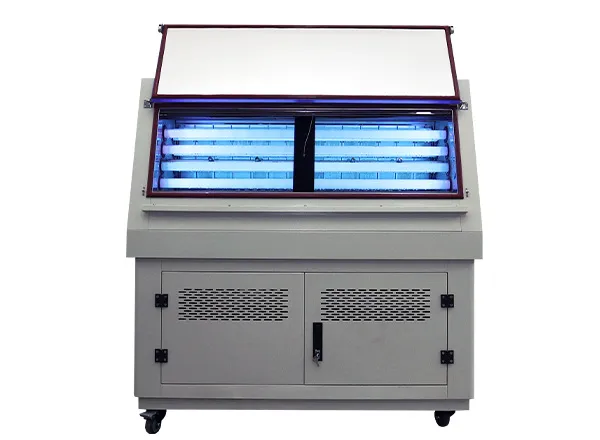
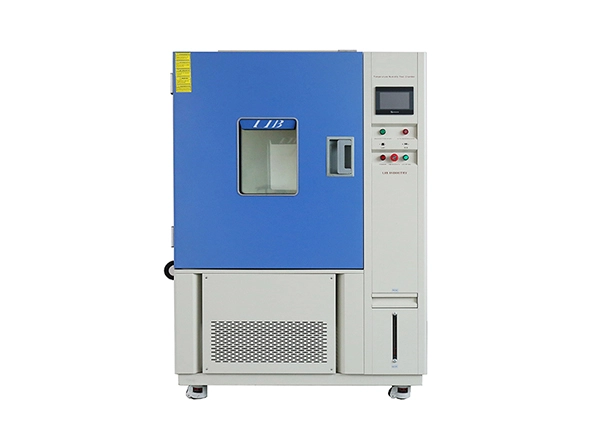
A xenon weatherometer provides an accelerated alternative to long-term outdoor exposure testing. By simulating sunlight, heat, humidity, and rain within a controlled chamber, manufacturers can evaluate the weather resistance of coatings, plastics, textiles, rubber, packaging materials, automotive components, and countless other products.
One of the most common questions engineers and buyers ask is:
“What does 500 or 1000 hours in a xenon weatherometer actually mean?”
Unfortunately, there is no universal conversion between xenon exposure hours and outdoor service life. A 1000-hour xenon test does not automatically equal five years outdoors, nor does 500 hours necessarily represent one year of weather exposure.
To interpret xenon weathering results correctly, it is essential to understand what the test hours represent, what factors influence degradation, and how exposure data should be evaluated.
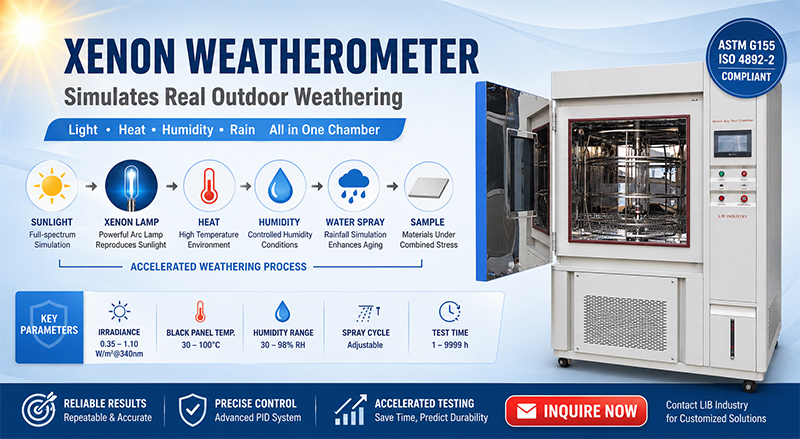
Many engineers and buyers search for a simple conversion between xenon weatherometer hours and outdoor service life. The reality is that no universal conversion exists.
However, test duration is commonly interpreted as follows:
Xenon Test Duration | Typical Purpose |
500 Hours | Material screening and formulation comparison |
1000 Hours | Product qualification and durability validation |
2000 Hours | Long-term weather resistance evaluation |
3000+ Hours | Service life correlation studies |
Rather than representing a specific number of outdoor years, xenon weatherometer hours provide a controlled exposure to light, heat, humidity, and moisture that helps manufacturers compare materials under repeatable laboratory conditions.
There is no general conversion factor between xenon weatherometer hours and outdoor years.
A 1000-hour xenon test does not automatically equal:
5 years in Florida
3 years in Arizona
10 years in Northern Europe
Any other fixed outdoor duration
The relationship depends on numerous variables, including material formulation, exposure cycle, irradiance level, temperature, humidity, water spray conditions, geographic climate, product application, and performance requirements, all of which together determine the final testing outcome and material degradation behavior under simulated environmental conditions.
A better interpretation is that xenon weatherometer testing delivers a controlled dose of light, heat, and moisture that allows manufacturers to compare materials, identify weaknesses, verify product quality, and predict long-term durability trends.
Only when laboratory data has been correlated with actual field exposure history can meaningful service-life estimates be made.
 Outdoor weathering is slow, expensive, and difficult to control.
A plastic enclosure used in a solar inverter may experience intense UV radiation, high daytime temperatures, rainfall, condensation, dust accumulation, and seasonal environmental variation, all of which can accelerate material aging and affect long-term durability. Similarly, an outdoor textile awning may suffer from color fading, strength loss, moisture damage, and surface cracking when exposed to prolonged outdoor environmental stress.
Waiting years for natural exposure results is often impractical.
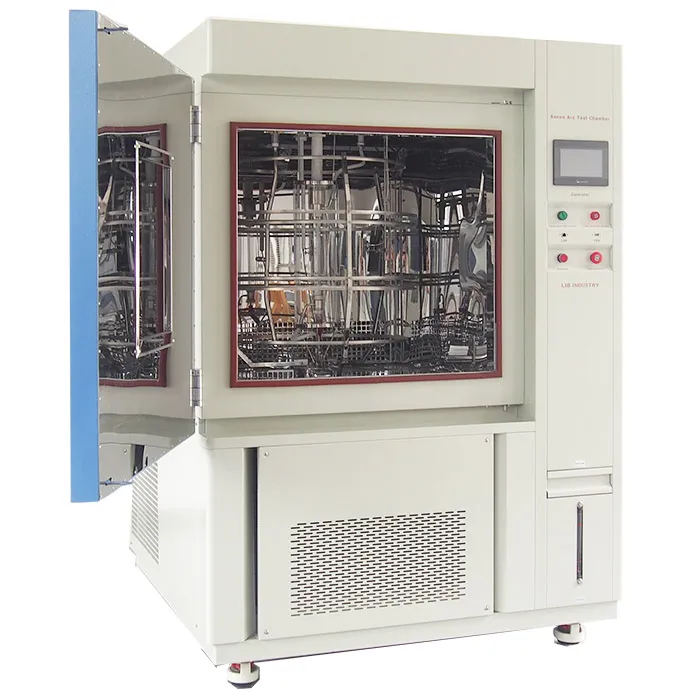
A xenon weatherometer accelerates the process by creating a controlled environment where critical weathering factors can be reproduced and monitored.
Modern xenon chambers allow users to control:
Irradiance
Black panel temperature
Air temperature
Relative humidity
Water spray cycles
Exposure duration
By maintaining consistent test conditions, manufacturers obtain repeatable and comparable weathering data within hundreds or thousands of testing hours.
Unlike UV-only systems, xenon arc lamps can reproduce a full-spectrum sunlight distribution when used with appropriate optical filters, making them particularly suitable for evaluating outdoor durability.
Xenon weatherometer testing is widely used wherever products must survive long-term outdoor exposure.
Exterior trims, coatings, dashboards, plastic housings, weather seals, lighting components, and decorative surfaces frequently undergo ASTM G155 and ISO 4892-2 testing.
Photovoltaic modules, junction boxes, cable insulation, connectors, and outdoor electrical enclosures require accelerated weathering evaluation before deployment.
Architectural coatings, roofing materials, waterproof membranes, sealants, and façade systems often require 1000-hour or longer weathering exposure.
Outdoor furniture, sporting goods, textiles, packaging materials, and consumer electronics rely on xenon weathering data to validate durability and color stability.
A 1000-hour xenon test can be extremely severe for one product and relatively mild for another.Several factors influence how laboratory exposure relates to actual outdoor performance.
Different materials respond differently to xenon exposure.
Carbon-black-filled polypropylene, clear polycarbonate, coated metal panels, painted plastics, and elastomers may exhibit completely different degradation mechanisms.
Stabilizers, pigments, fillers, coatings, additives, and surface finishes all influence weathering resistance and therefore affect any correlation between xenon exposure hours and outdoor service life.
The exposure cycle has a major impact on test severity.
A chamber operating at 0.35 W/(m²·nm) at 340 nm delivers a different radiant dose than a chamber operating at 0.51 W/(m²·nm).
Increasing irradiance may shorten testing time, but it can also alter degradation mechanisms and produce unrealistic failure modes if not carefully controlled.
Weathering damage is rarely caused by sunlight alone.
Temperature can accelerate chemical reactions.
Humidity can promote:
Hydrolysis
Swelling
Adhesion loss
Corrosion
Staining
Water spray introduces additional thermal and moisture cycling that can significantly affect material performance.
Outdoor exposure varies significantly depending on:
Geographic location
Solar intensity
Humidity
Rainfall
Pollution
Mounting angle
Seasonal variation
Therefore, the same xenon exposure duration may correlate differently across applications and regions.
Exposure hours alone do not determine success or failure.
Meaningful weathering evaluations should focus on measurable performance changes such as:
Color change (ΔE)
Gloss retention
Haze
Yellowness index
Tensile strength retention
Impact resistance
Chalking
Cracking
Adhesion performance
For example:
“Passed 1000 hours” provides limited information.
“After 1000 hours, ΔE = 1.8 and gloss retention = 82%” provides meaningful engineering data.
The testing standard and exposure cycle dramatically affect the interpretation of xenon weatherometer hours.
Test Reference | Common Parameter Set | What 500 and 1000 Hours Represent |
ASTM G155 Cycle 1 | Daylight filter; 0.35 W/(m²·nm) at 340 nm; 102 min light at 63°C BPT; 18 min spray | 500 h ≈ 630 kJ/(m²·nm); 1000 h ≈ 1260 kJ/(m²·nm) |
ISO 4892-2 Method A Cycle 1 | Daylight filter; 0.51 W/(m²·nm) at 340 nm; 65°C BST; RH 50% | 500 h ≈ 918 kJ/(m²·nm); 1000 h ≈ 1836 kJ/(m²·nm) |
This illustrates why two tests with identical exposure hours may represent significantly different weathering doses.
A 500-hour xenon weatherometer test is commonly used as an early-stage screening tool.
At this duration, engineers can often identify:
Poor UV stabilizers
Unstable pigments
Weak coatings
Premature chalking
Yellowing
Surface cracking
Typical questions answered by a 500-hour test include:
Does the new pigment fade faster?
Does gloss retention meet requirements?
Does moisture cause blistering?
Are mechanical properties maintained?
For product development teams, 500 hours often provides sufficient information to eliminate unsuitable materials before committing to longer qualification programs.
A 1000-hour xenon exposure roughly doubles the light dose, thermal exposure, and moisture cycling compared with a 500-hour test performed under the same conditions.
As a result, 1000-hour testing is often used for:
Product qualification
Customer approval
Supplier validation
Material comparison
Long-term durability assessment
Rather than asking:
“How many years does 1000 hours equal?”
A more useful question is:
“How much did the material change after 1000 hours?”
Monitoring performance at intervals such as:
0 h
250 h
500 h
750 h
1000 h
helps engineers understand degradation trends and identify whether changes are gradual, accelerating, or stabilizing.
Although both durations are widely used, they serve different objectives.
Parameter | 500 Hours | 1000 Hours |
Primary Purpose | Screening | Qualification |
Light Dose | Moderate | High |
Moisture Exposure | Moderate | Extended |
Failure Detection | Early degradation | Long-term performance |
Typical Use | R&D and material selection | Customer approval and certification |
For many manufacturers, a 500-hour test identifies unsuitable materials, while a 1000-hour test provides stronger confidence before commercial release.
Understanding xenon weatherometer results requires more than simply looking at the number of exposure hours.
No universal conversion exists because outdoor weathering conditions vary dramatically between climates and applications.
ASTM G155 and ISO 4892-2 often use different irradiance levels, temperatures, humidity settings, and spray cycles.
Therefore, identical exposure hours may not represent equivalent weathering doses.
Many failures are caused by moisture-related degradation rather than UV radiation alone.
Hydrolysis, blistering, delamination, and adhesion loss can all be strongly influenced by humidity and spray cycles.
The focus should always be on property changes such as color, gloss, strength, adhesion, and appearance—not simply total exposure duration.
Increasing irradiance may accelerate testing, but excessive irradiance can introduce unrealistic degradation mechanisms that do not represent actual field conditions.
When reporting xenon weatherometer results, laboratories should document all major exposure conditions and performance measurements. This information allows the test to be reproduced and helps customers correctly interpret the results.
Report Section | Information to Record |
Specimens | Material, color, thickness, surface finish, quantity |
Chamber Settings | Filter type, irradiance, temperature, humidity, spray cycle, total hours |
Measurements | ΔE, gloss, haze, strength retention, adhesion, photographs |
Interpretation | Pass/fail criteria, trend analysis, control comparison |
|  |
 | |
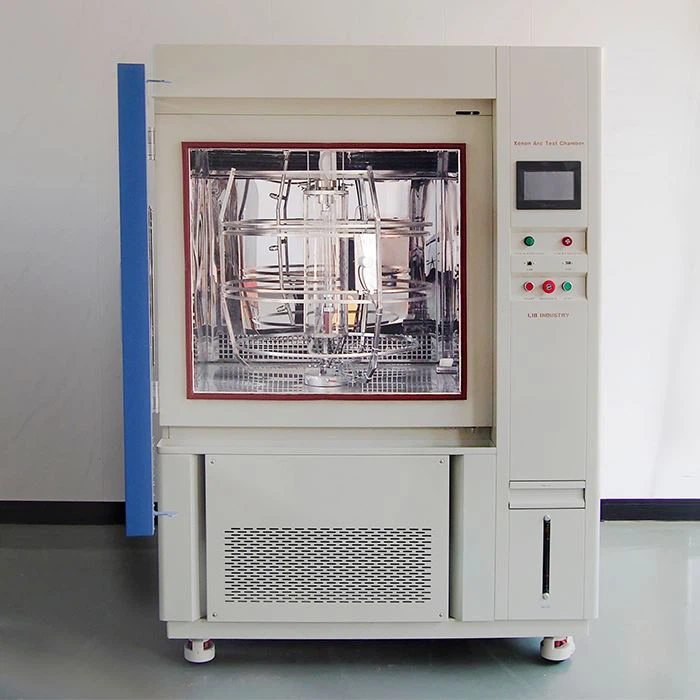
Model | XL-S-750 Xenon Arc Weathering Test Chamber |
Internal Dimension (mm) | 950*950*850 mm |
Overall Dimension (mm) | 1300*1420*1800 mm |
Sample holder | Adjustable speed, 1r /min |
Chamber Type | Rotating Holder |
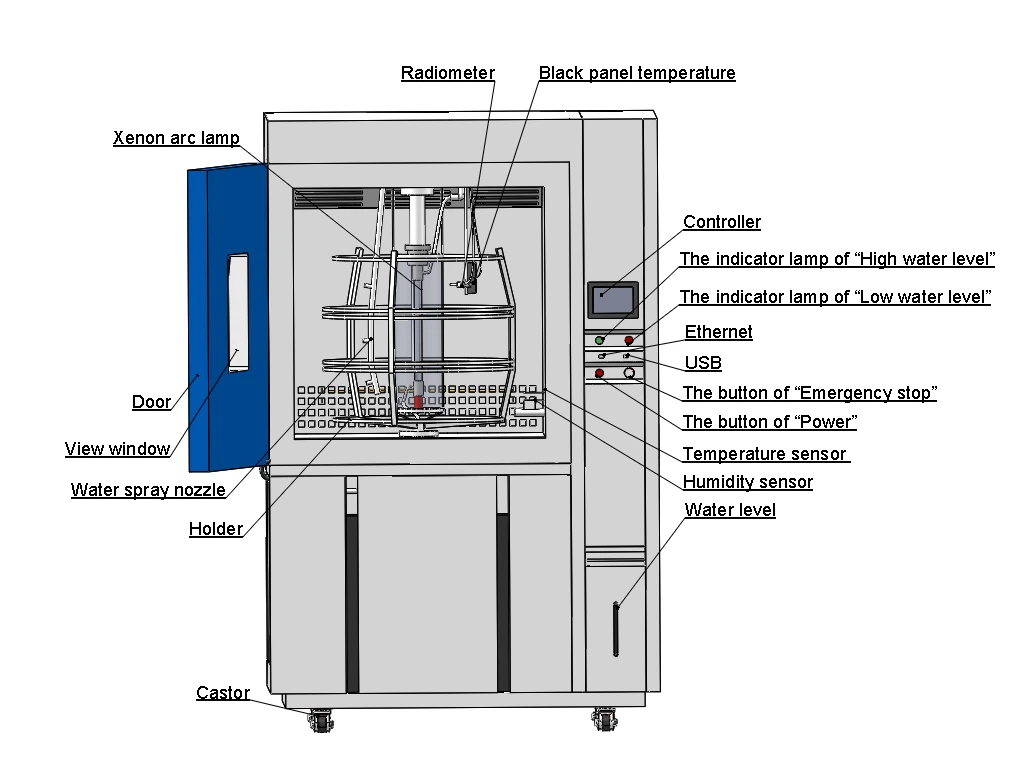
Irradiation Source | 1 piece of 4500w water-cooled xenon arc lamp with inner quartz and outer borosilicate filter |
Irradiance Range | 150 W/㎡ |
Bandwidth Measurement | 300~400 nm |
Chamber Temperature Range | -40~ 100 ℃ ±2 ℃ |
Black Panel Temperature | BPT 35 ~ 85 ℃ ±2 ℃ |
Humidity Range | 30 % ~ 98 % RH |
Water Spray Cycle | 1~9999 H 59 M (Adjustable) |
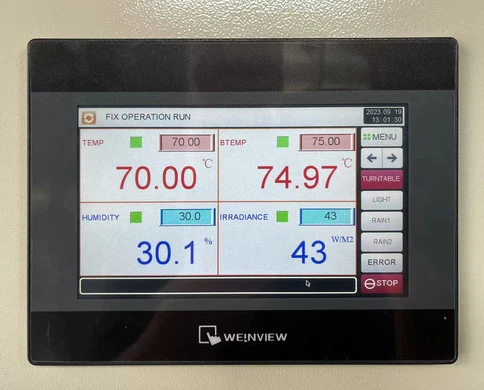
Controller | Programmable color LCD touch screen controller |
Radiometer | UV Radiometer, Tolerance: ±5 % |
Multi-standard compatibility including ASTM G155, ISO 4892-2, and SAE J2527
|
|
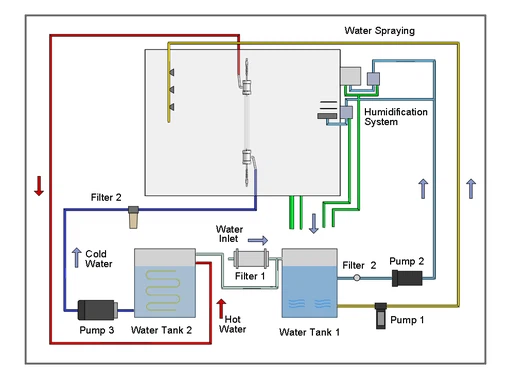
xenon lamp and filters
 |  |
 |
|
| Spraying system provides uniform water over specimens. Automatic water supply, filtration, and drainage ensure uninterrupted long-term testing. | |
LIB Industry designs xenon weatherometers for laboratories and manufacturers requiring repeatable accelerated weathering data.
Key advantages include:
Full-spectrum xenon arc lamp simulating natural sunlight
ASTM G155 and ISO 4892-2 compliant testing
Irradiance control from 35–150 W/m²
Black panel temperature control up to 100°C
Humidity control from 50% to 98% RH
Automatic water spray and moisture cycling
Rotating specimen holder for uniform exposure
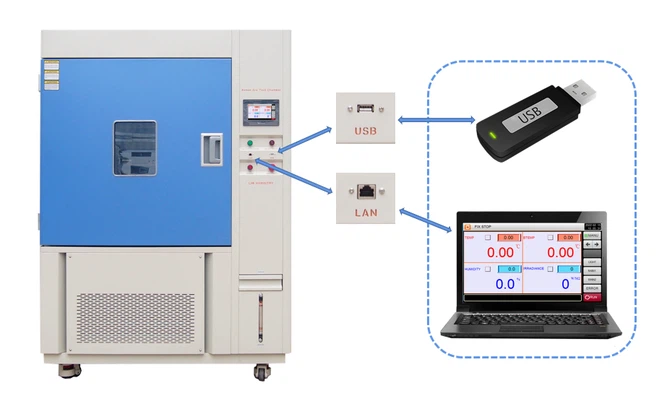
Programmable touchscreen controller with data logging
These features help laboratories generate consistent weathering results that can be reproduced and compared across different projects and material batches.
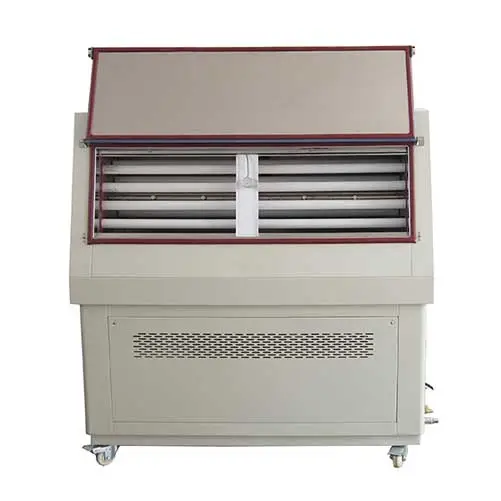
Provides accelerated ultraviolet exposure testing for coatings, plastics, and polymer materials according to ASTM G154. | Combines solar radiation, temperature, and humidity for comprehensive outdoor durability evaluation. |
Performs environmental aging and stability testing under controlled climatic conditions. |
Whether you require a 500-hour screening test, a 1000-hour qualification program, or a customized weathering validation plan, LIB Industry can help determine the most appropriate ASTM G155 or ISO 4892-2 test cycle for your material.
Our engineers provide:
Test standard consultation
Xenon chamber selection support
Customized weathering programs
Sample evaluation recommendations
Global installation and technical support
3-year warranty and lifetime technical support
Contact LIB Industry today to discuss your accelerated weathering testing requirements.
No. There is no universal conversion between xenon weatherometer hours and outdoor exposure years. The relationship depends on the material, exposure conditions, climate, and performance requirements.
There is no fixed answer. A 1000-hour test represents a controlled laboratory exposure dose rather than a direct calendar-year equivalent. Correlation requires supporting field exposure data for the same material and application.
Outdoor weathering varies with location, solar intensity, rainfall, humidity, pollution levels, temperature, and mounting conditions. Xenon weatherometers provide controlled laboratory conditions that improve repeatability but cannot eliminate all environmental differences.
Reports should include the testing standard, exposure cycle, irradiance level, environmental conditions, total exposure hours, measured property changes, and pass/fail criteria rather than focusing solely on test duration.
The most widely used standards include ASTM G155 and ISO 4892-2. Additional industry-specific standards may reference xenon arc exposure procedures for automotive, plastics, coatings, textiles, and construction materials.
 English
 русский
 français
 العربية
 Deutsch
 Español
 한국어
한국어 italiano
 tiếng việt
 ไทย
ไทย Indonesia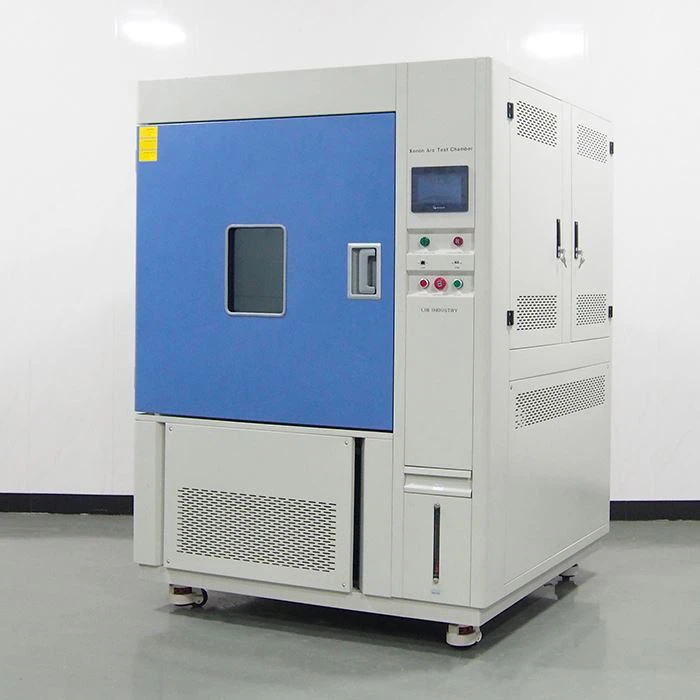


 Solar Climatic Chamber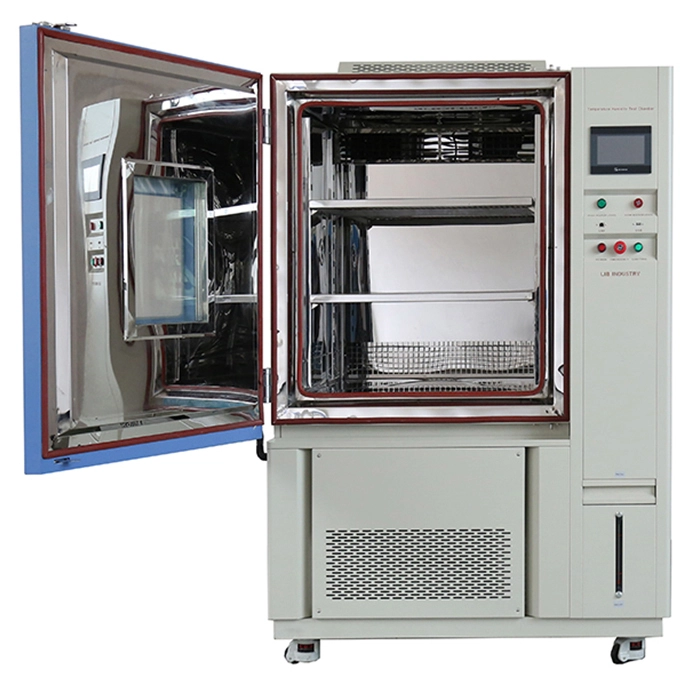
.webp "Coil Steel Sunshine Carbon Arc Weathering Tester")