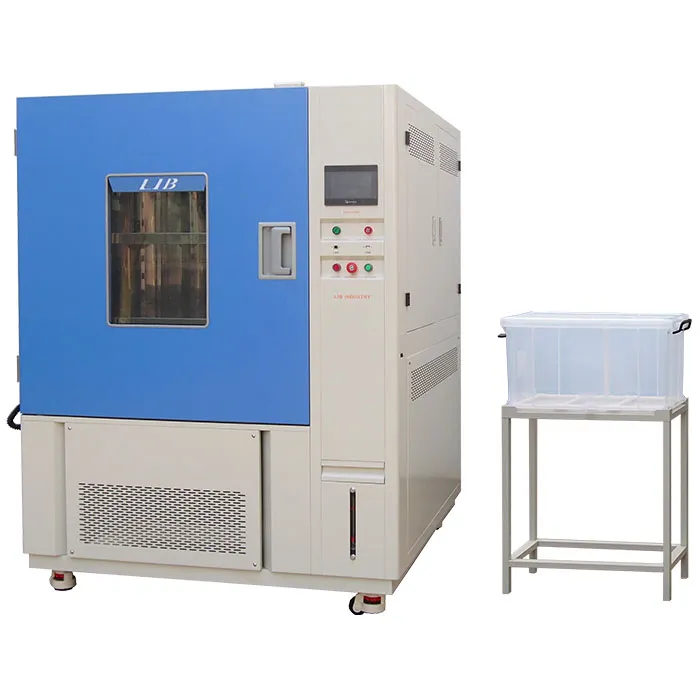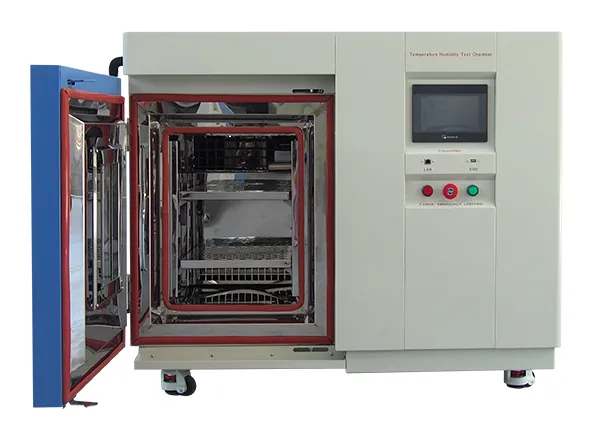
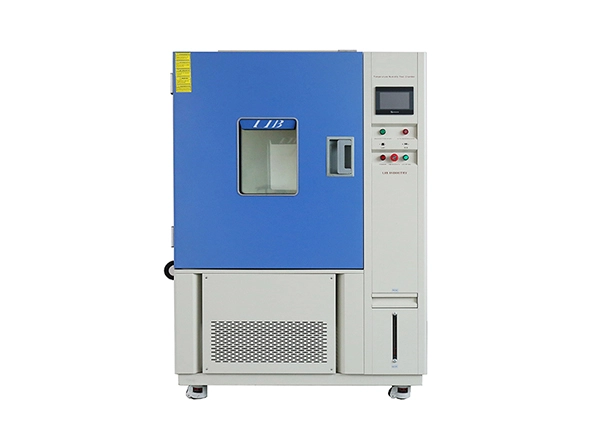
Outdoor materials are constantly exposed to sunlight, humidity, temperature changes, and oxygen, which gradually trigger photoaging—a slow degradation process affecting most non-metallic materials.Typical failures include plastic embrittlement, coating discoloration, surface cracking, gloss loss, and reduced mechanical strength. The challenge is that these changes are often not visible in early testing but become critical in real-world use, leading to costly repairs or product failure.
To address this uncertainty, accelerated weathering testing has become essential in material development and quality control. Among international standards, ASTM G155 is one of the most widely adopted methods for xenon arc-based full-spectrum weathering simulation.An ASTM G155 Weathering Test Chamber reproduces years of outdoor exposure within weeks under controlled conditions.
The ASTM G155 standard defines the use of xenon arc light sources to simulate full-spectrum sunlight exposure combined with controlled environmental stress factors. The goal is not just to “expose” a sample, but to reproduce realistic outdoor degradation mechanisms.
A complete ASTM G155 simulation typically involves three coordinated stress factors:
Solar radiation includes ultraviolet (UV), visible light, and infrared (IR). Although UV accounts for a small portion of total sunlight, it is the primary cause of polymer chain breakage, discoloration, and surface degradation. Visible and infrared radiation mainly contribute to thermal aging and heat-related deformation.
The ASTM G155 standard uses a xenon arc lamp system as its core light source. With precision optical filtering, the system produces a continuous spectrum closely matching natural sunlight, typically covering 295–800+ nm.
Key spectral ranges include:
UV: 295–400 nm (photo-degradation activation zone)
Visible: 400–760 nm (color and appearance stability)
IR: >760 nm (thermal aging effect)
This full-spectrum simulation enables accurate evaluation of:
Color fading (ΔE shift)
Gloss loss
Surface cracking and embrittlement
Polymer oxidation behavior
Compared with UV-only systems, xenon arc testing provides higher correlation with real outdoor aging, especially for coatings, plastics, and automotive materials.
Moisture is a key driver of outdoor material failure. Rain, humidity, and dew formation accelerate hydrolysis, swelling, and coating degradation in polymers and composites.
ASTM G155 chambers integrate a programmable deionized water spray system and controlled humidity condensation cycle to reproduce natural wet-dry transitions.
Typical parameters include:
Spray cycle: programmable (0–99 min)
Relative humidity: up to 95–100% RH
Water quality: deionized water (≤ 20 μS/cm conductivity)
Cycle modes: light exposure ↔ dark condensation
This enables simulation of real environmental conditions such as:
UV exposure followed by rainfall impact
Nighttime condensation and moisture absorption
Thermal shock caused by rapid temperature changes
Temperature significantly influences photochemical reaction rates and material aging speed. Higher temperatures accelerate oxidation and polymer degradation processes.
ASTM G155 systems use Black Panel Temperature (BPT) or Black Standard Temperature (BST) sensors to monitor specimen surface conditions.
Typical control range:
BPT: 40°C to 110°C
Chamber temperature: ambient to ~100°C
Accuracy: ±1–2°C
The system integrates heating, airflow circulation, and optional cooling control to maintain stable thermal conditions throughout the test cycle.
This ensures the specimen surface closely replicates real outdoor solar heating conditions, improving:
Test repeatability
Acceleration consistency
Cross-laboratory data comparability
A high-performance ASTM G155 system must ensure long-term stability, repeatability, and uniform environmental exposure. LIB industry designs its weathering test systems around these engineering principles to maintain scientific reliability across long-duration testing.
Rather than relying on single-point control, the system integrates multi-layer monitoring and feedback mechanisms to maintain consistency.
Maintain stable irradiance output over long test cycles
Ensure uniform environmental exposure across all specimens
Minimize performance drift caused by component aging
Support continuous operation with minimal recalibration
A key challenge in xenon arc testing is maintaining consistent light intensity over time. LIB industry systems address this through:
Precision xenon arc lamp integration
High-stability optical filtering system
Real-time irradiance monitoring
Automatic output compensation for lamp aging
This closed-loop system ensures that irradiance levels remain stable even during long-duration accelerated aging tests, improving data reliability and repeatability.
Uniform exposure is critical for ensuring that all test samples experience identical aging conditions. The system integrates multiple mechanisms to achieve this consistency:
| System Component | Function |
|---|---|
| Rotating sample rack | Ensures even 360° exposure to radiation |
| Distributed spray system | Simulates uniform rainfall exposure |
| Controlled airflow system | Maintains consistent humidity distribution |
| Black panel temperature control | Stabilizes thermal exposure conditions |
This multi-point environmental balancing design reduces experimental deviation and improves comparability between test batches.
In real laboratory environments, equipment may be relocated or integrated into different testing workflows. Mechanical and structural stability is therefore essential.
Key design considerations include:
Reinforced frame structure for vibration resistance
Protected sensor layout to prevent misalignment during transport
Modular system architecture for easier maintenance
Stable recalibration performance after relocation
This ensures that the system can resume accurate operation after installation changes without extensive recalibration or downtime.
ASTM G155 testing is widely used across industries where long-term environmental durability is critical.
Automotive exterior and interior components
Architectural coatings and building materials
Plastic housings and engineering polymers
Outdoor electronic enclosures
Textile and fiber materials
The primary value lies in predicting long-term performance before real-world exposure occurs. Instead of waiting months or years for natural weathering results, manufacturers can obtain accelerated insights within weeks.
This significantly improves:
Product development speed
Material selection accuracy
Quality assurance reliability
Warranty risk control
Different weathering standards serve different purposes. Understanding their differences is essential for building an effective testing strategy.
| Feature | ASTM G155 | ASTM G154 |
|---|---|---|
| Light Source | Xenon arc lamp | Fluorescent UV lamp |
| Spectral Range | Full spectrum (UV + visible + IR) | Narrow UV range |
| Realism | High outdoor simulation accuracy | Accelerated UV degradation focus |
| Moisture Method | Spray + condensation cycles | Condensation only |
| Best Use Case | Appearance, color stability, full material aging | Cracking, brittleness, UV resistance screening |
ASTM G155 is preferred when realistic simulation of outdoor exposure is required, especially for products where appearance and long-term stability are critical.
ASTM G154 is more suitable for early-stage material screening where rapid UV-induced degradation indicators are needed.
Many laboratories combine both methods to achieve a more complete understanding of material performance under different degradation mechanisms.
Integrated Testing Strategy for Real-World Durability
In real applications, materials are not exposed to a single stress factor. Instead, they experience a combination of:
Solar radiation
Moisture and humidity
Salt exposure (in coastal environments)
Temperature cycling
Mechanical stress
To replicate this complexity, manufacturers often combine multiple test systems:
Xenon arc weathering (ASTM G155) for full-spectrum aging
UV aging (ASTM G154) for rapid photodegradation screening
Salt spray testing for corrosion resistance evaluation
This integrated approach provides a more complete durability profile and reduces unexpected field failures.
Accuracy is maintained through strict control of irradiance, temperature, and humidity parameters. Regular calibration using ISO 17025-certified laboratories is recommended, typically once per year, to ensure compliance and data traceability.
Uniform exposure is achieved through rotating sample racks or evenly distributed flat specimen layouts. Rotation ensures that all samples receive equal radiation, moisture, and thermal exposure throughout the test cycle.
Standard systems are typically delivered within 3–4 weeks. Each unit undergoes factory pre-testing and is shipped using reinforced export packaging with vibration protection for sensitive optical and electronic components.
Support typically includes long-term warranty coverage (excluding consumables such as xenon lamps), remote technical assistance, software updates, and global spare parts supply to ensure continuous system operation.
The ASTM G155 Weathering Test Chamber plays a critical role in transforming unpredictable natural weathering into measurable and controllable laboratory data. By replicating full-spectrum sunlight, moisture cycling, and thermal stress, it enables manufacturers to understand how materials will behave over long-term outdoor exposure.
With advanced optical control, stable environmental simulation, and robust engineering design, modern systems such as those developed by LIB industry provide a reliable foundation for accelerated durability testing.
In today’s competitive manufacturing landscape, product performance is no longer judged only at launch—it is defined by how well it survives years of environmental exposure. Accelerated weathering testing ensures that this performance can be predicted, optimized, and validated long before products reach the field.
 English
 русский
 français
 العربية
 Deutsch
 Español
 한국어
한국어 italiano
 tiếng việt
 ไทย
ไทย Indonesia
.webp "SO2 Gas Cyclic Salt Fog Corrosion Spray Chamber")