Coated steel materials such as galvanized steel, aluzinc (galvalume), and pre-painted steel (PPGI/PPGL) are widely used in construction, automotive components, solar mounting systems, and electrical enclosures. Their performance is largely determined by the protective coating system applied to the steel substrate.
Although these coatings provide excellent corrosion resistance under normal environmental conditions, they are still vulnerable when exposed to chloride-rich environments, humidity, and temperature variations. Over time, corrosion may initiate through coating defects, cut edges, or micro-cracks, leading to typical failure mechanisms such as white rust formation on zinc-based coatings, red rust once the steel substrate is exposed, and paint blistering or delamination in pre-painted systems.
To evaluate these degradation processes in a controlled and accelerated way, manufacturers rely on neutral salt spray testing conducted in a salt spray test chamber under standardized conditions such as ASTM B117 and ISO 9227 NSS. This method allows engineers to simulate long-term corrosion exposure within a significantly shortened time frame, making it a standard quality control and material validation tool across multiple industries.
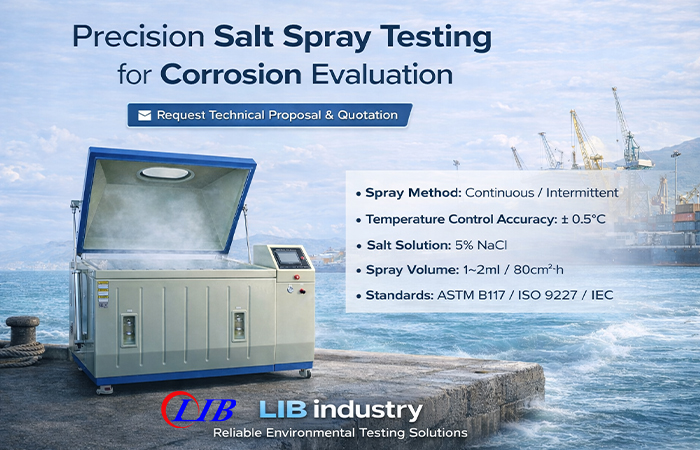
The most widely adopted standards for salt spray testing of coated steel are ASTM B117 and ISO 9227 NSS. Both define neutral salt spray conditions used to evaluate corrosion resistance under controlled laboratory environments.
In general, NSS (Neutral Salt Spray) testing is performed under the following conditions:
Parameter | Requirement |
Solution | 5% NaCl aqueous solution |
Chamber Temperature | 35°C ±2°C |
pH Value | 6.5–7.2 |
Salt Fog Deposition | 1–2 mL / 80 cm² / hour |
ASTM B117 and ISO 9227 are closely aligned in terms of test environment, although they differ in documentation structure, classification systems, and reporting formats. In practice, both standards are used interchangeably in many industrial specifications for coated steel products.
Depending on application requirements, test durations may range from 240 hours for basic quality checks to 1000 hours or more for high-performance coatings. The evaluation focuses on the appearance and progression of corrosion, including white rust formation, red rust propagation, and coating integrity degradation.
A reliable salt spray test is not only defined by chamber conditions but also by how specimens are prepared, positioned, and evaluated. For coated steel materials, these steps are critical to ensure repeatable and meaningful results.

 3.1 Sample Preparation
Before testing, coated steel sheets must be properly cut and prepared according to laboratory standards. Edge sealing is often required, especially for galvanized and pre-painted steel, to prevent premature corrosion from exposed cut edges that could distort results. Surface cleaning is also essential to remove oil, dust, or residues that may affect corrosion behavior.
To support different sample types, LIB salt spray test chambers are equipped with customizable specimen holders designed to securely fix steel panels of varying dimensions while maintaining corrosion-resistant contact surfaces.
Proper sample positioning directly affects salt deposition and test repeatability. Standards typically require specimens to be inclined at an angle between 15° and 30°, ensuring that condensate and salt solution do not accumulate on the surface.
To meet this requirement, LIB chambers feature adjustable sample racks and modular rack systems that allow precise angle control. For laboratories handling different product geometries, optional custom sample fixtures can be designed to ensure stable and uniform exposure conditions.
 3.3 Salt Fog Generation and Exposure Stability
The core of any salt spray system is its ability to generate a stable and uniform salt fog environment. In ASTM B117 testing, continuous and consistent atomization of a 5% NaCl solution is required to maintain exposure stability throughout long test cycles.
LIB salt spray test chambers utilize a precision spray tower system designed to ensure uniform fog distribution inside the chamber. The system incorporates controlled air pressure atomization and solution filtration mechanisms to prevent nozzle clogging and salt crystallization, maintaining consistent spray performance during extended operation.
Since salt spray testing often runs continuously for hundreds or even thousands of hours, uninterrupted monitoring is essential. Opening the chamber frequently can disrupt internal temperature stability and test accuracy.
 To address this, LIB designs include a high-transparency observation window that allows operators to visually inspect specimens without interrupting the test process. Optional internal lighting further improves visibility during long-duration tests or low-light laboratory environments.
Modern corrosion testing increasingly relies on automation to improve repeatability and reduce operator intervention. Programmable control systems allow laboratories to define test parameters, cycle durations, and alarm conditions in advance.
LIB salt spray test chambers are equipped with PLC-based programmable controllers that support continuous and multi-stage test programming. Users can set automatic operation cycles, monitor system status in real time, and store test data for traceability and reporting purposes.
Choosing the appropriate chamber size and configuration depends primarily on specimen dimensions, testing volume, and laboratory capacity requirements.
Model | Capacity | Application |
S-150 | 160 L | Small-scale laboratory testing and R&D |
S-250 | 270 L | Routine quality control and standard testing |
S-750 | 750 L | Large steel panels and batch testing |
All LIB salt spray test chambers are designed to comply with ASTM B117 and ISO 9227 NSS requirements, ensuring consistent and standardized corrosion testing performance across different model sizes.
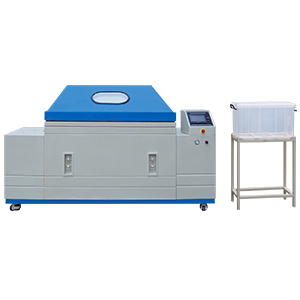
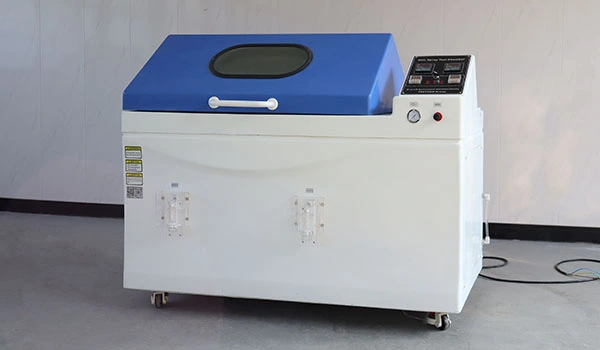
The chamber adopts a one-piece fiberglass reinforced plastic (FRP) structure, providing excellent corrosion resistance and long-term durability under continuous salt fog exposure. This integrated molding design helps eliminate potential leakage points and improves overall structural stability during long-duration testing.
Key internal components in contact with the salt spray environment are made of SUS304 stainless steel to ensure resistance against corrosion and maintain stable operation under ASTM B117 and ISO 9227 NSS test conditions. The viewing window is designed with transparent, corrosion-resistant material, allowing real-time observation without affecting internal temperature or humidity stability.
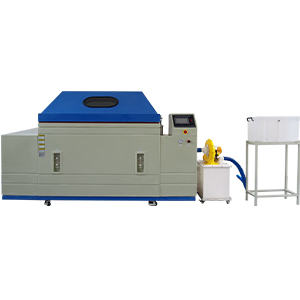
The system uses a corrosion-resistant spray tower with quartz nozzles to ensure uniform salt fog distribution. Spray pressure is maintained at around 83 kPa, supporting a consistent deposition rate of 1–2 mL/80 cm²·h as required by ASTM B117.
A built-in salt solution tank ensures continuous supply of 5% NaCl solution with pH controlled between 6.5 and 7.2. This helps maintain stable neutral salt spray (NSS) conditions and reduces variation in test results.
Standard V-groove and rod-type sample holders allow specimens to be positioned at adjustable angles (typically 15°–30°), ensuring uniform exposure for different coated steel samples. Custom fixtures are available for non-standard test pieces.
A PLC touchscreen controller enables programmable test cycles and real-time monitoring of temperature and spray time. Test data can be recorded and exported via USB or Ethernet for traceability and reporting.
A built-in salt spray collector with measuring cylinder allows verification of deposition rate, ensuring compliance with ASTM B117 test requirements and improving result reliability.
Salt spray testing of coated steel is widely used across industries where corrosion resistance is critical. Typical applications include roofing sheets, wall cladding, structural steel, solar mounting systems, automotive sheet metal parts, household appliance housings, and electrical enclosures.
Common test specimens include galvanized steel (GI), aluzinc or galvalume (Zn-Al coated steel), and pre-painted steel (PPGI/PPGL). These materials are generally evaluated under neutral salt spray conditions in accordance with ASTM B117 and ISO 9227 NSS, which provide a standardized accelerated corrosion environment for comparative testing.
In addition to test method standards, material and coating specifications such as ISO 1461 for hot-dip galvanized coatings, ASTM A653 for zinc-coated steel sheet, and EN 10346 for continuously coated steel are often referenced in industrial quality requirements. These standards help define coating performance expectations, while ASTM B117 and ISO 9227 are used to simulate corrosion behavior under laboratory conditions.
By combining standardized materials and test methods, salt spray testing helps manufacturers evaluate coating durability, compare different material systems, and ensure long-term performance in real service environments.
Need a reliable salt spray test chamber for ASTM B117 and ISO 9227 corrosion testing? LIB provides professional corrosion testing equipment with accurate performance, stable operation, and customizable solutions for coated steel and industrial material evaluation. Contact us today to discuss your testing requirements and get a suitable chamber solution.
Cyclic Salt Fog Corrosion Test Chamber Combines salt spray, humidity, and drying cycles to simulate more realistic outdoor corrosion environments. | ||
Simulates full-spectrum sunlight with controlled irradiance and water spray system. |
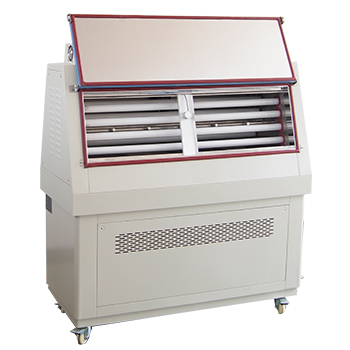
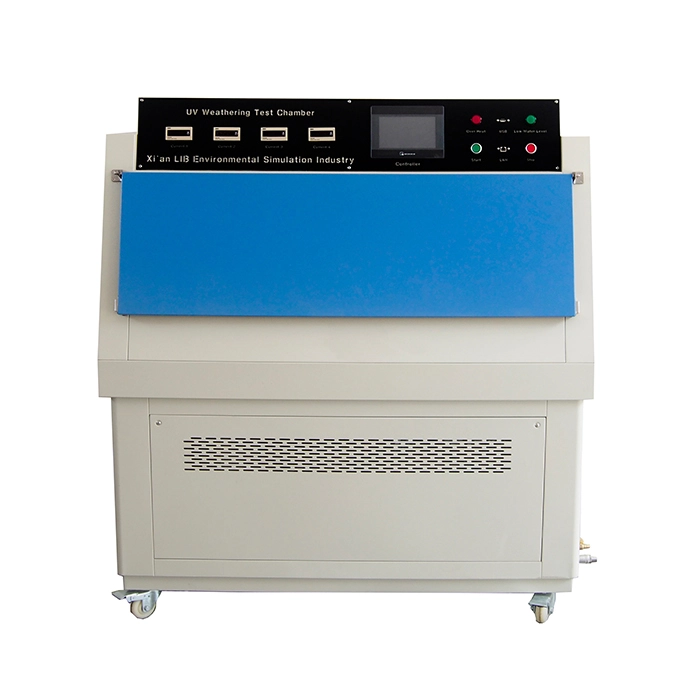
Uses UV fluorescent lamps to simulate accelerated UV degradation. |
LIB salt spray test chambers are designed to meet multiple international standards including ASTM B117, ISO 9227 NSS, JIS Z2371, and GB/T 10125, making them suitable for global quality testing requirements.
Yes. A single salt spray test chamber can be used for all coated steel types as long as the test conditions follow NSS requirements. The main differences lie in evaluation criteria rather than chamber configuration.
Evaluation is typically based on corrosion appearance, including white rust percentage, red rust formation, and coating degradation, following ISO 4628 or relevant industry grading systems.
LIB provides a 3-year warranty, lifetime technical support, spare parts supply, remote troubleshooting assistance, and optional on-site service depending on customer requirements.
Yes. LIB can provide customized solutions including chamber size, sample rack design, control system configuration, automation functions, and voltage or language requirements for different laboratory environments.
 English
 русский
 français
 العربية
 Deutsch
 Español
 한국어
한국어 italiano
 tiếng việt
 ไทย
ไทย Indonesia