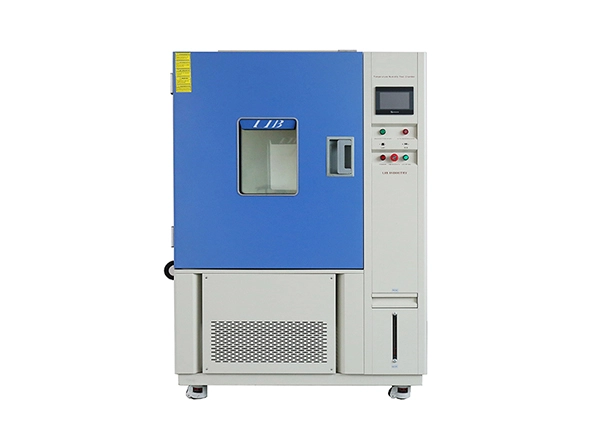
_20260427153729.webp) Standards, Applications & LIB Industry Equipment Guide
Standards, Applications & LIB Industry Equipment Guide
Building products are constantly subjected to severe environmental weathering: solar radiation, ambient heat, morning dew, and heavy rainfall occur simultaneously. Over time, exterior coatings lose their gloss and color, plastic profiles turn brittle and yellow, and roofing membranes harden under repeated wet-dry cycles. Because waiting years for outdoor exposure data is impractical for fast-paced manufacturing cycles, laboratories rely on a UV Accelerated Weathering Tester to simulate outdoor aging damage in a controlled, repeatable environment.
This guide covers weathering degradation mechanisms, material-specific testing applications, international testing standards (ASTM G154, ISO 4892-3, ASTM D4587), standard execution workflows, and turnkey chamber solutions from LIB Industry — so you can spec a test program that actually holds up to scrutiny.
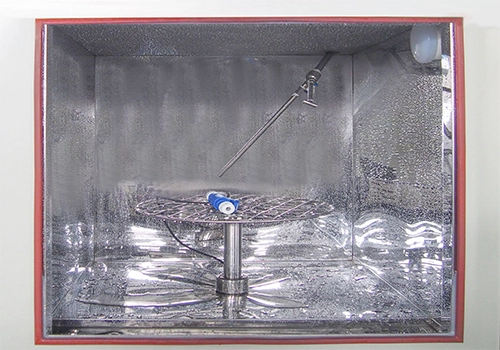
A UV weathering chamber exposes test specimens to alternating cycles of fluorescent ultraviolet light, elevated temperatures, and moisture via condensation or water spray. This cyclic exposure accelerates photochemical degradation far beyond natural outdoor rates — compressing years of real-world damage into weeks of test data.
Stressor | Resulting Degradation |
UV Photons / Radiation | Polymer chain scission & free radical formation |
Elevated Chamber Temperature | Accelerated oxidation & softening |
Condensation / Spray | Hydrolysis, blistering & delamination |
Coating development teams can benchmark novel façade finishes against incumbent products in weeks rather than years. By tracking color shift (ΔE), gloss retention, chalking, and adhesion loss at preset intervals, weak formulations are eliminated early — saving significant development time and cost.
Shifts in pigment sources, resin batches, UV stabilizer concentrations, or curing parameters alter a material's weatherability. Running archival reference panels alongside new production batches under identical test conditions lets manufacturers catch raw material deviations before they ever reach the field.
Accelerated weathering data only supports service-life prediction when the chamber faithfully reproduces outdoor failure mechanisms. Good practice means testing at least three replicate samples per condition, using robust positive and negative controls, and validating chamber data against actual field climate exposure — anything less leaves your claims exposed to challenge.
Different building products fail under unique environmental stressors. Selecting the correct lamp type, moisture cycle, and evaluation metric isn't a formality — get it wrong and your data won't reflect how the product actually fails in the field.
Façade coatings, coil-coated metals, and wood finishes are evaluated for color change, blistering, and adhesion drop. Because dark-colored coatings absorb more solar radiation and reach higher surface temperatures, black-panel temperature control is critical when comparing pigmented systems.
Vinyl siding, window frames, and exterior sealants undergo yellowing, surface crazing, and embrittlement. Post-exposure mechanical testing (tensile strength, impact resistance, and elongation) reveals polymer chain degradation before catastrophic field cracking occurs.
Asphalt products and single-ply waterproofing membranes face intense solar radiation followed by prolonged water ponding. Programmed cycles combining UV light, water spray, and condensation replicate these conditions, measuring post-exposure peel strength, flexibility, and puncture resistance.
While bare structural concrete primarily faces carbonation and freeze-thaw cycles, polymer-modified mortars, sealants, and exterior coatings depend entirely on UV-stable organic binders. Weathering tests monitor surface chalking, blistering, and pull-off adhesion loss.
Reporting a standard name alone is insufficient — test reports must detail the specific lamp type, irradiance level, black-panel temperature, moisture cycle timing, and evaluation criteria, or the data won't be defensible to auditors, customers, or regulators.
Standard | Typical Use |
ASTM G154 | General nonmetallic materials (UVA-340 / UVB-313) |
ISO 4892-3 | Plastics exposed to fluorescent UV lamps |
ASTM D4587 | Paints and related protective coatings |
SAE J2020 | Exterior automotive and polymeric components |
Standard | Application | Example Parameters | Evaluation Focus |
ASTM G154 | Nonmetallic materials & coatings | Cycle 1: UVA-340 at 0.89 W/(m²·nm); 8h UV at 60°C, then 4h condensation at 50°C | Comparative screening & general weathering resistance |
ISO 4892-3:2024 | Plastics exposed to fluorescent UV | Method A, Cycle 1: UVA-340 at 0.76 W/(m²·nm); 8h dry at 60°C, then 4h condensation at 50°C | Polymer yellowing, embrittlement, tensile retention |
ASTM D4587 | Paints & protective metal coatings | 8h UV at 0.89 W/(m²·nm) (60°C), then 4h condensation (50°C) | Blistering, chalking, adhesion loss, color shift |
SAE J2020 | Exterior polymeric components | 8h UV at 70°C (UVB target 0.48 W/(m²·nm) at 310nm), then 4h condensation (50°C) | Accelerated automotive & severe exterior screening |
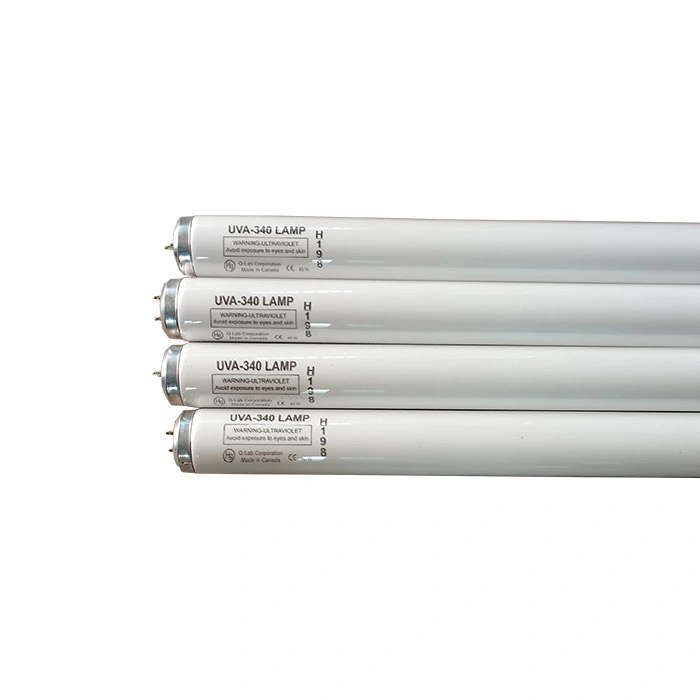
Lamp Selection Note: UVA-340 lamps provide an excellent simulation of solar spectrum short-wave UV down to the solar cut-off (295 nm). UVB-313 lamps emit high-energy short-wave UV below the natural solar cutoff, providing aggressive, rapid screening but occasionally causing unnatural polymer degradation pathways.
A disciplined testing protocol minimizes data scatter and ensures your results hold up when reproduced across different testing laboratories.
Step 1 | Sample preparation & baseline measurement (color, gloss, mass) |
|
Step 2 | Specimen mounting (exposed face toward lamps, zero gaps) | |
Step 3 | Chamber programming (set standard cycle, temp, irradiance) | |
Step 4 | Isothermal UV exposure & moisture/condensation cycling | 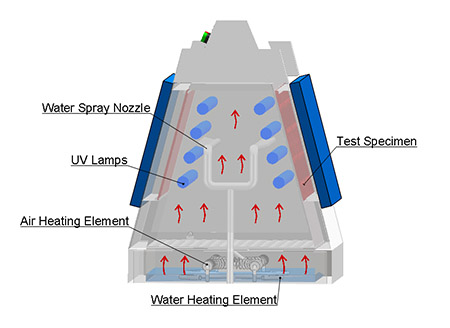 |
Step 5 | Periodic inspections at preset intervals (250h, 500h, 1000h) | |
Step 6 | Post-test quantitative analysis & control comparison |
1. Consistent Specimen Mounting — Mount samples with exposed faces flush to the chamber interior, leaving zero air gaps to prevent localized edge heating and airflow disruption. Use a minimum of three replicate panels alongside unexposed reference controls.
2. Moisture & Thermal Control — Temperature acceleration increases chemical reaction rates and can soften low-glass-transition polymers. Condensation cycles create a continuous water film driving hydrolysis and blistering, while water spray introduces thermal shock and surface washing.
3. Structured Evaluation Intervals — Inspect and measure samples at fixed intervals (e.g., 250, 500, 750, and 1,000 hours) without altering measurement geometry or analytical methods — inconsistent methodology is one of the fastest ways to invalidate an otherwise sound test.
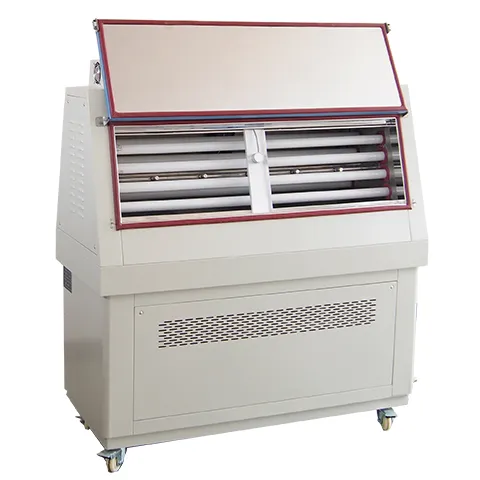
The LIB Industry UV Accelerated Weathering Tester integrates ultraviolet radiation, elevated thermal control, moisture condensation, and water spray into a single programmable testing platform supporting both UVA-340 and UVB-313 lamp configurations.
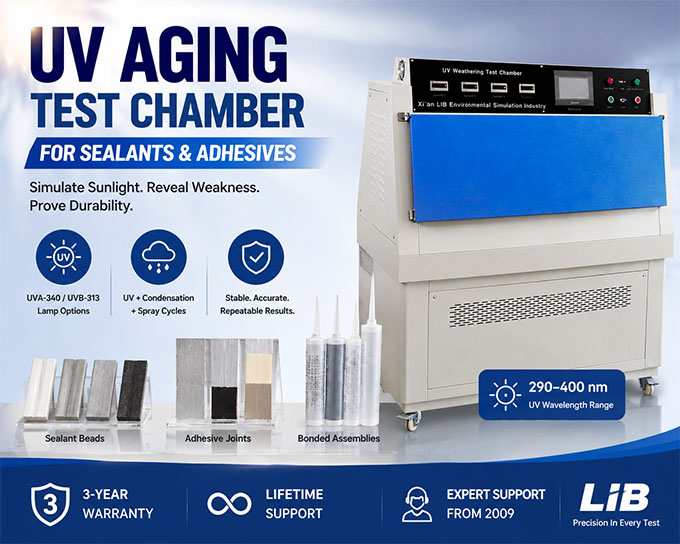
Parameter | LIB Standard Configuration |
UV Light Source | 8 × 40W fluorescent UV lamps |
Spectral Range | 290 nm to 400 nm |
Temperature Range | Ambient to +90°C (±2°C) |
Black-Panel Temperature | +35°C to +80°C precision control |
Condensation Humidity | ≥ 95% RH |
Specimen Capacity | Up to 56 panels (75 × 150 mm standard) |
Specimen-to-Lamp Distance | 50 mm |
Irradiance Control Range | Closed-loop feedback (0.3 to 20 W/m²) |
Spray Programming Interval | Continuous or intermittent (1 min to 9,999h 59min) |
Closed-Loop Irradiance Monitoring — Automatically compensates for lamp aging to maintain constant UV intensity.
Corrosion-Resistant Construction — Grade 304 stainless steel interior and exterior workspaces withstand long-term moisture and condensation exposure.
Intelligent PLC Touchscreen — Stores pre-configured international test standards while allowing fully customized cycles.
Comprehensive Safety Protection — Over-temperature cut-offs, low water level alarms, leakage current protection, and automatic power-off upon door opening.
Established in 2012, Xi'an LIB Environmental Simulation Industry is a leading global manufacturer and supplier of environmental test chambers, delivering reliable testing systems to clients across more than 56 countries.
LIB industry provides complete turnkey solutions — spanning custom chamber design, precision manufacturing, factory calibration, delivery, on-site installation, operator training, and comprehensive lifecycle maintenance.
3-Year Complete Warranty | Full technical support and maintenance assistance from day one, so equipment issues don't become testing delays. |
Lifetime Technical Support | Remote diagnostic assistance, spare parts, and service guidance for zero-downtime testing programs — for as long as you own the chamber. |
Most manufacturers stop answering once the warranty runs out. LIB doesn't — every chamber is backed by a 3-Year Complete Warranty and Lifetime Technical Support & Service, so your testing program stays reliable well past the standard support window.
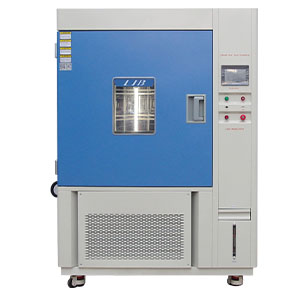
Full-spectrum sunlight simulation (UV + visible + IR) for the closest lab match to real outdoor exposure. Irradiance up to 1120 W/m². |
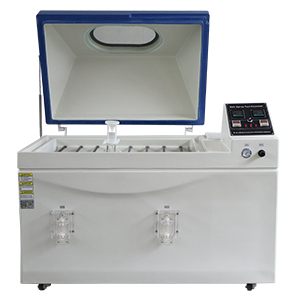
ASTM B117 / ISO 9227 corrosion testing for coatings, metals, and fasteners. Chamber volume up to 1000L. |
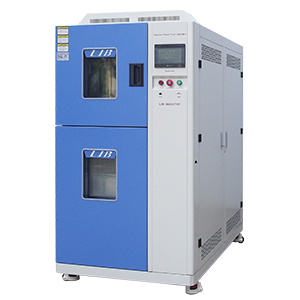
Rapid hot-cold transition in under 3 seconds, −70°C to +220°C, for stress-testing solder joints and material bonds. |
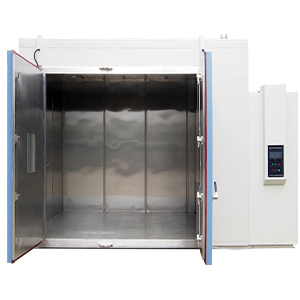
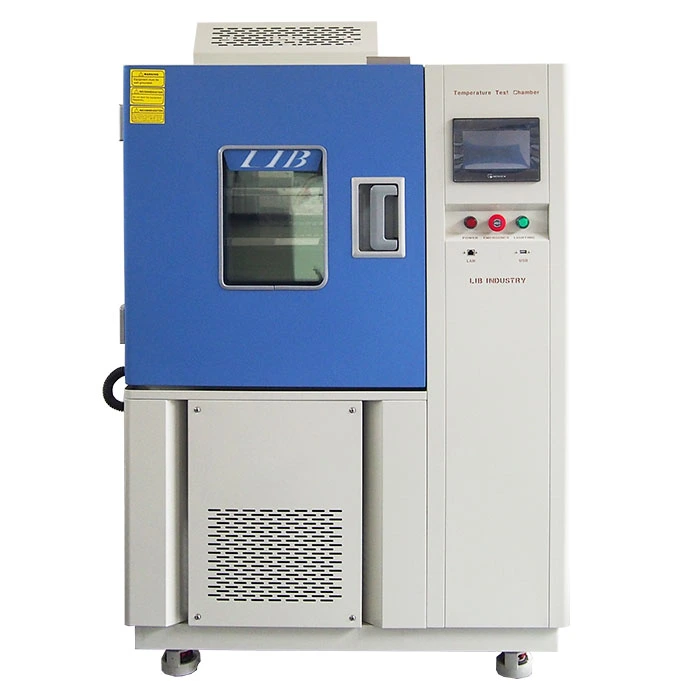
Large-scale temperature and humidity testing for complete products and assemblies. Custom volumes up to 100 m³. |
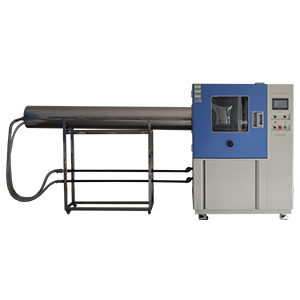
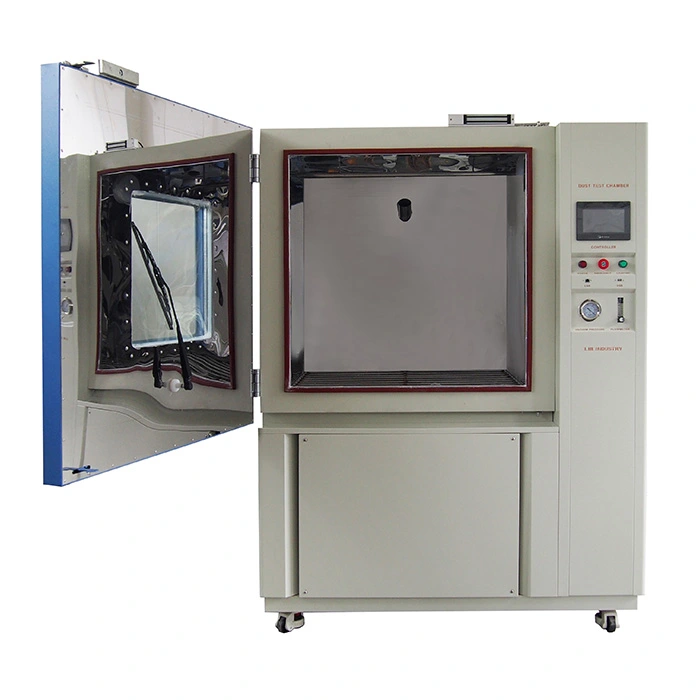
IP Waterproof & Dustproof Test Chamber IPX1–IPX9K rated ingress testing for enclosures, connectors, and outdoor electronics. |
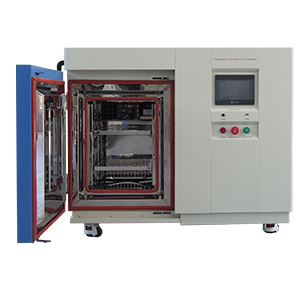
Benchtop Environmental Chamber (TH Series) Compact 50L/80L chamber for small-sample temperature and humidity testing. Temperature fluctuation as low as ±0.5°C. |
Q1: What is a UV accelerated weathering tester?
It is a specialized environmental chamber that exposes materials to fluorescent ultraviolet light, controlled heat, condensation, and water spray. By cycling these weathering stressors, laboratories simulate years of outdoor degradation — such as fading, chalking, cracking, and embrittlement — in a matter of weeks.
Q2: Which standards are most commonly used for UV weathering tests?
Industry standards include ASTM G154 (general nonmetallic materials), ISO 4892-3 (plastics), ASTM D4587 (paints and coatings), and SAE J2020 (automotive and exterior polymeric components). Selection depends on the material type, end-use environment, and regulatory requirements.
Q3: What physical properties should be measured after UV durability testing?
Measurements should directly reflect the product's functional requirements — commonly color difference (ΔE), gloss retention, chalking formation, micro-cracking density, peel and pull-off adhesion, tensile/flexural strength retention, impact resistance, and water absorption.
Q4: Does LIB Industry provide on-site installation and calibration?
Yes. LIB industry provides end-to-end service including professional on-site installation, multi-point sensor calibration, operator training, and complete compliance documentation — backed by our 3-Year Warranty.
A weathering result is only as strong as the standard, parameters, and equipment behind it. Matching the right lamp type, cycle, and evaluation metric to your material — on a chamber that holds its calibration over years, not months — is what turns a test result into evidence you can defend.
Ready to spec a UV weathering program for your materials? Get in touch with LIB Industry's team to match your standard, sample type, and throughput needs to the right chamber configuration — backed by a 3-Year Warranty and Lifetime Technical Support.
 English
 русский
 français
 العربية
 Deutsch
 Español
 한국어
한국어 italiano
 tiếng việt
 ไทย
ไทย Indonesia