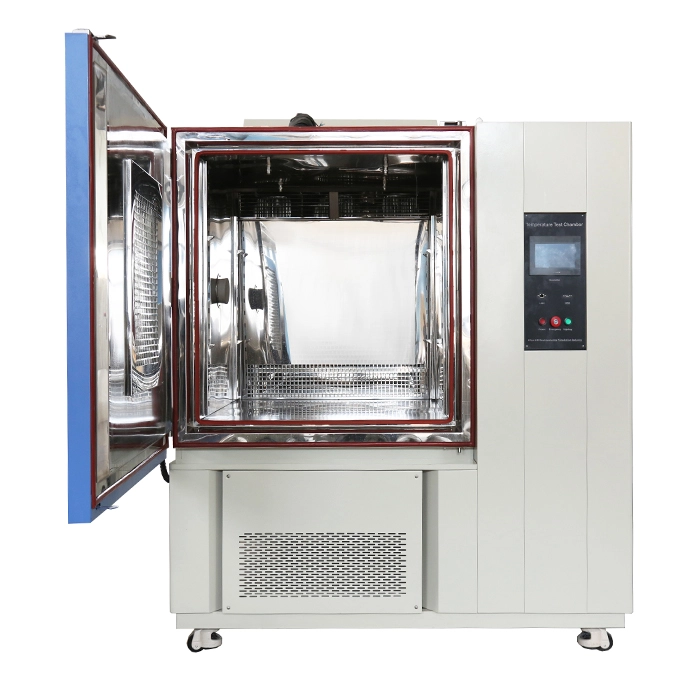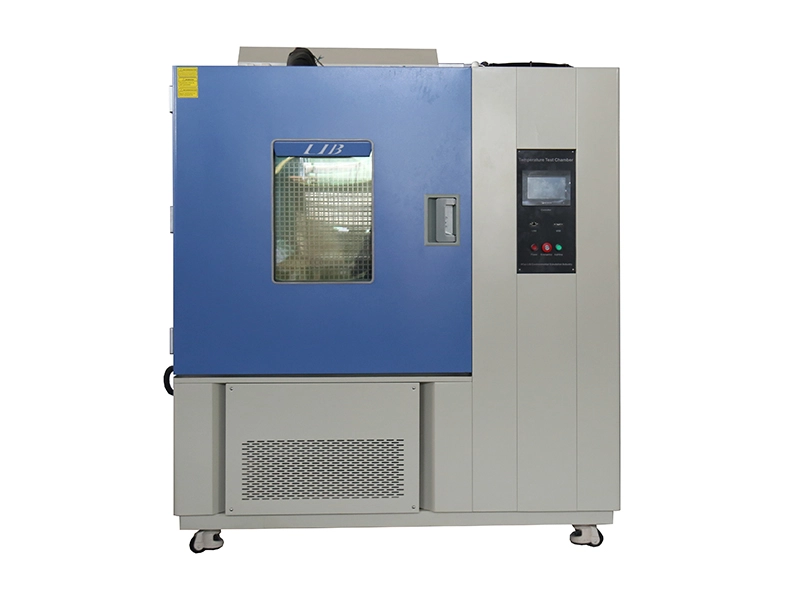
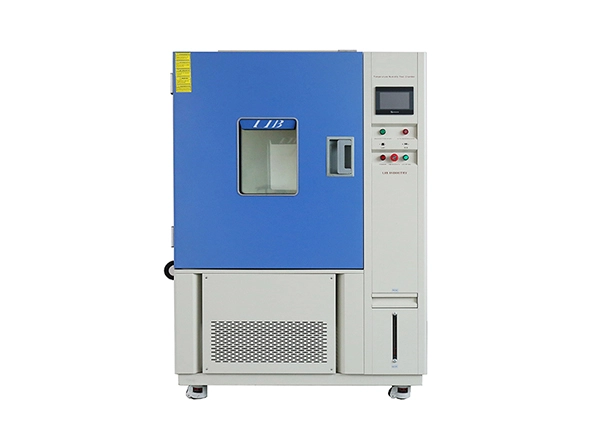

If every new formulation had to wait two to three years for natural aging data before it could go to market, companies would lose their competitive edge before the product ever reached shelves.
This is exactly why the Accelerated Stability Chamber exists. By simulating extreme temperature and humidity conditions under controlled settings, it artificially speeds up chemical reaction and degradation rates — compressing a stability verification cycle that would normally take years down to just weeks or months.
This article walks through the reaction-kinetics principles behind accelerated stability testing, the international standards it follows, a standardized operating procedure, key selection criteria for equipment, LIB Industry's dedicated solutions, and a real customer case study — helping R&D engineers and procurement teams make fast, well-informed, compliant decisions.
The scientific foundation of accelerated stability testing is the Arrhenius Equation, which describes the quantitative relationship between temperature and reaction rate constant:
k = A × e^(−Ea / RT)
Where:
k — reaction rate constant
A — pre-exponential (frequency) factor
Ea — activation energy of the reaction
R — gas constant
T — absolute temperature (Kelvin)
In simple terms, as temperature rises, the rate of a chemical reaction — including degradation reactions — increases exponentially. This means that placing a sample in a higher-than-ambient temperature and humidity environment lets you observe, in a short period, the same kind of degradation that would otherwise only appear after long-term storage. That accelerated data is then used to mathematically extrapolate the product's actual shelf life at room temperature.
In practice, engineers commonly use the Q10 factor to simplify these calculations: for roughly every 10°C increase in temperature, the reaction rate increases by a factor of Q10 (typically between 2 and 4, depending on the activation energy of the system).
The Q10 value allows an "acceleration factor" to be estimated — the conversion ratio between test time at elevated temperature and the equivalent real-time storage duration at room temperature. This lets teams quickly estimate how long a chamber test needs to run to be equivalent to one, two, or more years of ambient storage.
Standard | Scope | Typical Test Conditions |
ICH Q1A (R2) | Stability testing guideline for pharmaceuticals and fine chemicals | 40°C ± 2°C / 75% RH ± 5% RH |
ASTM D4332 | Environmental aging test methods for materials and chemical reagents | Temperature/humidity gradients set according to material properties |
ISO 2230 | Storage, aging, and shelf-life evaluation of rubber products | Constant or cyclic aging conditions |
These standards give different industries a consistent, comparable testing baseline, and they're typically the first thing regulatory bodies check during product registration and compliance filings.
Step 1 — Baseline Testing and Parameter Setup
Before samples go into the chamber, fully characterize their initial state — purity, viscosity, pH, appearance, odor, and other key indicators. This becomes the T0 baseline that every later degradation measurement is compared against.
Step 2 — Sample Loading and Temperature/Humidity Profile Setup
Choose a testing mode based on the product's characteristics:
Constant temperature/humidity mode — evaluates steady-state degradation behavior under long-term storage conditions.
Cyclic stress mode — simulates temperature/humidity fluctuations during transport or extreme climates, useful for assessing environmental adaptability and packaging reliability.
Step 3 — Timed Sampling and Degradation Data Collection
Pull samples at predefined intervals (commonly day 30, day 60, day 90, etc.) and test the relevant physicochemical parameters to track the degradation curve over time.
Step 4 — Data Extrapolation and Shelf-Life Determination
Feed the degradation rate data collected at elevated temperature into the Arrhenius equation or an appropriate kinetic model, then extrapolate to predict the expected shelf life under actual storage conditions (e.g., 25°C). This forms the basis of the final stability testing report.
Different lab and production scenarios call for very different chamber capacity, control precision, and compliance features. The comparison below helps procurement teams quickly match the right equipment type to their needs:
Comparison | Benchtop / Small Environmental Chamber | Standard Accelerated Stability Chamber | Walk-In Stability Chamber |
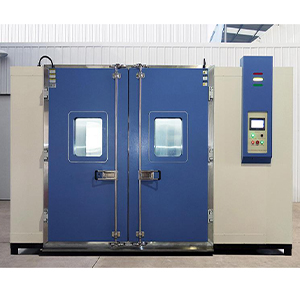
Capacity | 50L – 100L (suited for small-scale/screening samples) | 225L – 1000L (main workhorse for most labs) | > 2000L (bulk sample sets / large packaging) |
Temperature/Humidity Range | −20°C/-40℃/-70℃ to +150°C 10%/20%–98% RH | ||
Control Precision | ±0.5°C / ±2.5% RH | ||
Data Compliance | Basic data logging | Supports 21 CFR Part 11 audit trail | Supports 21 CFR Part 11 with multi-point centralized monitoring |
Typical Use Case | Early-stage formulation screening | Standard accelerated testing for chemicals and pharmaceuticals | Factory-level batch QC / long-term retained-sample storage |
|
|
| |
Selection tip: For early-stage formulation work that only requires small-batch, rapid screening, a benchtop chamber is cost-effective and sufficient. Once a product moves into formal stability verification and compliance filing, a standard chamber is the primary configuration for most labs. For companies needing large-scale sample retention, long-term monitoring, or factory-level QC, a walk-in chamber offers the space and flexibility required.
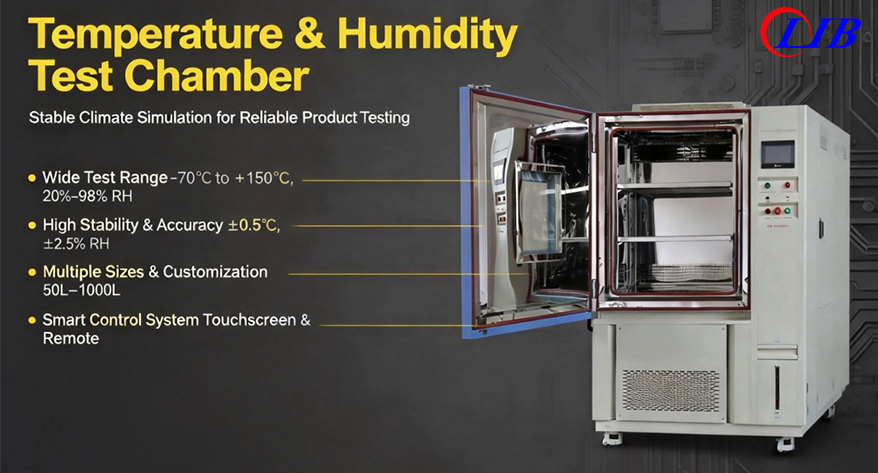
As an experienced environmental test chamber manufacturer, LIB Industry provides professional stability testing solutions for chemical, material, pharmaceutical, automotive, and research applications.
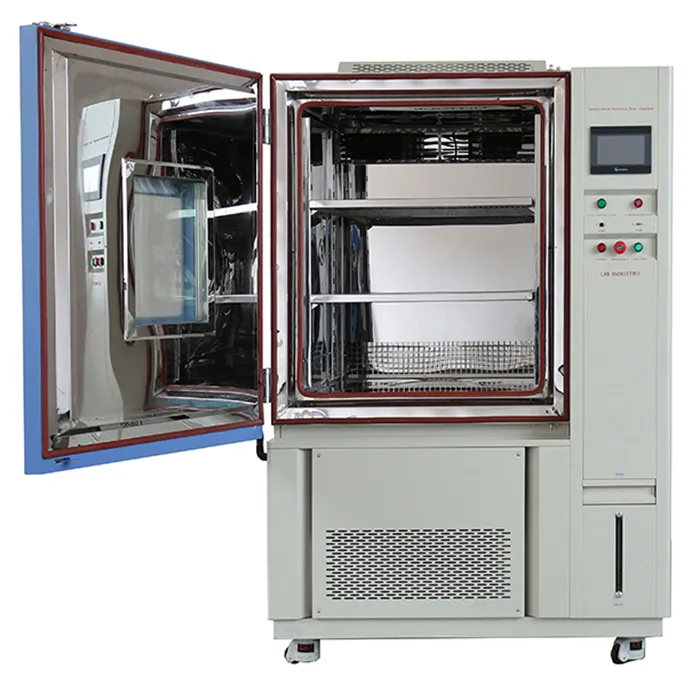
LIB Accelerated Stability Chambers are designed to provide accurate, reliable, and long-term environmental simulation performance.
|
|
|
| |
| Robust Workroom | Cable Hole | Temperature and Humidity Sensor | PID controller |
LIB chambers use advanced PID control technology and optimized airflow circulation to maintain excellent temperature and humidity uniformity.
The system minimizes temperature differences inside the chamber, ensuring every sample experiences the same test condition.
Typical performance:
Temperature accuracy: ±0.5°C
Humidity accuracy: ±2.5% RH
Temperature range options: -20°C to +150°C
Humidity range: 20%–98% RH
For chemical testing applications, LIB provides customized configurations according to sample characteristics.
Available options include:
Corrosion-resistant chamber structure
Special coatings
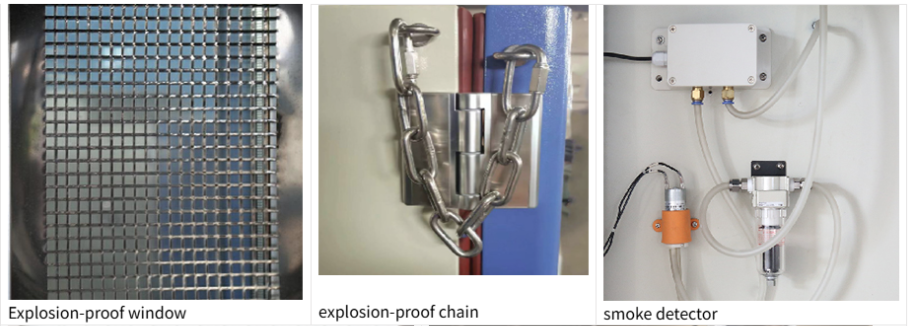
Safety protection systems
Customized shelves and sample holders
These solutions help laboratories safely test chemical products with different characteristics.
Modern stability testing requires complete traceability.
LIB chambers support:
USB data export
RS485 communication
Ethernet connection
Remote monitoring
Temperature and humidity recording systems
These features help laboratories maintain reliable testing records and improve compliance management.
LIB Industry focuses on long-term equipment reliability.
Our advantages include:
3-year warranty
Lifetime maintenance support
24/7 technical assistance
Global customer service network
Professional installation guidance
From equipment selection to installation and after-sales support, LIB provides complete environmental testing solutions.
Customer Background: A well-known European fine chemicals R&D center specializing in chemical reagent formulation and polymer adhesive evaluation.
Challenge: Their existing chamber had noticeable humidity drift, and the consistency and traceability of long-term test data fell short of international filing requirements — forcing R&D timelines to stretch out, with some tests needing to be re-run entirely.
LIB's Solution: LIB's engineering team custom-configured an Accelerated Stability Chamber fitted with a high-precision electronic humidity sensor and a corrosion-resistant coated liner, tailored to the customer's product profile, and added safety modules to accommodate their volatile solvent samples.
Delivery and Feedback: The project team documented the full installation, including on-site installation photos and FAT (Factory Acceptance Test) / SAT (Site Acceptance Test) sign-off. The customer gave high marks for LIB's after-sales response time, operational stability, and data compliance — noting that the new chamber significantly improved the reliability of their R&D data and the efficiency of their regulatory filings.
Q1: What is the main principle behind an Accelerated Stability Chamber?
Its core principle is rooted in chemical reaction kinetics: by placing samples in a temperature/humidity environment well above ambient, degradation reactions are artificially accelerated. That accelerated degradation data is then extrapolated using a mathematical model back to room-temperature storage conditions, allowing the actual shelf life to be predicted in a much shorter time frame.
Q2: What is the standard temperature and humidity for accelerated chemical stability testing?
A widely used baseline condition is 40°C ± 2°C at 75% ± 5% RH, drawn from the ICH Q1A (R2) guideline, and it's commonly applied to fine chemicals and pharmaceutical raw materials. Exact conditions should still be adjusted based on the specific product and the industry standard being followed.
Q3: How does the Q10 factor help in calculating product shelf-life?
The Q10 factor represents roughly how much the reaction rate increases for every 10°C rise in temperature. Using a known Q10 value, engineers can quickly convert between elevated-temperature test time and equivalent room-temperature storage time — a simplified but practical way to estimate shelf life within a short testing window.
Q4: Can an Accelerated Stability Chamber test flammable or dangerous chemical samples?
Yes, but it requires dedicated safety configurations. LIB's chambers, for example, offer nitrogen purging, explosion-proof relief doors, and corrosion-resistant liners for flammable, explosive, or volatile solvent-based samples, ensuring the testing process meets lab safety requirements.
Q5: How often should an Accelerated Stability Chamber be calibrated?
For data accuracy and compliance, temperature/humidity sensors should generally be professionally calibrated every 6 to 12 months. The exact interval can be adjusted based on usage frequency, operating environment, and internal quality system requirements. Regular preventive maintenance (PM) should also be scheduled to keep the equipment running reliably long-term.
Brand Strength: Founded in 2012, LIB Industry is a specialized manufacturer and designer of environmental test chambers, with a product line covering temperature, humidity, light exposure, corrosion, dust/wind, and water-resistance testing — providing comprehensive environmental simulation solutions across industries.
One-Stop Service: From lab planning, equipment selection, and custom design, to shipping, installation, and compliance verification (IQ/OQ/PQ), LIB offers full-lifecycle project support that reduces communication overhead and speeds up implementation.
Worry-Free After-Sales Policy:
3-year extended warranty (well beyond the industry-standard 1 year)
Lifetime maintenance and technical support
24-hour rapid after-sales response
Global spare parts supply network
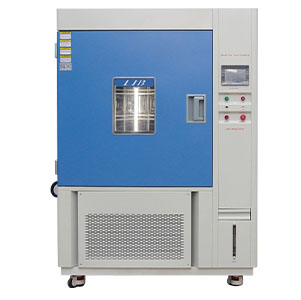
Uses xenon arc lamps to simulate the full solar spectrum (visible, UV, and part of the infrared range), with synchronized temperature, humidity, and rain-cycle control. Widely used for full-spectrum weathering and photoaging evaluation of coatings, plastics, rubber, and chemical products, with results that correlate closely with outdoor natural exposure. |
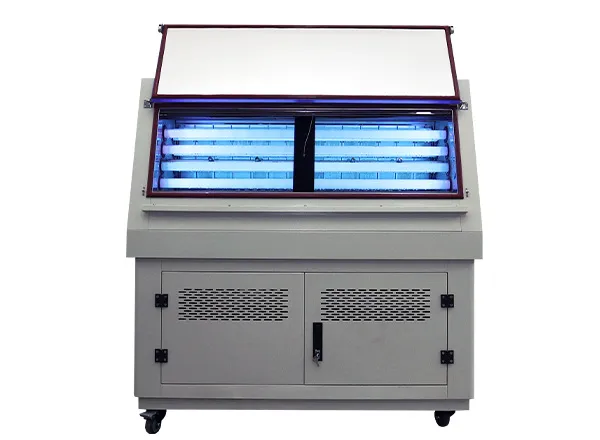
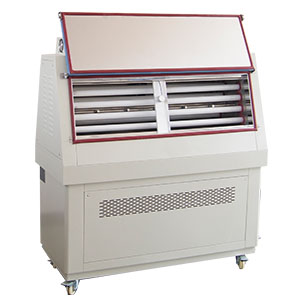
LIB UV Test Chamber Uses UVA/UVB fluorescent lamps to simulate the short-wave UV radiation found in sunlight, combined with condensation and spray cycles. Focused on evaluating fading, chalking, cracking, and other aging effects from prolonged UV exposure — a cost-effective photoaging test solution widely used in coatings, ink, and polymer material R&D. |
Whether you're at the early formulation screening stage or preparing complete stability compliance data for a product launch or export filing, LIB Industry can support your specific testing needs — from chamber selection through custom configuration and full project delivery.
Contact LIB's senior engineering team today for a free technical consultation, product datasheets, and a custom Accelerated Stability Chamber quote
 English
 русский
 français
 العربية
 Deutsch
 Español
 한국어
한국어 italiano
 tiếng việt
 ไทย
ไทย Indonesia


.webp "FIAT 50417 Vulcanized Rubber Ozone Test Chamber")
.webp "Walk In Mixed Noxious Gas Chamber")