Can the chamber maintain the required environmental conditions when the test specimen generates significant heat?
This is where heat load capacity becomes important.
A chamber may reach -40°C or +150°C under empty-chamber conditions, but its performance can change when a battery, automotive electronic component, power device, or other operating DUT continuously generates heat inside the chamber.
For this reason, LIB industry evaluates heat load performance using two key conditions: a -20°C heat load verification point and customer-specified temperature and humidity setpoints. This approach helps determine whether the chamber can maintain the required environment while continuously removing heat generated by the test specimen.
Heat load capacity refers to the ability of an environmental test chamber to remove heat generated by the test specimen while maintaining the required temperature and humidity conditions.
In actual testing, the refrigeration system must handle more than the heat entering through the chamber walls. It may also need to continuously remove heat generated by powered test specimens.
A simplified calculation is:
Required cooling capacity ≈ Specimen heat generation + Heat entering the chamber + Internal heat sources
For example, if a DUT continuously generates several kilowatts of heat, the chamber needs sufficient refrigeration and air circulation capacity to remove that heat while maintaining the programmed setpoint.
This is why empty-chamber performance does not fully represent loaded performance.
| Performance Aspect | Empty Chamber | Under Heat Load |
|---|---|---|
| Cooling demand | Relatively low | Significantly higher |
| Temperature control | Easier | More challenging |
| Recovery after disturbance | Usually faster | May take longer |
| Humidity control | Less affected | Can be affected by heat generation |
| Application relevance | Limited | More representative |
A chamber reaching a low temperature without a load does not automatically mean it can maintain that temperature when the DUT continuously releases heat.
The first LIB heat load verification point is -20°C.
The chamber is set to -20°C while a controlled heat load is introduced into the working space. The purpose is to verify whether the refrigeration system can continuously remove the introduced heat while maintaining the required low-temperature condition.
A typical verification sequence includes:
Set the chamber to -20°C.
Introduce the specified heat load using a controlled heating source.
Allow the chamber to reach a stable operating condition.
Monitor the actual temperature during continuous heat generation.
Evaluate temperature stability and the ability to maintain the setpoint.
The purpose is not simply to determine whether the chamber can reach -20°C. It is to determine whether the chamber can maintain -20°C while simultaneously removing heat from the test space.
This provides a more meaningful evaluation of refrigeration performance for applications in which the DUT remains powered during low-temperature testing.
For battery systems, automotive electronics, and power electronics, this distinction can be particularly important because the specimen may generate substantial heat while operating inside the chamber.
A single low-temperature test point cannot represent every environmental testing application.
Actual test conditions may include:
25°C / 50% RH
40°C / 75% RH
60°C / 90% RH
85°C / 85% RH
The required condition depends on the product, test procedure, operating state, and applicable standard.
LIB's second heat load verification approach is therefore to evaluate chamber performance at the customer's specified temperature and humidity point.
This is useful when the DUT generates different amounts of heat under different operating conditions. A power electronic device, for example, may generate relatively little heat in standby but significantly more heat at full load. Battery heat generation can also vary with charging, discharging, current, and operating state.
Testing at the customer's actual environmental setpoint provides a more representative evaluation than relying on a single predefined condition.
The verification concept can therefore be summarized as:
Required Temperature + Required Humidity + Specified Heat Load = Application-Specific Heat Load Verification
This approach allows the chamber to be evaluated according to the customer's actual testing requirements.
A real DUT does not always need to be used during chamber verification. Its thermal output can be simulated using an electrical heating load.
A controlled electrical heater can generate a defined amount of heat inside the chamber, providing a repeatable way to simulate the thermal output of an operating product.
During the heat load test, the following parameters can be monitored:
| Parameter | What It Verifies |
|---|---|
| Set temperature | Required environmental condition |
| Actual temperature | Temperature control under load |
| Temperature fluctuation | Stability during continuous heat generation |
| Temperature recovery | Recovery capability after load changes |
| Relative humidity | Humidity control under thermal load |
| Heat load | Simulated DUT heat generation |
| Test duration | Continuous load-handling capability |
Test duration is also important. A chamber that maintains the setpoint for a short period may not provide the same performance during a long-duration test with continuous heat generation.
Therefore, heat load verification should be treated as an operating-condition evaluation, rather than simply another empty-chamber specification.
When requesting a chamber for a high-heat-load application, providing only the temperature range is usually insufficient.
For example:
“We need a chamber from -40°C to +150°C.”
does not indicate how much cooling capacity the system needs.
A more useful specification would be:
“We need to maintain 40°C / 85% RH while the DUT generates 8 kW of heat.”
This gives the manufacturer the information needed to evaluate the refrigeration system and chamber configuration.
When contacting LIB industry, customers should provide:
Maximum heat generation — How many kW of heat will the DUT produce?
Required temperature — What temperature must be maintained under load?
Required humidity — What RH condition is required?
Specimen size and quantity — How much space will the DUT occupy?
Test duration — How long will the heat load be continuously applied?
Stability or recovery requirement — How tightly must the chamber maintain or recover the setpoint?
Based on these parameters, LIB can evaluate the appropriate chamber configuration.
For demanding applications, chamber volume, refrigeration capacity, air circulation, condenser configuration, specimen arrangement, and heat dissipation all need to be considered together.
The key principle is:
Do not select a chamber based only on its temperature and humidity range. Select it based on the environmental condition it must maintain while handling the actual thermal load of the DUT.
LIB industry provides environmental test chambers for applications where test specimens generate heat during testing, covering different chamber sizes and configurations for laboratory, automotive, battery, electronics, and large-product testing.
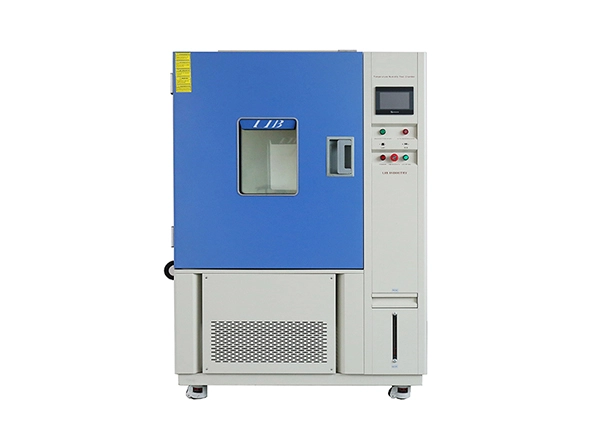
For small components and laboratory testing, LIB benchtop temperature and humidity chambers provide a compact solution with working volumes from 50 L to 225 L. Temperature ranges can reach -40°C, with humidity control from 20% to 98% RH. Their compact footprint is suitable for electronic components, sensors, small battery cells, materials, and other laboratory samples where the heat load is relatively limited.
For larger specimens and higher testing throughput, LIB standard temperature and humidity chambers are available in capacities such as 225 L, 500 L, 800 L, and 1000 L. Depending on the model, temperature ranges can extend from -70°C to +150°C, with humidity control of 20%–98% RH. These chambers provide greater working volume for automotive electronics, electrical components, consumer electronics, and materials testing.
When the DUT generates substantial heat during operation, chamber selection needs to go beyond temperature range and working volume. LIB can provide custom high-heat-load configurations based on the actual heat generated by the DUT, allowing the refrigeration system to be matched to the required thermal load.
This configuration is particularly relevant to battery systems, power electronics, electrical equipment, and other products that remain powered during environmental testing.
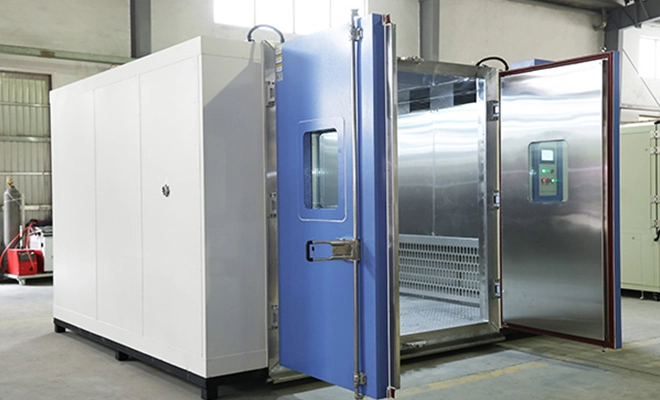
For battery packs, vehicle components, large assemblies, or multiple specimens, LIB walk-in environmental chambers provide the additional working space required for large-scale testing. Chamber dimensions, refrigeration capacity, air circulation, and environmental control can be customized according to the application.
This allows the chamber to address both the physical dimensions of the DUT and the heat that must be removed during operation.
LIB also provides battery testing chambers and automotive component testing solutions for applications where the DUT operates inside the chamber. In these applications, heat generated during charging, discharging, operation, or load testing becomes part of the chamber's cooling requirement.
The chamber therefore needs to maintain the specified environmental condition while continuously removing heat from the operating specimen.
Across these configurations, the key consideration remains the same: the chamber must maintain the required temperature and humidity while handling the heat generated by the test specimen.
LIB can evaluate heat load performance at the defined -20°C test point or at a customer-specified temperature and humidity setpoint, helping ensure that the selected chamber is matched to the actual thermal requirements of the application.
No. Temperature range describes the environmental conditions the chamber can reach under specified conditions. Heat load capacity describes its ability to maintain those conditions while removing heat generated by the DUT.
The -20°C point provides a defined low-temperature condition for evaluating whether the refrigeration system can maintain the setpoint while simultaneously removing an introduced heat load.
Yes. LIB can evaluate heat load performance at customer-specified temperature and humidity setpoints, subject to the chamber configuration and application requirements.
Heat load evaluation is especially relevant to batteries, automotive electronics, power electronics, electrical components, and other products that generate heat while operating inside the environmental chamber.
Provide the required temperature, humidity, maximum heat generation, specimen size, specimen quantity, and test duration. If available, also provide the required temperature stability and recovery criteria.
LIB industry provides a 3-year warranty and lifetime maintenance support, with 24/7 English-language after-sales service and a typical response time of 1–3 hours. Equipment can also undergo up to 72 hours of pre-shipment testing to verify operation before delivery.
Need a high-heat-load environmental test chamber? Provide LIB with your required temperature, humidity, heat load, specimen size, and test duration. LIB can recommend the right configuration and verify performance at -20°C or your specified setpoint.
Precision In Every Test.
 English
 русский
 français
 العربية
 Deutsch
 Español
 한국어
한국어 italiano
 tiếng việt
 ไทย
ไทย Indonesia

.webp "BS EN 50289-4-17 / UL 1581 Xenon Arc Weathering Cable Test Chamber")