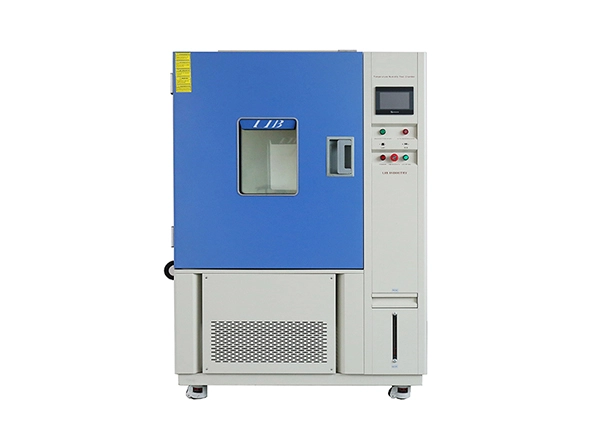
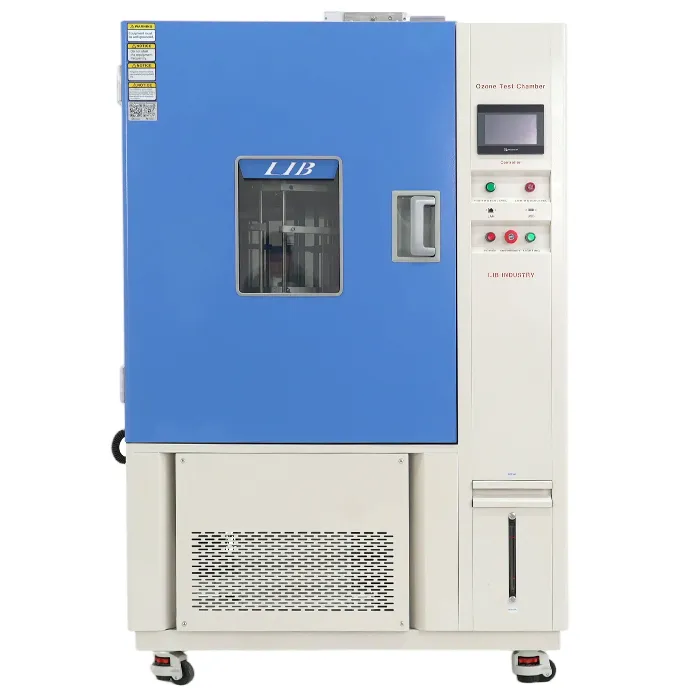
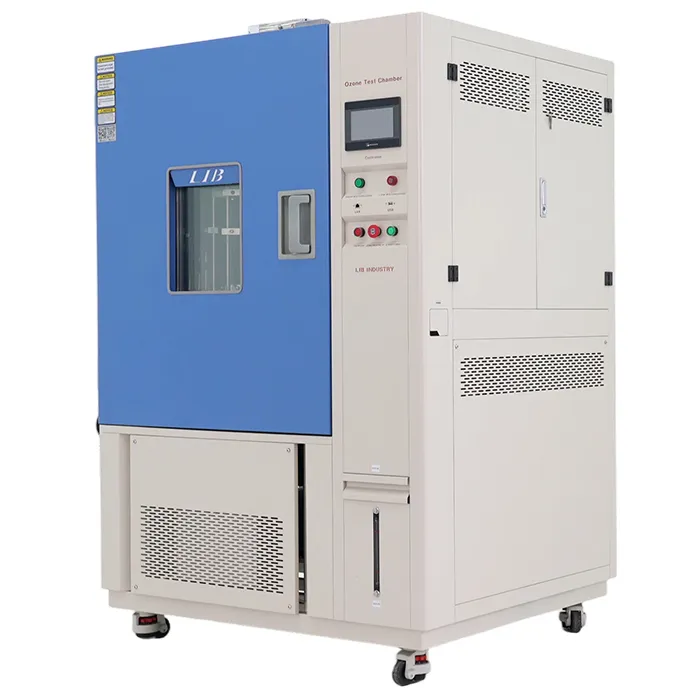
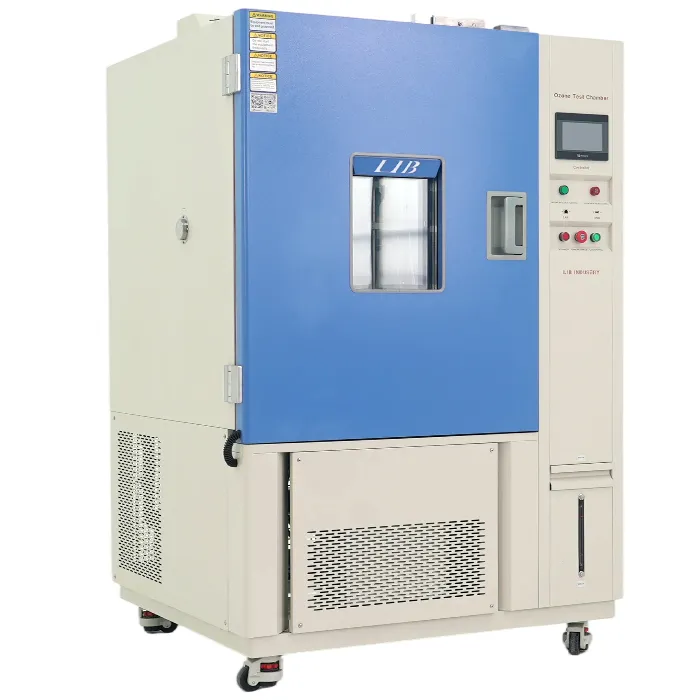
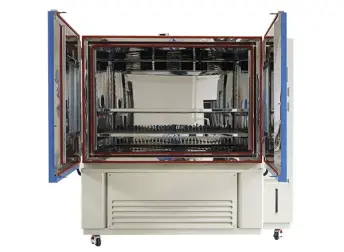
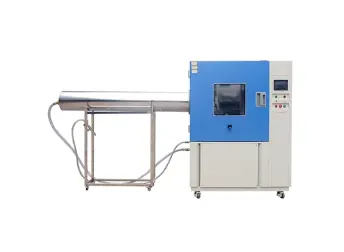
Key Features of ISO 1431-1 Dynamic Rubber Ozone Test Chamber
Dynamic Tensile Strain for Ozone Crack Evaluation
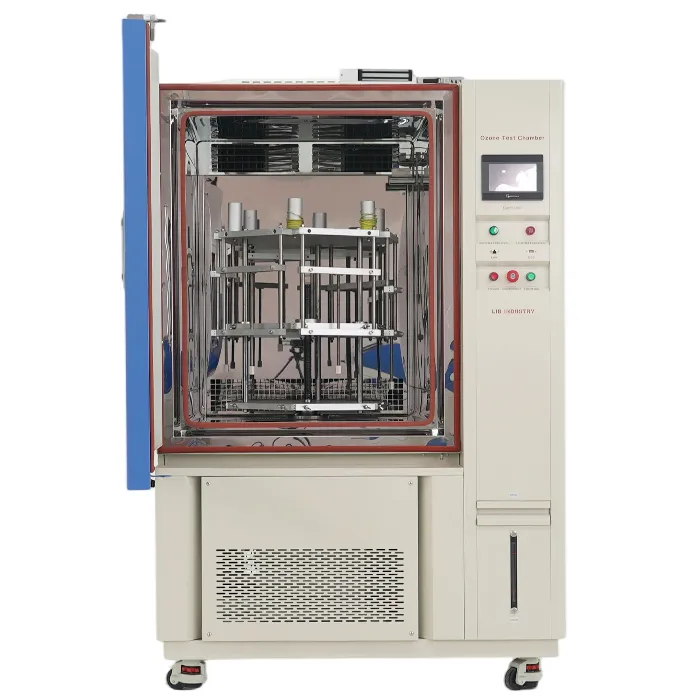
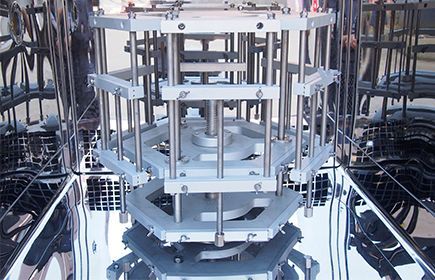
The chamber is equipped with a static + dynamic combined sample holder for applying controlled tensile deformation to rubber specimens during ozone exposure. The adjustable tensile stretch range of 5%–35% enables laboratories to evaluate ozone-induced cracking under different deformation conditions, with sample holder rotation adjustable from 0–10 r/min for controlled specimen movement.
Wide Ozone Concentration Control
The system provides an ozone concentration range of 1–1000 PPHM. A silent discharge ozone generator produces stable, repeatable ozone conditions, while an integrated ozone gas sensor continuously monitors and regulates the chamber atmosphere according to the selected test parameters.
Controlled Temperature Environment
The chamber maintains temperatures from 0°C to +100°C, with a temperature fluctuation of ±0.5°C and deviation of ±2.0°C — stable enough for repeatable environmental conditions throughout extended ozone exposure tests.
Static and Dynamic Testing in One Chamber
The combined sample holder supports both fixed and changing tensile strain, making the system suitable for comparative evaluation of rubber cracking behavior under different deformation conditions — without needing separate equipment.
Automated Control and Data Connection
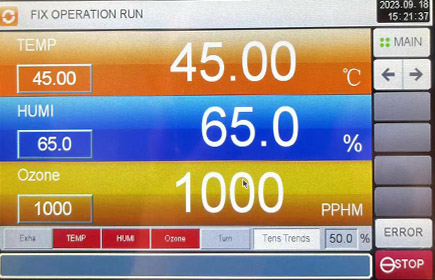
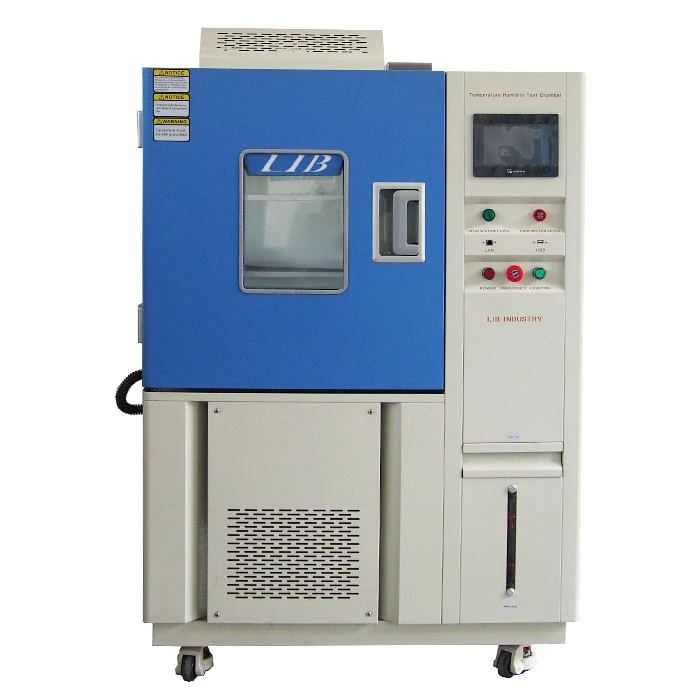
A programmable color LCD touch-screen controller centralizes control of temperature, ozone concentration, sample movement, and test sequences. Ethernet connection and PC Link enable convenient test monitoring and data management.
Static vs. Dynamic Ozone Testing
Test Feature | Static Ozone Testing | Dynamic Ozone Testing |
Ozone Exposure | ✓ | ✓ |
Controlled Temperature | ✓ | ✓ |
Fixed Tensile Strain | ✓ | — |
Changing / Cyclic Tensile Strain | — | ✓ |
Static + Dynamic Fixture | Optional | ✓ |
Simulation of Repeated Deformation | Limited | ✓ |
Suited to Component Durability Evaluation | ✓ | ✓ |
Why does dynamic testing matter? Rubber components such as seals, hoses, gaskets, and flexible connectors often experience repeated deformation during service. Dynamic ozone testing combines chemical exposure with mechanical deformation to provide a more demanding, realistic evaluation of ozone-related cracking resistance.
Technical Specifications of ISO 1431-1 Dynamic Rubber Ozone Test Chamber
| Model | OC-250 | OC-500 | OC-800 | OC-010 |
Internal Dimension (mm) | 600*600*700 | 700*800*900 | 800*1000*1000 | 1000*1000*1000 |
Overall Dimension (mm) | 960*1150*1860 | 1200*1340*2020 | 1300*1540*2120 | 1500*1540*2140 |
Interior Volume (L) | 250 | 500 | 800 | 1000 |
Temperature Range | 0℃ ~ +100 ℃ |
Temperature Fluctuation/ Deviation | ± 0.5 ℃/± 2.0 ℃ |
Humidity Range | 30% ~ 98% RH with ± 2.5% RH Humidity Deviation |
Cooling Rate | Ambient ~ 0℃ within 20 min |
Ozone Concentration | 1~1000PPHM |
Sample Holder Rotate Speed | 0~10 r/min |
Airflow Rate | 0 ~ 60L/min |
Clamps Tensile Stretch | 5%~35% |
Cooling system | Mechanical compression refrigeration system,French TECUMSEH compressor |
Controller | Programmable color LCD touch screen controller Ethernet connection, PC Link |
Water supply system | Automatic water supply,Water purification system |
Temperature Sensor | PTR Platinum Resistance PT100Ω/MV A-class |
Gas Sensor | Ozone gas sensor |
Ozone Generator | Silent discharge type ozone generator |
Sample Holder | Static + dynamic combined sample holder |
Interior Material | SUS304 stainless steel |
Observation Window | Interior lighting, double-layer thermo stability silicone rubber sealing |
Frequently Asked Questions on ISO 1431-1 Dynamic Rubber Ozone Test Chamber
What is a dynamic ozone test for rubber?
A dynamic ozone test evaluates the resistance of rubber to ozone-induced cracking while the specimen is subjected to controlled tensile deformation or movement — rather than remaining under fixed strain.
What standard is used for dynamic ozone testing?
ISO 1431-1 covers resistance of vulcanized or thermoplastic rubber to ozone cracking under static and dynamic tensile strain. ASTM D1149 is also commonly used for evaluating rubber deterioration and cracking in a controlled ozone environment.
Can the chamber perform both static and dynamic ozone testing?
Yes. The OC series uses a static + dynamic combined sample holder, allowing the system to be configured for different specimen deformation conditions without separate equipment.
Can LIB industry customize the ozone test chamber?
Yes. Chamber volume, specimen fixtures, ozone control, mechanical deformation systems, and control functions can all be customized according to the required test method and application.

 English
 русский
 français
 العربية
 Deutsch
 Español
 한국어
한국어 italiano
 tiếng việt
 ไทย
ไทย Indonesia