The fundamental purpose of high and low temperature testing is to expose latent design weaknesses before a product reaches the market, a vehicle assembly line, or an unmanned field cabinet.
When a component fails inside a thermal chamber, the immediate assumption is often a defective test sample. However, experienced reliability engineers know that not all failures are created equal. A significant portion of thermal test failures stems from external variables: compromised test setups, distorted airflow, sensor drift, or poor chamber stability.
For quality assurance managers and procurement teams, a test failure is useless unless it is proven to be real, repeatable, and actionable for R&D purposes. This guide breaks down the root causes of both genuine product failures and chamber-induced "false alarms," and explains how to choose high low temperature test chamber that delivers untainted data.
When a product legitimately fails during high-temperature, low-temperature, or thermal cycling testing, it is typically due to the inherent physical limits of its materials. Different materials expand, contract, and age at varying rates.
Low Temperatures | High Temperatures |
Material Embrittlement | Polymer Softening & Deformation |
Loss of Seal/Elasticity | Accelerated Oxidation & Drift |
Continuous Cyclic Fatigue (CTE)
→ Micro-cracks & Open Circuits
Modern sub-assemblies—such as automotive control modules—integrate metals, plastics, glass, adhesives, silicon, and rubber. Each of these materials possesses a distinct Coefficient of Thermal Expansion (CTE).
When cycled across extreme ranges (e.g., -40°C to +125°C), solder joints, connector pins, and potting interfaces are subjected to intense, alternating tensile and compressive stresses. Over dozens or hundreds of cycles, these microscopic stress events culminate in interfacial delamination, micro-cracks, open circuits, or structural seal failure.
At sub-zero temperatures, polymers, elastomers, and structural adhesives undergo a transition toward a glassy, brittle state.
Plastics & Jackets: Cable insulation and enclosures that survive drop tests at room temperature can crack effortlessly under minimal impact in cold storage.
Elastomeric Seals: O-rings lose their sealing force as they stiffen, creating paths for vacuum loss or fluid leakage.
Prolonged exposure to dry heat compromises physical and electrical properties simultaneously:
Structural Creep: Plastic enclosures and screw bosses soften, reducing internal fastening pressure and compromising IP-rated water seals.
Electrical Drift: High temperatures accelerate chemical reactions, stimulating oxidation, causing sensor calibration deviations, and increasing the internal stress of high-density battery packs (LIBs).
An environmental test chamber should be a neutral referee. If the chamber introduces uncontrolled environmental variables, it can trigger false failures (rejecting a perfectly good design) or false passes (shipping a ticking time bomb to the end user).
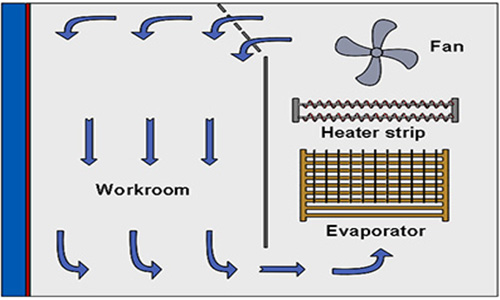 Temperature Fluctuation Beyond Tolerances
In precise testing—such as testing Lithium-Ion Batteries (LIBs)—short-term temperature fluctuation around the setpoint is far more damaging than long-term drift. Rapid, micro-cycling of air temperature applies artificial thermal shocks to sensitive electronics.
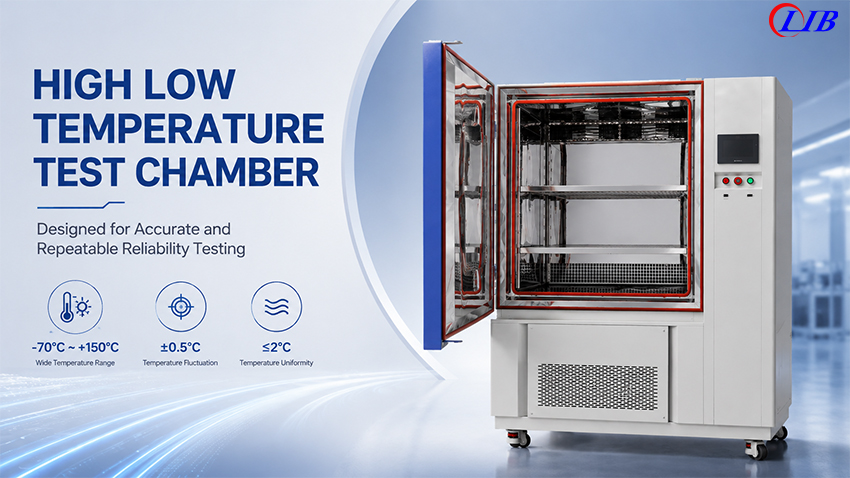
High-tier reliability testing demands chambers capable of tight control limits (≤ ±0.5°C) to guarantee that the stress recorded is strictly from the baseline profile.
If the air distribution inside the workroom is poorly engineered, temperature gradients will form. A sample placed directly near the primary air supply duct will experience vastly different thermal loading than a sample obstructed behind a bulky fixture.
To maintain parity across batch testing, spatial temperature uniformity must be rigidly maintained at ≤ 2°C.
Air Outlet: High Velocity / Direct Temp → Sample A: Over-stressed
Dead Zone: Obstructed Airflow → Sample B: Under-stressed
Result: Unfair batch testing and corrupted statistical data.
Every time a chamber door is opened for sample adjustment, or a high-mass powered device is loaded, the internal climate breaks down.
If the refrigeration and heating systems react sluggishly, the chamber can take a large portion of the designated dwell time just to return to the setpoint.
Example: A programmed 30-minute soak at -40°C is invalidated if the chamber spends 12 of those minutes recovering from a thermal upset. The actual core temperature of the product never reaches stabilization.
Even the most advanced environmental chamber will yield inaccurate data if the operational setup violates thermodynamics.
Air temperature invariably reaches the target setpoint faster than the core mass of the test sample. While a bare PCB stabilizes in moments, heavy cast-aluminum automotive housings or dense battery modules require prolonged soak times.
Stopping the clock too early leads to false passes.
Stacking test samples tightly together, placing them directly against internal chamber walls, or blocking the return air plenum chokes the convective heat transfer.
Active electronics, motors, lamps, and battery charging cycles release parasitic heat into the chamber.
If this heat dissipation exceeds the chamber’s active cooling capacity (e.g., exceeding a 1000W active load limit), the chamber will fail to maintain low-temperature baselines.
When a high-low temperature test fails, engineers should follow a structured diagnostic matrix to determine liability:
Varies by rack location
Airflow blocked / Uneven zones
→ Chamber / Setup Error
Fails at exact same temperature
Design or material limit
→ True Product Defect
If failures consistently occur in a specific zone of the chamber (e.g., lower-left corner), investigate localized airflow velocity and uniformity.
If failures occur uniformly regardless of placement, the issue is likely a native product design limit.
Review the continuous curves of the setpoint vs. actual temperature.
Inspect logs for thermal overshoot during fast ramps, unexpected alarm triggers, or drop-offs caused by hidden power fluctuations.
Take high-resolution photographs of the internal loading density, wire routing through the access ports (ensuring door seals aren't pinched), and the orientation of the samples relative to the air ducting.
|  | ||||
|
|
|
| Robust Workroom | Cable Hole | Tem |
Selecting an environmental test chamber based purely on its extreme temperature limits is a common procurement error.
True data integrity requires a balanced combination of dynamic control, structural safety, and thermal recovery performance.
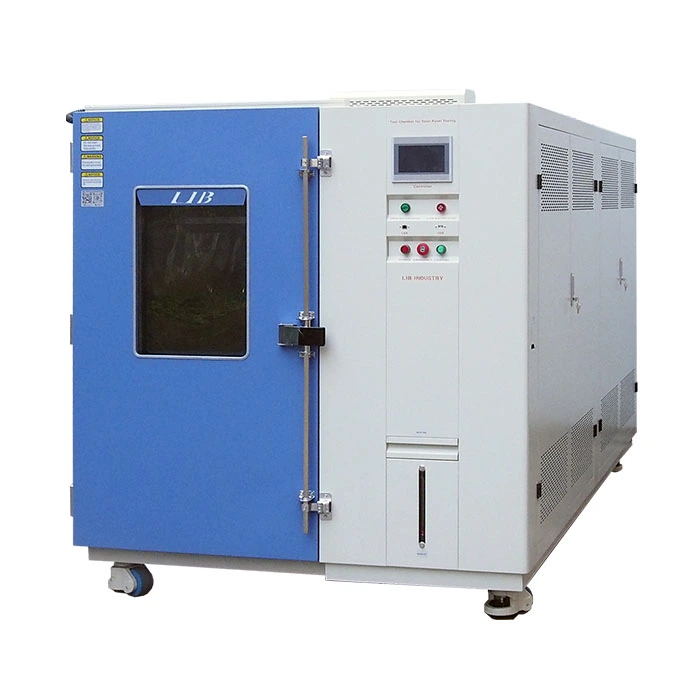
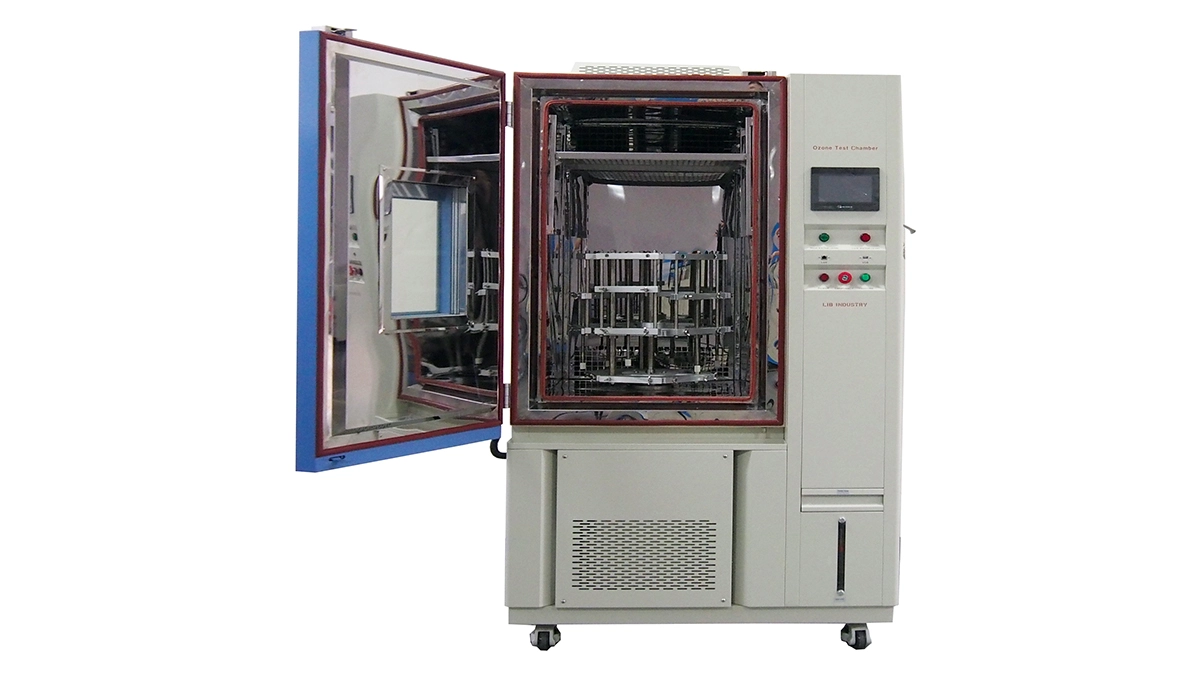
Xi’an LIB Environmental Simulation Industry (established in 2009) engineers high-low temperature test chambers designed specifically to eliminate equipment-induced variables for automotive, aerospace, defense, medical, and electronics testing.
Purchasing Criterion | Technical Metric | Why It Matters to the Engineer |
Temperature Range | -20°C / -40°C / -70°C to +150°C | Covers universal commercial, industrial, and military profiles |
Ramp Rate | 5°C/min (Heating & Cooling) | Provides controlled, repeatable linear transitions |
Control Fluctuation | ±0.5°C | Prevents micro-thermal cycling and phantom stress |
Spatial Uniformity | ≤ 2°C | Ensures identical exposure across all samples |
Workroom Scaling | 100L to 1000L volumes | Maintains unobstructed airflow paths |
Active Heat Load | ≥ 1000W dissipation | Maintains sub-zero baselines during powered testing |
Reliability cycling often runs continuously for weeks or months, placing immense physical demand on mechanical components.
LIB chambers integrate multi-tier safety protections—including over-temperature cut-offs, refrigerant high-pressure relief valves, over-current protection, and earth-leakage isolation—safeguarding both your high-value prototype samples and your laboratory personnel.
From requirement analysis and bespoke volume sizing to calibration support and global commissioning, Xi'an LIB provides the hardware stability required to transform random test failures into clear, actionable design intelligence.
Thermal cycling failures are primarily caused by fatigue. Each temperature change creates small expansion and contraction stresses at material interfaces. Over repeated cycles, these stresses accumulate and eventually lead to cracks, delamination, or electrical failure.
Temperature fluctuation measures how stable the temperature remains over time at a single point. Temperature uniformity measures how consistent the temperature is across different locations inside the chamber. Both are critical for obtaining reliable and repeatable test results.
Yes. LIB industry provides customized solutions including chamber dimensions, temperature ranges, ramp rates, cable ports, observation windows, shelves, and special testing configurations. Solutions are designed according to specific industry and testing requirements.
LIB industry offers a 3-year warranty and lifetime service support. Customers receive installation guidance, commissioning assistance, technical training, spare parts support, calibration assistance, and long-term technical consultation throughout the equipment lifecycle.
Yes. LIB industry provides global delivery, remote technical support, and on-site installation and commissioning services when required. Our engineering team assists customers from project planning through equipment operation to ensure successful implementation.
 English
 русский
 français
 العربية
 Deutsch
 Español
 한국어
한국어 italiano
 tiếng việt
 ไทย
ไทย Indonesia