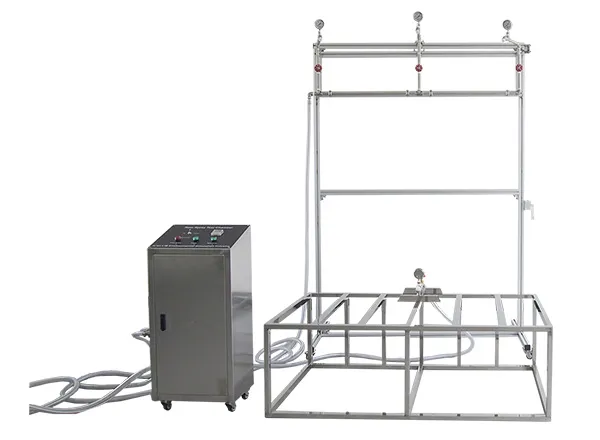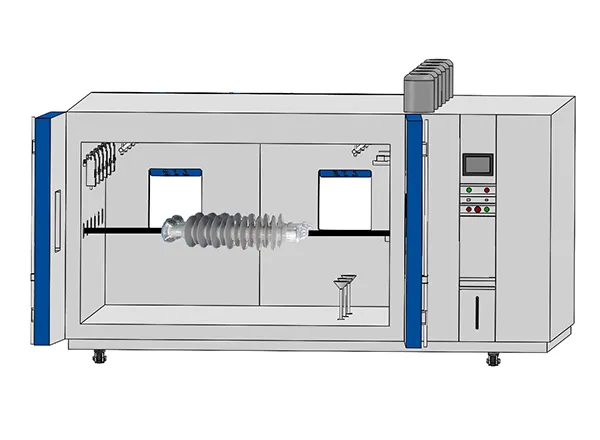
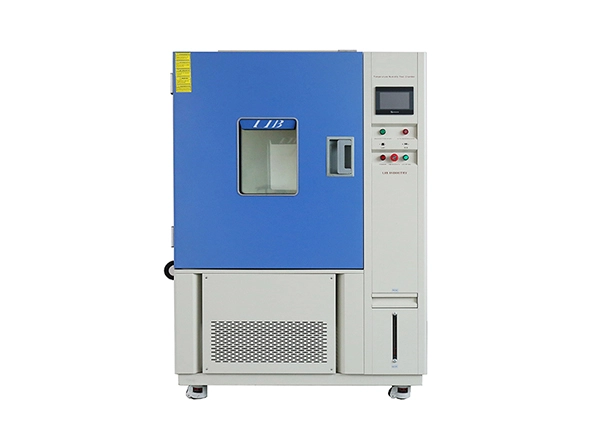
The most damaging moments for a product are not always caused by extreme temperatures alone, but by how quickly those temperatures change. A circuit board leaving a cold storage environment, an automotive component entering a heated engine compartment, or an aerospace part moving through dramatic altitude changes may experience sudden thermal transitions that challenge every material and connection inside the product.
To recreate these demanding conditions in a controlled environment, engineers rely on a thermal shock chamber. Unlike conventional temperature testing equipment that gradually adjusts temperature, a thermal shock chamber is built to create rapid movement between hot and cold zones, forcing products to experience intense thermal stress within a short testing cycle.
The secret behind this capability is not simply powerful heating or cooling technology. It is the precise coordination of multiple systems, including temperature zones, transfer mechanisms, airflow circulation, and control software. Together, these technologies allow modern thermal shock equipment to reproduce real-world temperature changes with high accuracy, helping manufacturers discover potential failures before products reach customers.
As a professional environmental testing solution provider, LIB Industry Technology develops testing solutions designed to support reliable product validation across multiple industries. Customers can explore more environmental testing solutions on our products page or contact our specialists for suitable testing recommendations.
The core function of a thermal shock chamber is to create an extremely fast temperature transition between two different environments. This process is achieved through a specially designed structure that separates hot and cold zones while allowing the test sample to move quickly between them.
Most thermal shock chambers use a two-zone design. One zone maintains a high-temperature environment through powerful heating systems, while the other zone maintains a low-temperature environment through advanced refrigeration technology. A mechanical transfer system moves the test sample from one zone to another, exposing it to sudden temperature changes.
For example, many industrial thermal shock tests require samples to experience temperatures ranging from approximately -65°C to +150°C. However, the exact temperature range depends on industry standards, product requirements, and equipment specifications. The purpose is not simply to reach extreme temperatures, but to achieve rapid and controlled transitions that simulate real operating conditions.
When a product moves between hot and cold zones, different materials inside the product expand and contract at different rates. This creates thermal stress that can reveal weaknesses such as:
Cracks in materials or solder joints
Seal and packaging failures
Component connection problems
Performance degradation after repeated temperature cycling
High-quality thermal shock equipment improves testing reliability by controlling transition speed, temperature stability, and recovery time. These capabilities allow manufacturers to evaluate product durability before mass production and real-world deployment.
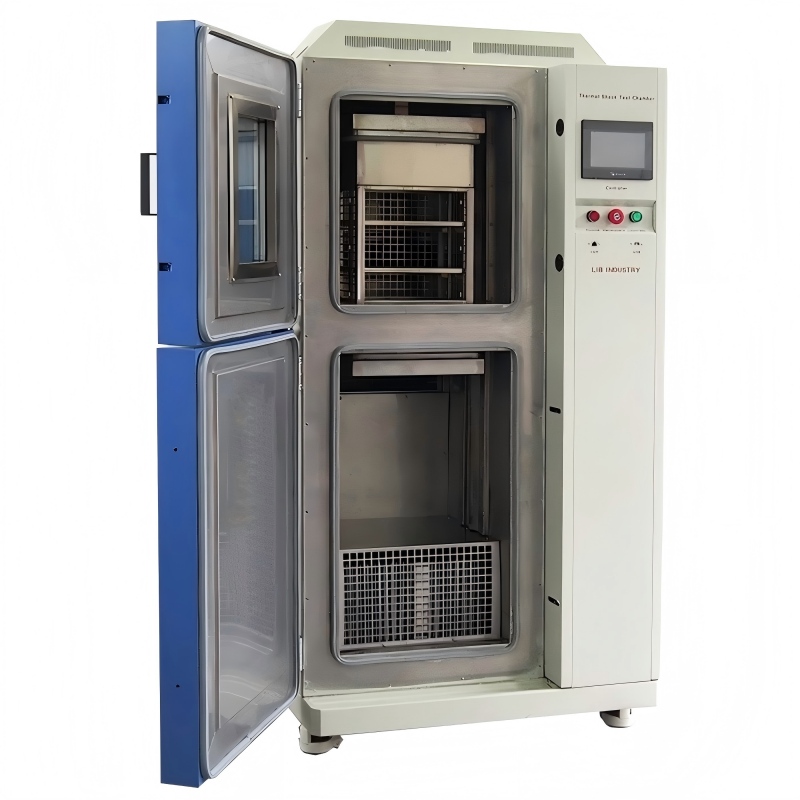
A thermal shock chamber depends on several integrated systems working together to transfer temperature efficiently. Each system contributes to maintaining fast response times and accurate test conditions.
| System | Main Function | Role in Temperature Transfer |
|---|---|---|
| Heating System | Generates and maintains high temperatures | Provides rapid heat supply for the hot zone |
| Refrigeration System | Creates and maintains low temperatures | Removes heat quickly from the cold zone |
| Sample Transfer System | Moves samples between zones | Creates rapid temperature transitions |
| Air Circulation System | Distributes temperature evenly | Improves heat exchange efficiency |
| Control System | Monitors and adjusts parameters | Maintains repeatable testing conditions |
The heating system of a thermal shock chamber must provide enough power to quickly restore the hot zone temperature after sample movement. At the same time, the refrigeration system must maintain sufficient cooling capacity to absorb heat transferred from the sample.
The transfer mechanism is equally important. A well-designed carrier system minimizes the time required for movement while reducing unwanted heat exchange between the two zones. Faster and more stable transfer helps create consistent thermal shock conditions.
Modern thermal shock equipment also integrates intelligent controllers that allow users to program temperature cycles, transfer times, and test sequences. This improves repeatability and makes it easier to meet different industry testing requirements.
Temperature transfer is not only determined by heating and cooling power. Air circulation plays a critical role in ensuring that heat or cold reaches every part of the test sample evenly.
Inside a thermal shock chamber, fans and airflow channels are designed to move conditioned air around the test area. Effective airflow improves heat exchange between the air and the sample surface, allowing faster temperature stabilization.
Poor airflow design may create temperature differences inside the chamber. Some areas may become warmer or colder than others, reducing testing accuracy. For this reason, professional thermal shock equipment focuses on optimized airflow paths and uniform temperature distribution.
During the transfer process, airflow systems also help the chamber recover quickly. When a sample enters a new temperature zone, the air circulation system rapidly removes excess heat or distributes cold air to restore the target condition.
For sensitive products such as semiconductor components, electronic assemblies, battery modules, and precision instruments, stable airflow is essential for obtaining reliable thermal shock test results.
Rapid temperature changes require more than powerful heating and cooling systems. A thermal shock chamber must also maintain precise control throughout the entire testing process.
Temperature sensors continuously monitor conditions inside the hot and cold zones. The control system analyzes sensor feedback and automatically adjusts heating output, refrigeration capacity, and airflow operation to maintain programmed temperatures.
Advanced thermal shock equipment usually includes programmable control interfaces that allow engineers to define testing parameters such as:
Target hot and cold temperatures
Dwell time in each zone
Number of thermal cycles
Transfer duration between zones
Accurate control ensures that every test cycle follows the same procedure. This repeatability is essential when comparing different materials, product designs, or manufacturing processes.
LIB Industry Technology provides environmental test solutions focused on accuracy, stability, and long-term reliability. Companies looking for application-specific solutions can contact LIB technical experts to discuss their testing requirements.
The efficiency of temperature transfer in a thermal shock chamber depends on several technical factors. Understanding these factors helps users select suitable thermal shock equipment and achieve better testing performance.
| Factor | Impact on Temperature Transfer |
|---|---|
| Temperature Difference | A larger temperature difference increases thermal stress but requires stronger heating and cooling performance. |
| Heating and Cooling Capacity | Higher capacity allows faster temperature recovery and more stable operation. |
| Sample Size and Material | Larger samples or materials with high heat capacity require more energy for temperature changes. |
| Insulation Performance | Good insulation reduces heat loss and improves efficiency. |
| Airflow Design | Optimized circulation improves temperature uniformity and transfer speed. |
| Transfer Mechanism Speed | Faster movement creates more accurate thermal shock conditions. |
The characteristics of the test sample are one of the most important considerations. A small electronic component may reach the target temperature quickly, while a large mechanical assembly may require additional stabilization time.
Equipment maintenance also affects long-term performance. Regular calibration, refrigeration system inspection, and airflow system maintenance help maintain the efficiency and accuracy of thermal shock testing.
Efficient temperature transfer determines whether a thermal shock test can accurately reproduce real-world temperature stress. A thermal shock chamber must not only create extreme hot and cold conditions but also switch between them quickly enough to simulate actual environmental challenges.
If temperature transfer is too slow, the test may not generate sufficient thermal stress, leading to inaccurate results. Reliable thermal shock equipment ensures that products experience consistent and repeatable temperature changes, helping engineers identify potential failures earlier.
Industries including automotive electronics, aerospace, telecommunications, semiconductor manufacturing, and energy storage rely on thermal shock testing to improve product reliability. By identifying weaknesses during development, manufacturers can reduce field failures, improve product quality, and increase customer confidence.
A thermal shock chamber transfers temperature between hot and cold zones through the combined operation of heating systems, refrigeration technology, transfer mechanisms, airflow circulation, and intelligent control systems. Each part plays an important role in achieving rapid, accurate, and repeatable temperature transitions.
The performance of thermal shock equipment directly influences testing reliability. Factors such as cooling capacity, insulation design, airflow efficiency, sample characteristics, and control precision determine how effectively a chamber can reproduce real-world thermal stress.
For companies that need dependable environmental testing solutions, selecting a properly designed thermal shock chamber is essential for improving product validation and ensuring long-term reliability.
A thermal shock chamber is used to test how products withstand rapid temperature changes between hot and cold environments.
Most thermal shock chambers use a mechanical transfer system that quickly moves samples between separate hot and cold zones.
The range depends on equipment design, but many thermal shock chambers can operate around -65°C to +150°C.
Air circulation improves temperature uniformity, speeds up heat exchange, and helps maintain accurate test conditions.
Thermal shock chambers are commonly used in electronics, automotive, aerospace, batteries, semiconductors, and industrial manufacturing.
Users can improve performance through proper maintenance, regular calibration, correct sample loading, and selecting suitable testing parameters.

 English
 русский
 français
 العربية
 Deutsch
 Español
 한국어
한국어 italiano
 tiếng việt
 ไทย
ไทย Indonesia