 A carton can look untouched on arrival while the board inside it has already failed — a cracked solder joint, a loosened connector, or a relay contact that only misbehaves under load. This article answers the question directly: shipping vibration is tested with a vibration chamber that reproduces the random motion, temperature, and humidity a package experiences in truck, air, rail, and parcel transport, so engineers can see failures before customers do. Below, we walk through why vibration damages electronics, which standards apply (ASTM D4169, ASTM D999, ASTM D4728, ISTA 3A), how to build a test plan, how LIB vibration chambers are configured for this work, and how to choose between chamber types for your product line.
Most transport vibration is random, not a single clean sine wave. A truck floor, a parcel sorter belt, an aircraft cargo hold, and a pallet stack each inject many frequencies into the package at once, and the carton or foam cushioning can just as easily amplify that energy as absorb it.
Solder joint fatigue and PCB cracking. Circuit boards rarely fail from one shock — they fail from accumulation. Thousands of small bending cycles create microcracks around heavy components, heat sinks, transformers, batteries, and corner-mounted connectors. Fine-pitch parts, BGA packages, and ceramic components carry both electrical and mechanical load, so they are the first to show shifted resonance peaks, lifted pads, or open circuits.
Connector loosening and cable displacement. Connectors combine friction, latch force, and contact pressure, all of which vibration can disturb. Wire harnesses shift, ribbon cables move, screws back out, and insulation rubs against metal edges — often without failing an initial power-on test, only to fail later under load or after further handling.
Component resonance. Displays, fans, inductors, batteries, antennas, and internal brackets each have their own resonant frequency. When cushioning shifts vibration energy into that range instead of damping it, damage accelerates rather than slows down.
Transport Stage | Typical Vibration Source |
Road | Truck and van floor vibration, usually strongest at low frequency |
Sorting/handling | Conveyor transfers, chutes, parcel sorters |
Warehousing | Pallet stacking (top-load pressure), dock plates, forklift movement |
Air | Cargo hold vibration plus pressure and temperature change |
Rail | Continuous low-frequency floor vibration over long duration |
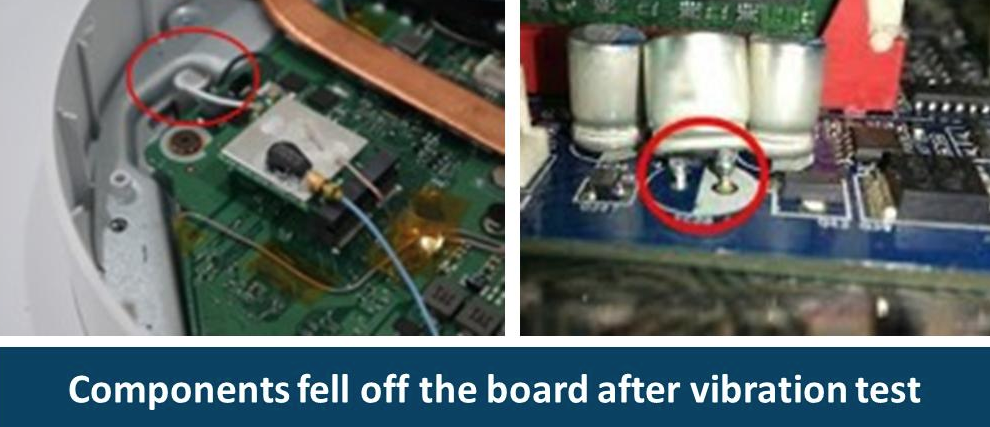
Because real shipments combine several of these in one trip, the test sample should be the full shipping configuration — product, accessories, cables, manuals, inner trays, carton, labels, and closure method — not just the bare board or unit.
The right standard depends on package weight, distribution mode (parcel, palletized, air, or mixed), product risk, and customer requirements.
Standard | Best Use | Key Parameters to Specify |
ASTM D4169 | Shipping containers and systems | Schedule E truck random vibration, typically 1–200 Hz PSD. A 60-minute truck sequence is often split into Low (0.40 Grms, 40 min), Medium (0.54 Grms, 15 min), and High (0.70 Grms, 5 min). |
ASTM D999 | Filled shipping containers | Method A1 repetitive vertical shock, A2 repetitive rotary shock, B single-container resonance, C palletized/unitized/stack resonance. Fixed-displacement setups often use 25.4 mm peak-to-peak displacement at roughly 2–5 Hz for 60 minutes. |
ASTM D4728 | Random vibration of filled shipping units | PSD control in g²/Hz with overall Grms derived from the curve; reports should list frequency range, breakpoints, Grms, orientation, duration, payload weight, fixture, and field-data basis. |
ISTA 3A | Parcel packages up to 70 kg / 150 lb | Standard, small, flat, and elongated package profiles. Random vibration with/without top load at 0.53 and 0.46 overall Grms; optional low-pressure random vibration at 60 kPa (truck-and-air) or 70 kPa (truck-only). |
Engineer's takeaway: if you can't name the Grms level, frequency range, and duration your product must survive, the test spec isn't finished yet.
Start with the actual route — a parcel under 70 kg points to ISTA 3A; a palletized industrial controller is closer to ASTM D4169 or D4728.
Add environmental stress where it applies — foam stiffens in cold storage, softens in heat, and loses damping after compression; corrugated board loses strength in high humidity. Combined chamber testing catches this, vibration-only testing does not.
Record test conditions precisely — product operating state, package orientation, sensor locations, environmental setpoints, and inspection method (visual, torque check, electrical test, firmware log, calibration check, or X-ray).
Compare input vs. response — a strong transmissibility peak means the packaging is feeding energy into the product rather than absorbing it, which points directly at a cushioning redesign.
Post-test inspection should look beyond pass/fail for crushed corners, foam bottoming-out, rubbing dust, cable movement, loosened screws, changed contact resistance, fan noise, intermittent resets, cracked housings, and shifted resonance frequency.
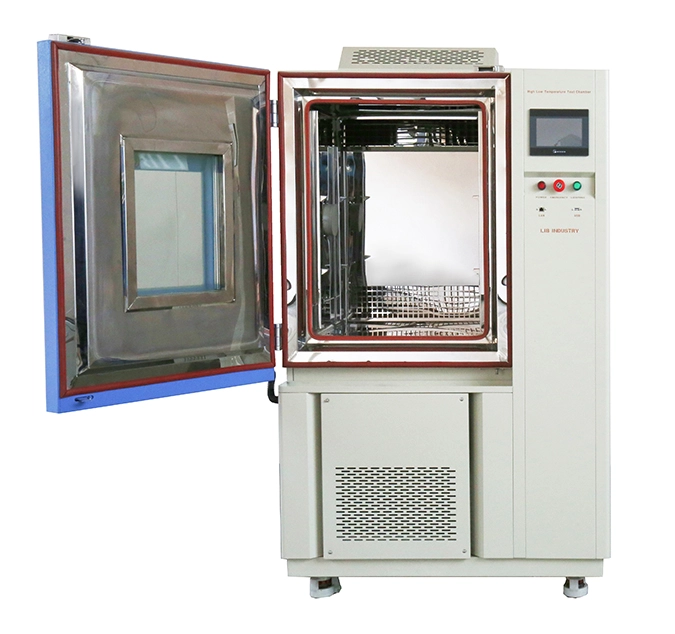
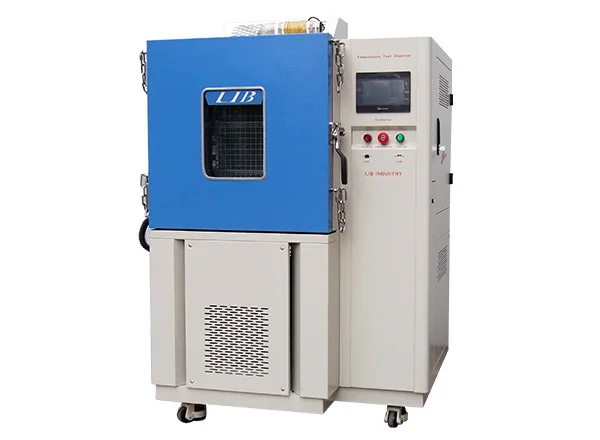
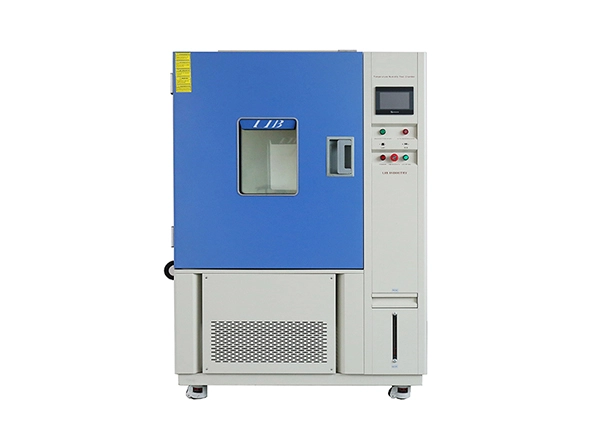
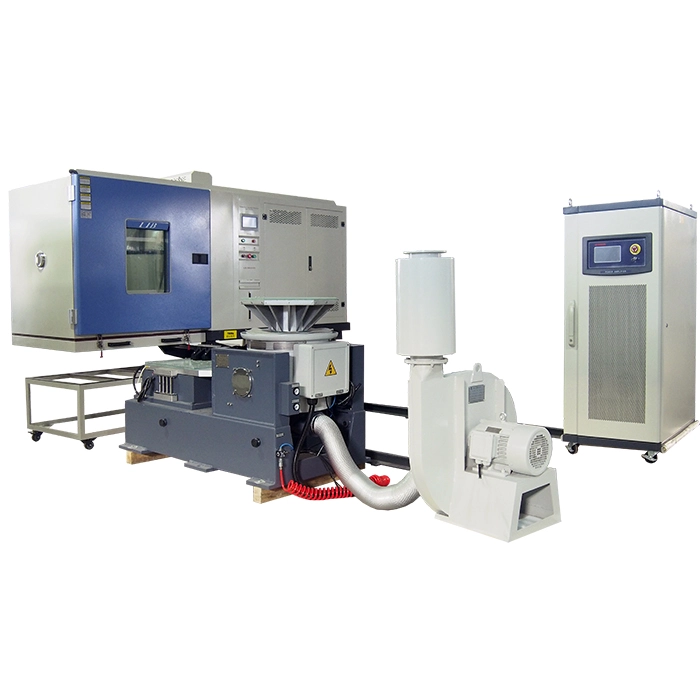
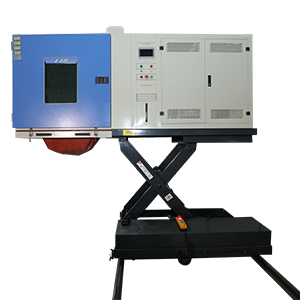
LIB vibration chambers combine mechanical vibration with controlled temperature and humidity in one enclosure, so the same package and sensor layout can be tested at ambient, cold, humid, and hot conditions without moving the sample between machines.
| Capability | Practical Value for Packaging Testing |
|---|---|
| Temperature range: -50°C to +150°C | Reproduces cold-warehouse foam stiffening and hot-truck softening |
| Temperature fluctuation ±0.5°C / deviation ±2.0°C | Keeps thermal conditions stable while vibration data is collected |
| Humidity range: 30%–98% RH, deviation ±2.5% RH | Evaluates carton strength, adhesives, labels, foam, and contact behavior |
| Heating/cooling rate: 5°C/min | Shortens transitions between storage and transport conditions |
| Vibration frequency range: 2–4000 Hz | Covers low-frequency transport motion and higher-frequency resonance screening |
| Rated vibration force: 1000 kgf | Handles demanding package-and-product combined loads |
| Digital power amplifier + mechanical refrigeration | Keeps combined temperature/humidity/vibration profiles repeatable run to run |
| 600 × 600 mm sliding table with head expander | Practical fixture area for packaged electronics and subassemblies |
| |
Factor | Standard Temperature/Humidity Chamber | LIB Vibration + Climate Chamber |
Simulates transport shock/vibration | No | Yes (2–4000 Hz, up to 1000 kgf) |
Simulates cold/hot storage | Yes | Yes |
Simulates humidity effects on packaging | Yes | Yes |
Suitable for shelf-life / storage qualification | Yes | Also suitable, plus transit qualification |
Suitable for ASTM D4169 / D999 / D4728 / ISTA 3A | No | Yes |
Best for | Storage and aging tests | Full shipping-and-distribution qualification |
If your product only needs to survive a warehouse shelf, a standard chamber may be enough. If it needs to survive a truck, a sorter belt, and an aircraft hold in the same trip, the combined chamber is the one that matches the real failure mode.
Engineering teams evaluating a vibration chamber supplier typically ask about more than the spec sheet — they ask what happens after delivery. For LIB customers, this has included on-site installation guidance, operator training on PSD profile setup and fixture mounting, calibration support, and after-sales response for combined temperature-humidity-vibration programs across electronics, automotive, telecom, solar, and industrial accounts.
What standards are used for packaging vibration testing?
The most common are ASTM D4169 for shipping container performance, ASTM D999 for vibration testing procedures on filled containers, ASTM D4728 for random vibration of filled shipping units, and ISTA 3A for parcel packages up to 70 kg / 150 lb.
How do I choose a vibration chamber for electronics packaging testing?
Match the chamber to package dimensions, payload mass, required frequency range, target Grms, temperature/humidity range, fixture area, and the governing standard. For electronics, a chamber that combines temperature, humidity, and vibration is usually more informative than vibration alone.
Which electronics are most vulnerable to transport vibration?
Products with heavy mounted PCB components, fine-pitch solder joints, plug-in modules, displays, batteries, fans, optical components, relays, and cable harnesses need the closest attention during package design.
Does a vibration chamber replace real shipping field trials?
Not entirely — it complements them. Instrumented field shipments generate real PSD data that can be programmed back into the chamber, giving a repeatable lab test that tracks the actual distribution environment.
What after-sales support does LIB provide with its vibration chambers?
LIB backs its vibration chambers with a 3-year warranty, lifetime technical support, and a one-stop service covering project consultation, chamber configuration, installation guidance, operator training, calibration, and ongoing maintenance — so labs get continuity of support for as long as the chamber is in use, not just during the warranty period.
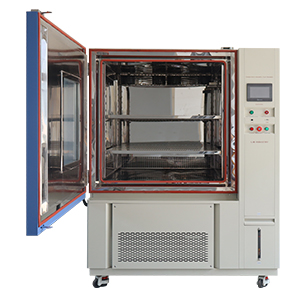
Temperature Humidity Vibration Combined Chamber — for products needing simultaneous climate and transit simulation. |
— for large palletized loads or multi-unit distribution testing. |
Constant Temperature Humidity Chamber — for storage, shelf-life, and pre-conditioning ahead of vibration testing. |
A carton can pass a surface inspection and still hide a damaged board. Solder fatigue, PCB cracking, loosened connectors, cable displacement, resonance, and hidden functional failures are the real risks of shipping vibration — and a vibration chamber is how they're found before a customer finds them first. A sound test plan uses the full packaged product, the governing standard (ASTM D4169, ASTM D999, ASTM D4728, or ISTA 3A), and pass/fail criteria tied to actual product function, not just carton condition.
Need help matching a vibration chamber to your packaging and distribution requirements? Contact LIB Environmental Simulation Industry for chamber configuration guidance, technical data sheets, quotations, or a custom test solution built around your shipping route and product risk profile.
3-Year Warranty | Lifetime Technical Support | Rapid Engineering Response
 English
 русский
 français
 العربية
 Deutsch
 Español
 한국어
한국어 italiano
 tiếng việt
 ไทย
ไทย Indonesia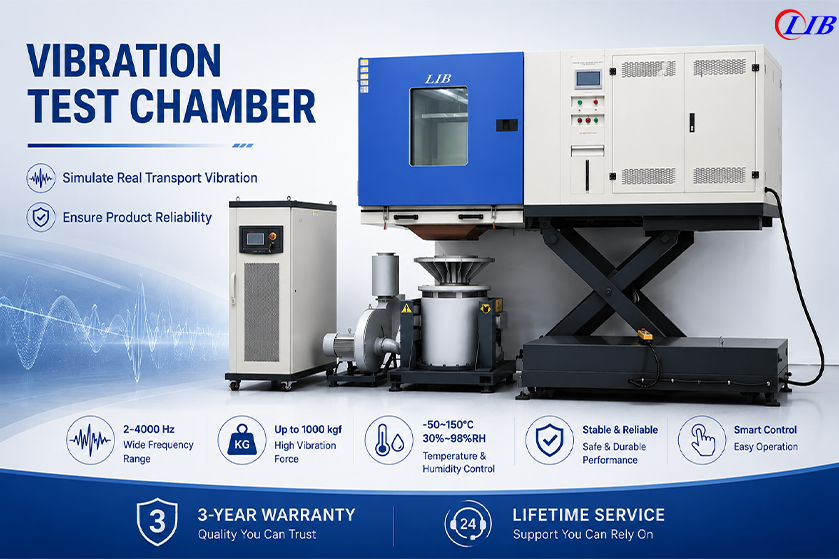

.webp "UV Accelerated Weathering Tester")