Many manufacturers invest heavily in environmental test equipment, expecting it to guarantee product quality and reliability. However, a common and costly reality persists: products still fail once they reach customers.
The root cause is often misunderstood.
It’s not that the equipment is inadequate — it’s that the wrong testing method is being applied.
One of the most frequent and expensive mistakes is confusing Environmental Stress Screening (ESS) with Reliability Testing. While both involve environmental chambers and ess test chamber, their purposes, execution, and outcomes are fundamentally different.
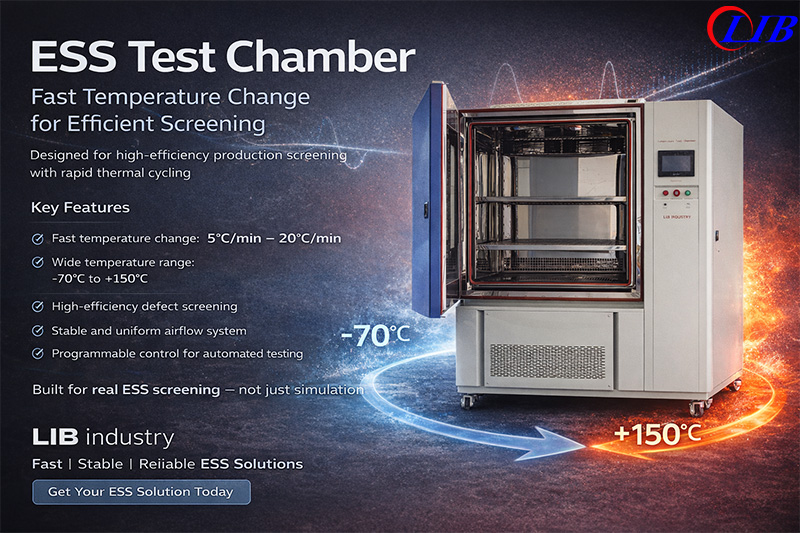
To optimize both quality and cost, it’s essential to clearly understand the difference — and more importantly, to choose the right solution for your production stage.
Environmental Stress Screening (ESS) is a process used in manufacturing to identify and eliminate early-life failures, also known as “infant mortality defects.”
A simple way to understand ESS is to think of it as a military physical examination.
Before soldiers are deployed, they undergo rigorous screening to ensure only those in good condition move forward. Similarly, ESS applies controlled environmental stress to products in order to expose hidden defects before they leave the factory.
Applied to 100% of production units
Focused on detecting latent manufacturing defects
Uses accelerated stress conditions (temperature cycling, vibration)
Ensures only qualified products reach customers
ESS is not about predicting how long a product will last — it’s about ensuring that weak or defective units are removed early.
Reliability Testing, on the other hand, serves a completely different purpose.
Instead of screening every unit, it evaluates the overall durability and lifespan of a product design.
Using another analogy, Reliability Testing is like predicting life expectancy based on a sample population.
Conducted on sample units, not full production
Focused on long-term performance and failure rates
Often simulates real-world or accelerated aging conditions
Used primarily during R&D and product validation stages
The goal is not to filter out defective units, but to improve product design and estimate reliability metrics such as MTBF (Mean Time Between Failures).
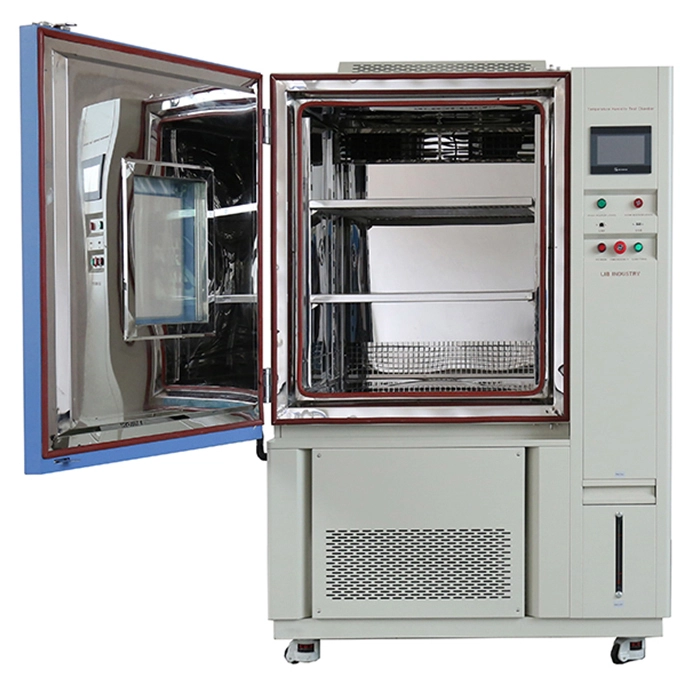
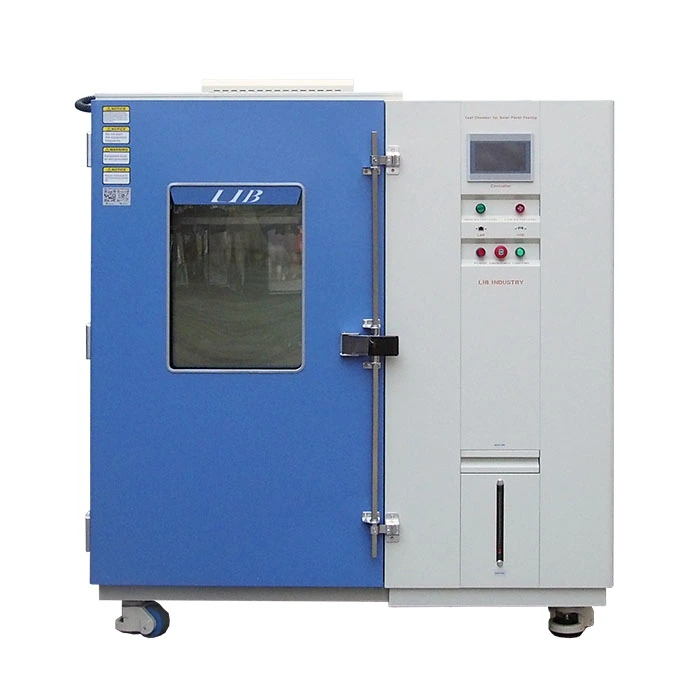
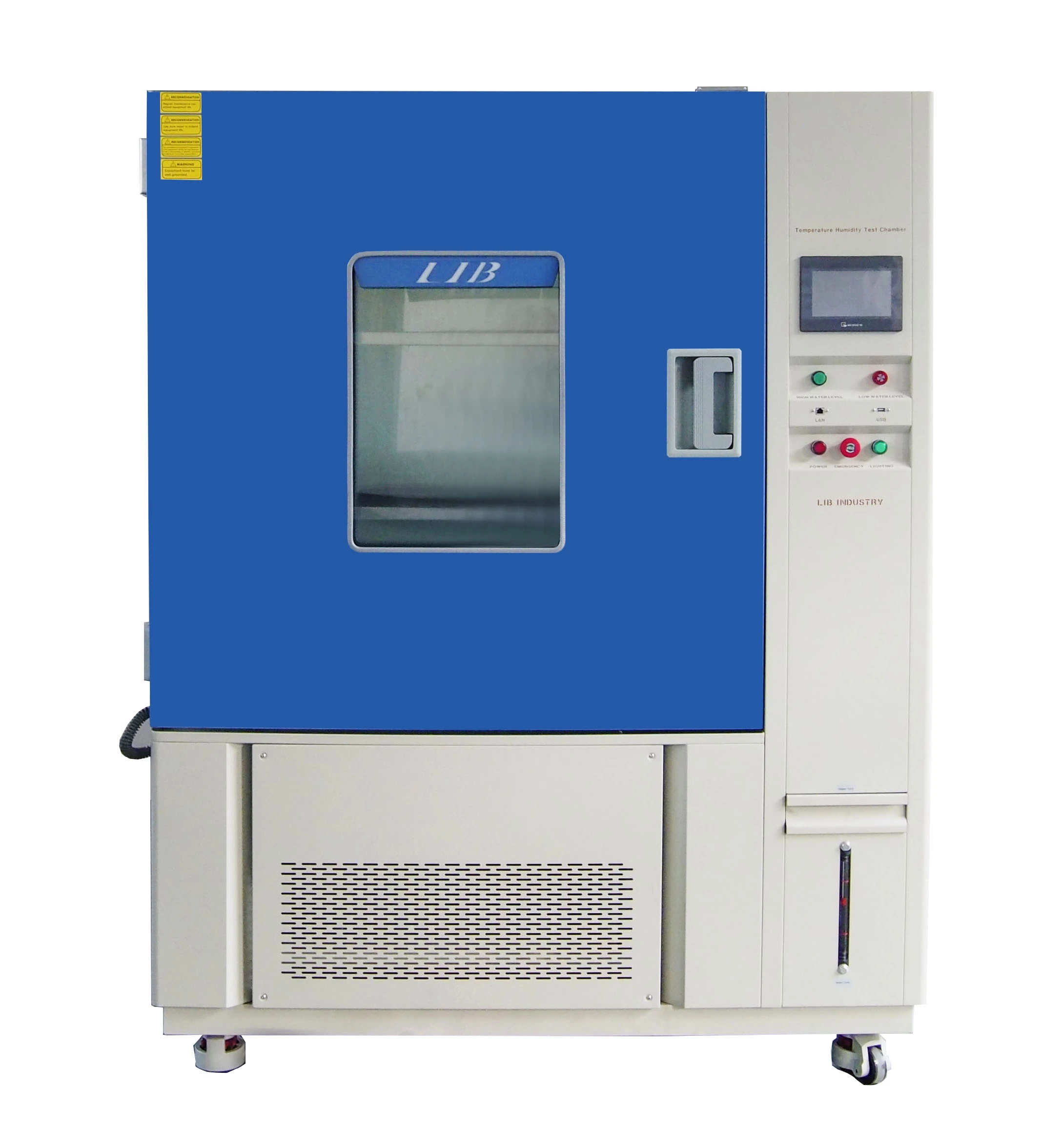
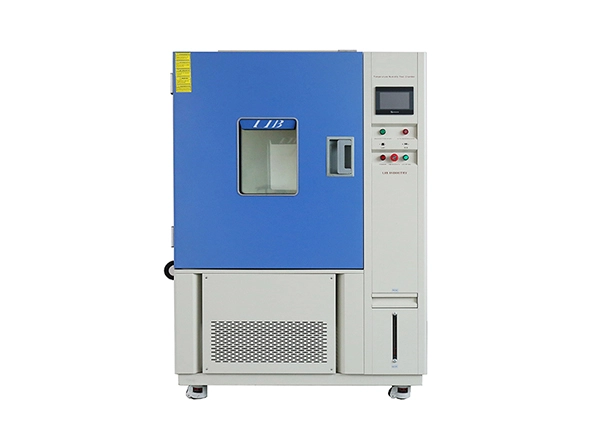
An ESS test chamber is a specialized environmental testing system designed specifically for high-efficiency stress screening in production environments.
Unlike standard temperature or humidity chambers, ESS chambers are engineered to rapidly apply stress in order to trigger hidden defects within a short period of time.
At LIB industry, ESS test chambers are developed with fast temperature change capability, enabling more effective stress activation and improved screening efficiency compared to conventional chambers.
 |  | |||||||
| Name | Fast Change Rate Thermal Cycle Chamber | |||||||
Temperature range | -70℃ ~+150 ℃ | |||||||
| Explosion-Proof Design | explosion-proof door chains, explosion-proof viewing window, smoke detector, and fire suppression sprinkler system Explosion-proof enclosure | |||||||
Low type | A: -20℃ B:-40℃ C -70℃ | |||||||
Temperature fluctuations | ± 0.5 ℃ | |||||||
Humidity Range | 20%~98% | |||||||
Heating rate | 5 ℃/15 ℃ /20℃ min | |||||||
Cooling rate | 5 ℃/15℃ /20℃ min | |||||||
Controller | Programmable color LCD touch screen controller, Multi-language interface, Ethernet , USB | |||||||
Exterior material | Steel Plate with protective coating | |||||||
Interior material | SUS304 stainless steel | |||||||
Standard configuration | 1 Cable hole (Φ 50) with plug; 2 shelves | |||||||
Timing Function | 0.1~999.9 (S,M,H) settable | |||||||
Rapid temperature cycling to induce thermal stress
Detection of defects in solder joints, materials, and assemblies
Continuous operation for batch or inline production screening
Early failure identification and removal
A professional ESS test chamber typically includes:
Fast temperature ramp rates:
5°C/min to 20°C/min (critical for effective screening)
Wide temperature range:
-70°C to +150°C
High airflow circulation system:
Ensures uniform temperature stress across all products
Programmable control system:
Enables automated ESS profiles
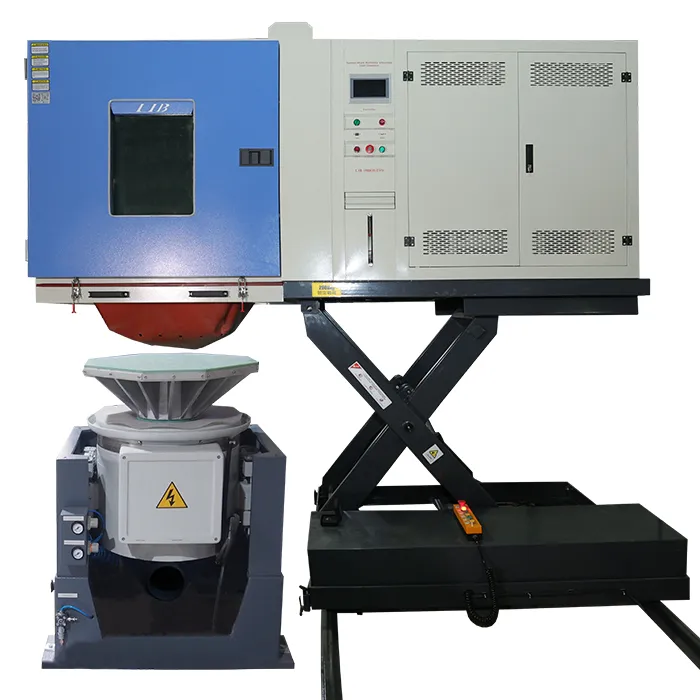
Optional vibration integration:
For combined environmental stress screening
Feature | ESS Test Chamber | Standard Chamber |
Temperature change rate | High (5–20°C/min) | Low (1–3°C/min) |
Purpose | Defect screening | Environmental simulation |
Usage stage | Production | R&D |
Screening efficiency | Very high | Low |
In short, using a standard environmental test chamber for ESS is inefficient and often ineffective.
Understanding the distinction between these two methods is critical for selecting the right approach:
Comparison | ESS | Reliability Testing |
Purpose | Detect early failures | Predict lifespan |
Stage | Production | R&D |
Sample size | 100% | Sampling |
Stress type | Rapid cycling | Realistic or aging |
Result | Pass/Fail | Statistical data |
These methods are not interchangeable — they serve complementary roles in product quality assurance.
Many manufacturers attempt to perform ESS using conventional temperature chambers.
The problem:
Slow ramp rates (e.g., 1°C/min)
Insufficient stress activation
Ineffective defect screening
Result: wasted time, energy, and false confidence in product quality.
Some users apply excessive stress levels, believing that stronger stress equals better screening.
The reality:
Over-stressing can damage good products
Introduces artificial fatigue
Reduces actual product lifespan
ESS (Environmental Stress Screening) test chambers are essential
ESS is widely used in production environments to quickly expose hidden defects through rapid thermal cycling and stress loading.
Key priorities:
High temperature ramp rates (fast stress activation)
Excellent airflow uniformity for consistent exposure
Stable batch-to-batch repeatability
High throughput for continuous screening lines
For both R&D and mass production scenarios, LIB industry also provides ESS solutions, including:
Standard ESS test chambers
High-ramp-rate rapid thermal cycling systems
Walk-in ESS chambers for large-scale or batch production testing
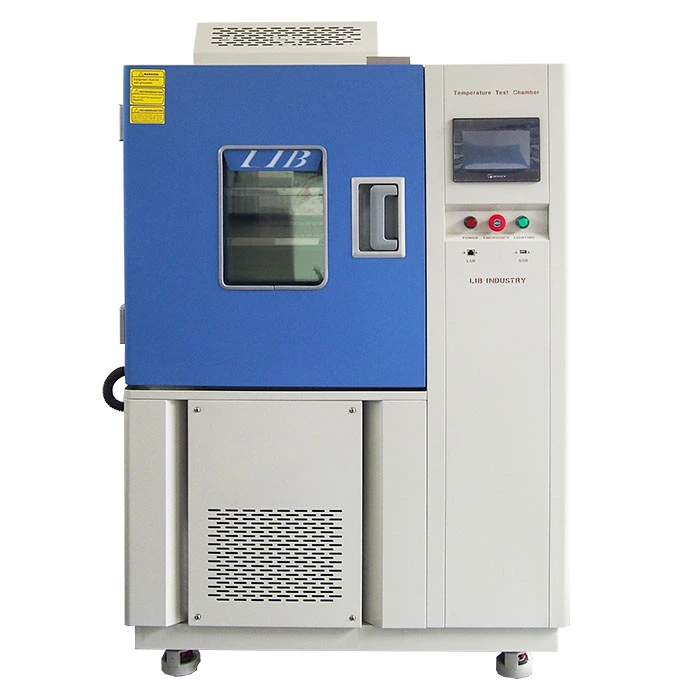 ESS Test Chamber | 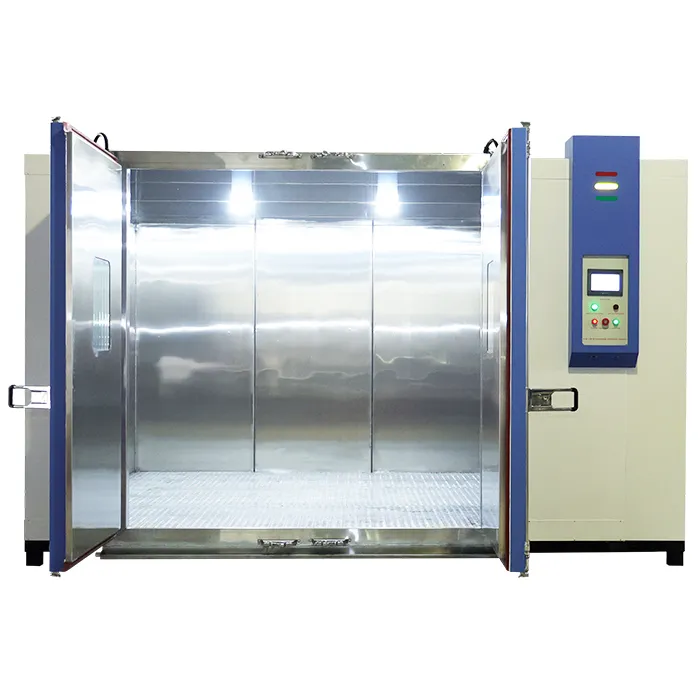 Walk-in ESS Test Chamber |
Choose reliability testing systems
Focus on:
Long-term stability
High data accuracy
Repeatable environmental conditions
Material and design validation
Consider combined temperature + vibration systems
These systems combine:
Thermal cycling (temperature stress)
Vibration stress
Sometimes humidity or combined environmental loads
This allows engineers to simulate real-world operating conditions more realistically and accelerate failure detection.
|
|
Choosing the right ESS test chamber is only the first step — long-term reliability and service support are just as important.
At LIB industry, we provide full lifecycle support to ensure stable and efficient operation of your ESS system:
Pre-sales technical consultation for correct ESS configuration
Installation and commissioning support (remote or on-site)
Operator training for proper ESS application
Fast-response after-sales service and spare parts supply
3-year warranty with lifetime technical support
Take the Next Step
Contact LIB industry for a free technical consultation.Get a customized ESS screening solution for your production line
Typically, 5°C/min to 20°C/min is considered effective for ESS applications. The exact requirement depends on product structure, material properties, and failure mechanisms.
To achieve this performance, LIB industry ESS test chambers (fast temperature change chambers) are specifically engineered for rapid thermal cycling and stable stress control.
No — when properly designed. ESS is intended to eliminate weak or defective units without affecting qualified products.
This is why precise control of stress level, airflow, and temperature transition is critical — all of which are key design priorities in LIB industry ESS test chambers.
ESS is typically used during mass production for 100% product screening, while reliability testing is used in the R&D phase for design validation and lifetime prediction.
Both are essential and complementary — they are not interchangeable.
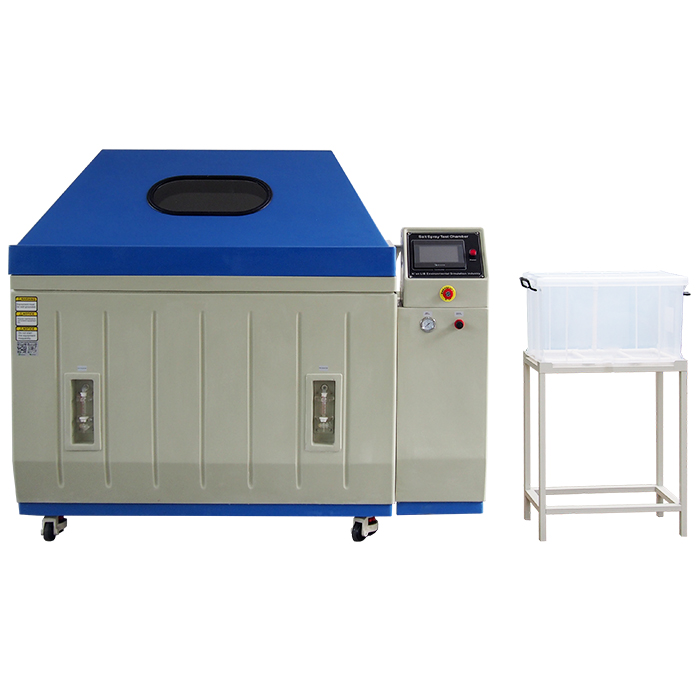
LIB industry provides a full range of environmental testing solutions, including:
Standard Temperature & Humidity Chambers | ESS Test Chambers (Fast Temperature Change Chambers) | Thermal Shock Test Chambers | Temperature & Vibration Combined Systems
Each system is designed to meet different stages of product development and production quality control.
 English
 русский
 français
 العربية
 Deutsch
 Español
 한국어
한국어 italiano
 tiếng việt
 ไทย
ไทย Indonesia