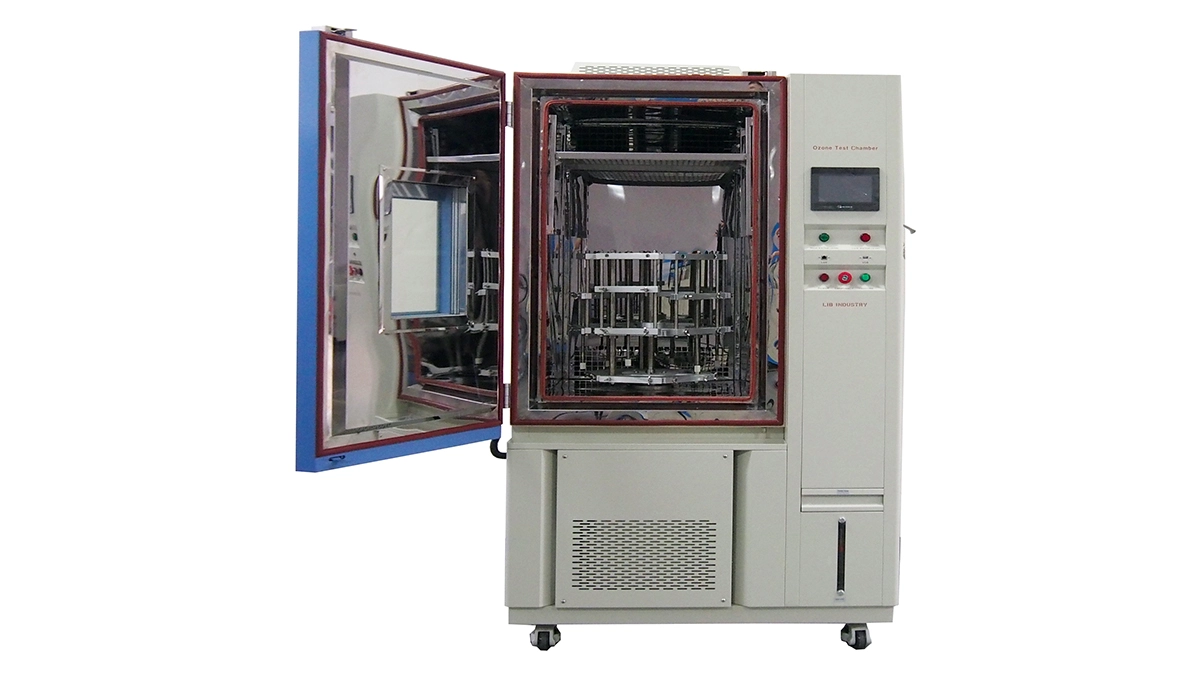
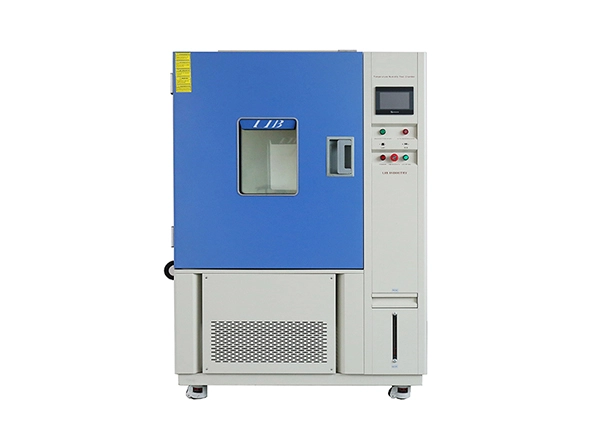
Electric vehicles are expected to handle more than dry lab conditions. They pass through heavy rain, deep roadside water, automatic wash systems, slush, mud, and daily temperature swings. For the battery pack, that means one thing: the enclosure must keep water out even when seals, joints, valves, and cable entries are pushed hard. That is why EV battery waterproof testing has moved from a nice-to-have check to a core part of automotive battery reliability testing.
For manufacturers, the goal is not just passing a lab test. The goal is to reduce field failures, lower warranty risk, and protect battery safety through a repeatable battery pack waterproof test.
Battery packs sit low in the vehicle structure, close to splash zones and road spray. A small leak does not always show up right away. In many cases, moisture enters slowly, stays trapped, and starts damaging busbars, connectors, coatings, sensors, or insulation over time. That is why battery pack water ingress testing has to go beyond simple spray checks. It needs to recreate the kind of pressure, heat, and angle changes that happen in the real world.
Water intrusion in an EV battery pack rarely begins as a dramatic event. More often, it starts at a weak interface, a damaged seal, an aging gasket, or a connector area that looked fine during assembly. This is why leak risk has to be discussed in real vehicle use, not only in design drawings.
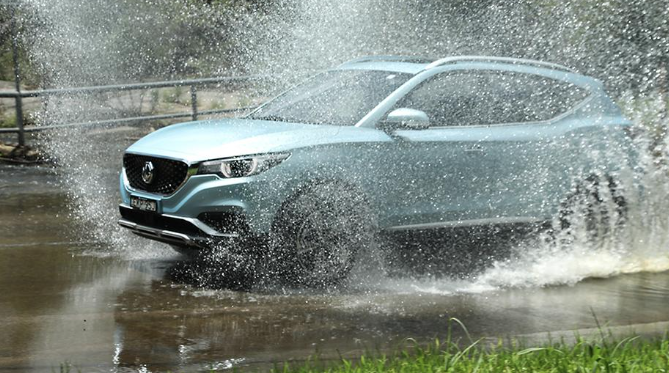
Battery packs face different water loads depending on the use case. Highway rain throws fine spray across the underside. Flooded roads add standing water and pressure from wheel movement. Automatic wash systems hit the enclosure with hot, high-pressure jets from changing directions.
| Exposure scenario | Typical stress on the pack | Main test concern |
|---|---|---|
| Heavy rain at speed | Continuous splash and wheel-thrown spray | Weak sealing at seams and cable exits |
| Flooded road sections | Temporary pooling and pressure differences | Water migration into hidden gaps |
| High-pressure vehicle wash | Hot, forceful jets from close range | Seal lift, connector leakage, surface damage |
Once water gets inside, the damage path can be fast or slow. Liquid may reach high-voltage areas and cause insulation loss or short circuit risk. In other cases, the first sign is corrosion on metallic parts, unstable sensor readings, or reduced connector reliability after repeated wet-dry cycles. Water can also affect adhesives, venting parts, and thermal interface materials.
For this reason, EV battery enclosure sealing test work is closely tied to safety, service life, and pack reliability. A pack that survives one splash event is not necessarily stable after months of harsh road exposure.
Many engineers use the term IPX9K as shorthand for the toughest hot water spray verification used in vehicle-related sealing work. For battery teams, the value lies in what the test forces the enclosure to endure.
Both ISO 20653 IPX9K and IEC 60529 IPX9K refer to the same type of test, involving high-pressure, high-temperature water sprays to test the waterproof capabilities of enclosures, such as those found in automotive battery packs.
ISO 20653 is a standard specifically designed for road vehicles and their electrical components, and it outlines tests for determining the level of protection an enclosure offers against ingress of water when subjected to high-pressure, high-temperature jets.
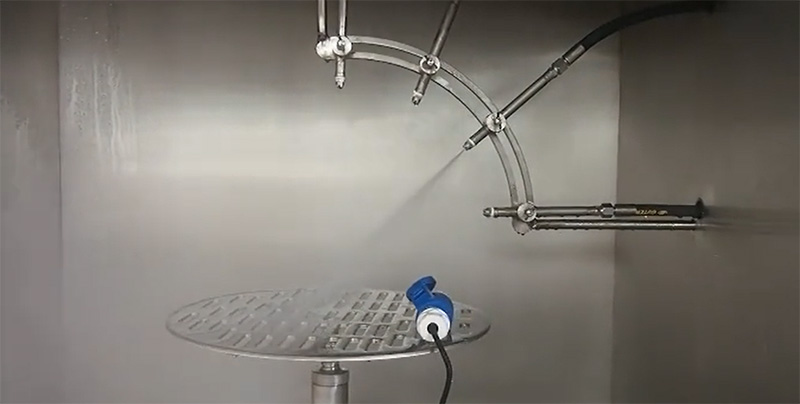
Water Pressure: 8000–10000 kPa,which simulates the high-pressure conditions vehicles experience from road splash, heavy rain, or pressure washing systems.
Temperature: up to 88°C,which simulates the extreme temperature conditions that an automotive battery pack might face when subjected to high-pressure water in hot climates.
Spray Angles: 0°, 30°, 60°, 90° to ensure the enclosure’s sealing capability from different directions.
Distance: 10–15 cm,which ensures the pressure is applied intensely to simulate real-world washdown conditions.
Duration: 30 seconds per angle ensuring thorough coverage.
This rigorous standard ensures that the electrical and structural components of vehicles, including battery packs, remain protected from ingress when exposed to extreme water jets under high-pressure conditions, such as those encountered during vehicle washdowns or heavy rain.
IEC 60529 is a broader standard for enclosure protection across industries, including automotive, electronics, and industrial equipment. Its IPX9K test conditions are similar to ISO 20653:
High-pressure water (8000–10000 kPa)
High-temperature spray (up to 88°C)
Multi-angle spray coverage
Close-range exposure for 30 seconds per angle
The ISO 20653 standard is specifically designed for road vehicles. Under the rigorous testing conditions of ISO 20653 IPX9K, every detail has the potential to become a leakage path,
The two references are often discussed together, but their use context is slightly different. ISO 20653 is closely tied to road vehicle electrical equipment, so it speaks more directly to automotive applications. IEC 60529 is broader and forms the base language for enclosure protection across industries. In day-to-day engineering work, both are used to shape test plans, supplier specs, and acceptance criteria.
The overlap is what matters most for battery engineers: hot water, strong jet force, multiple spray angles, and a pass/fail focus on harmful water ingress. That makes the IPX9K water spray test chamber highly relevant when the aim is automotive battery reliability testing rather than a basic waterproof claim.
Battery pack waterproofing is not a single design feature; it results from enclosure geometry, seal compression, fastening strategy, vent design, material aging, and manufacturing control. IPX9K testing gives engineers a practical way to challenge the full system.
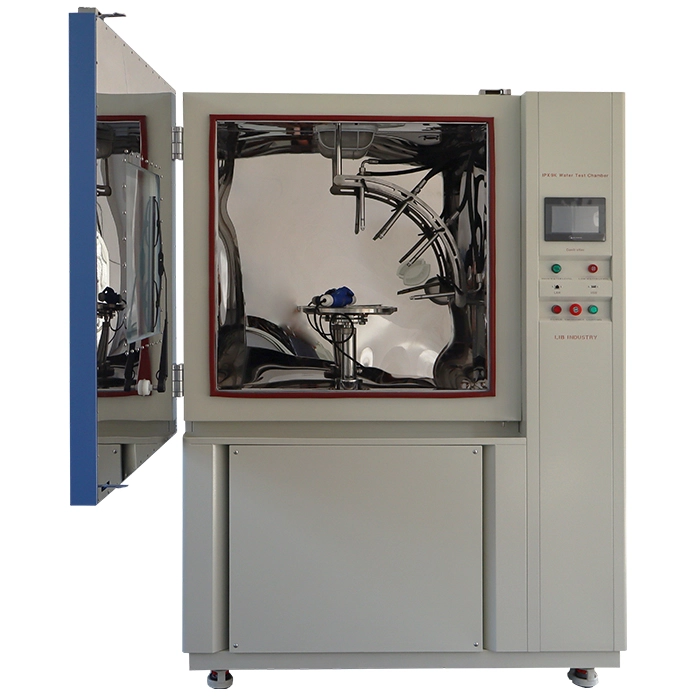
A proper IPX9K water spray test chamber recreates severe washdown conditions rather than simple rainfall. LIB IPX9K test equipment includes:
Water pressure: 8000–10000 kPa
Adjustable spray temperature up to +88°C
Four spray angles: 0°, 30°, 60°, 90°
Flow rate: 14–16 L/min
Close spray distance
These parameters attack the enclosure from angles that can expose weak sealing geometry.
Seals may shift during assembly. Fastener torque may vary. Surface flatness may change after welding or machining. A vent that works well on paper may become a weak point under real water, pressure, and temperature conditions.
That is why battery pack water ingress testing should be done on realistic assemblies, not only coupons or single components. Complete pack-level testing gives much better insight into true leakage behavior.
High-pressure jets create localized impact, thermal shock, and directional force. This combination helps reveal defects that lower-level tests may miss. For battery packs with complex geometry, water can rebound, collect near bolts, or penetrate narrow seam transitions.
Large perimeter gaskets get most attention, but smaller interfaces often matter just as much: cover joints, inspection lids, welded seams, bolted flanges, and bracket penetrations. Compression set, surface finish, tolerance stack-up, and thermal expansion can change seal performance over time.
Connector systems and cable entries are common leak paths due to material and shape complexity. Vent valves need to equalize pressure while limiting water entry. Focus areas include:
High-voltage connector zones
Low-voltage signal connectors
Vent valve mounting areas
Cable glands or pass-through points
Service access covers and drain features
Cooling plates and coolant channels add another layer of risk. Internal coolant leakage can create similar failure modes. Pressure differences during altitude change, heating, cooling, and rapid washdown can pull on seals.
When a lab needs repeatable EV battery waterproof testing, the chamber matters as much as the standard. Good equipment is not just about reaching pressure and temperature targets. It is about controlling them well enough that results can be trusted from one test cycle to the next.
 |  |
SUS 304 workroom | 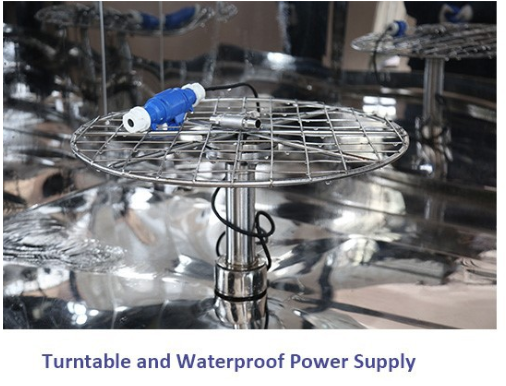 |
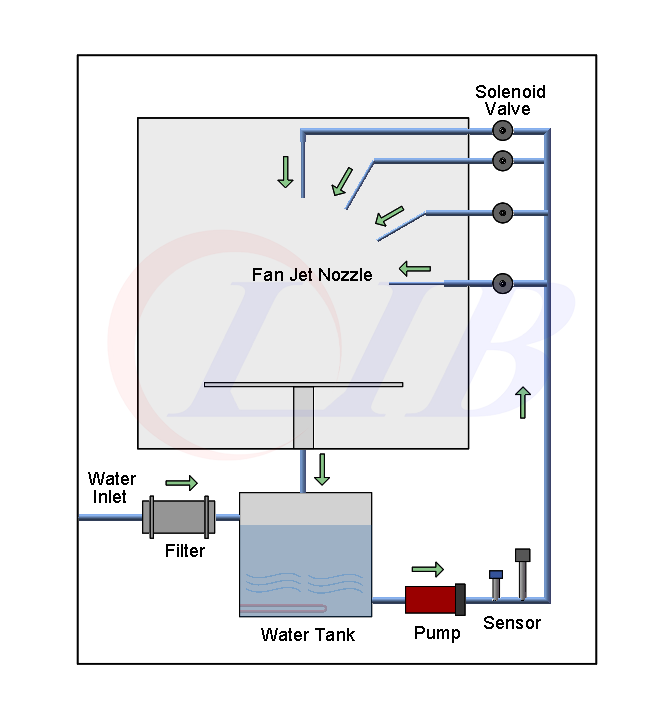
A high pressure & temperature water spray test chamber should do three jobs well: generate stable spray conditions, expose the specimen from defined positions, and make the process easy to repeat. LIB’s IPX9K water spray test chamber is positioned for exactly that kind of work, with controlled pressure, temperature, flow, and fixed spray angles.
Test factor | Typical chamber setting | Why it matters in battery pack waterproof test |
Water pressure | 8000–10000 kPa | Reveals weak seals and local intrusion paths |
Spray temperature | Ambient to high hot-water range | Adds thermal stress to sealing materials |
Flow rate | 14–16 L/min | Keeps jet impact stable and repeatable |
Spray angles | 0°, 30°, 60°, 90° | Exposes different enclosure geometries |
Close spray distance | Short-range impingement | Simulates harsh washdown conditions |
The value of an environmental simulation chamber for battery testing lies in repeatability. A road test may show that a leak exists, but it is harder to reproduce the same water temperature, force, angle, and duration over and over. In a chamber, those variables can be held much tighter.
That helps engineering teams compare designs, verify process improvements, and confirm corrective actions. It also makes supplier communication easier because the test condition is defined, not guessed.
For EV battery enclosure sealing test work, a dedicated chamber offers practical advantages:
· repeatable test cycles for development and validation
· controlled hot-water exposure for seal material assessment
· clearer comparison between design versions
· easier failure localization after test teardown
· better support for documented automotive battery reliability testing
In short, an IPX9K water spray test chamber turns a vague “waterproof check” into a useful engineering tool.
Leading Supplier: Chambers for automotive, battery, and electronics applications, including temperature, humidity, dust, and water ingress testing.
Tailored Solutions: Custom chamber solutions for specimen size, lab conditions, and test purpose.
Comprehensive Support: Design, production, commissioning, delivery, installation, training, and after-sales service. 3-year warranty with lifelong follow-up.
EV battery waterproof testing is no longer just a box to tick before SOP. It protects battery safety, reduces warranty risk, and ensures long-term reliability. Failures often start at ordinary details: connector shoulders, vent valve seats, enclosure seams, or cable entries. IPX9K testing exposes these risks under realistic high-pressure, high-temperature conditions.
What does IPX9K mean in EV battery waterproof testing?
Resistance against close-range, high-pressure, high-temperature water spray.
What’s the difference between ISO 20653 and IEC 60529?
ISO 20653 focuses on road vehicles; IEC 60529 is broader for enclosure protection across industries.
Why is an IPX9K water spray test chamber important?
It creates repeatable, extreme conditions that reveal weak seals and enclosure design issues.
What parts usually fail first?
Seals, bolted joints, connectors, vent valves, cable entries, service covers.
Can one chamber replace other leak checks?
No, it complements air leak, coolant circuit, and durability tests for a full sealing validation plan.
 English
 русский
 français
 العربية
 Deutsch
 Español
 한국어
한국어 italiano
 tiếng việt
 ไทย
ไทย Indonesia