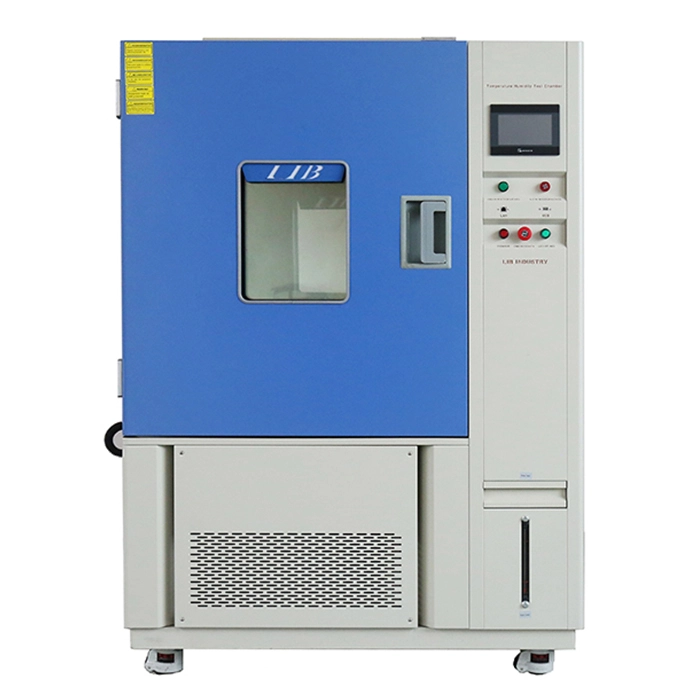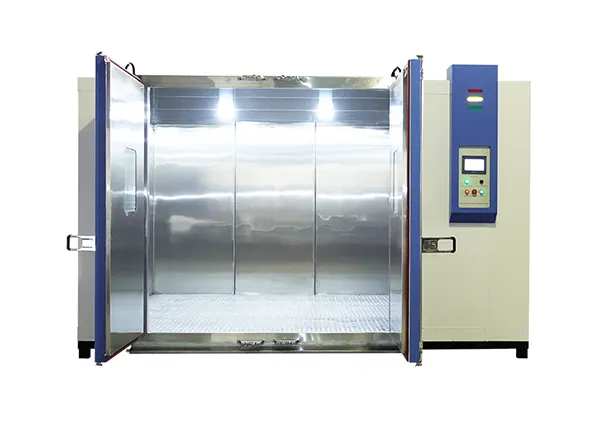
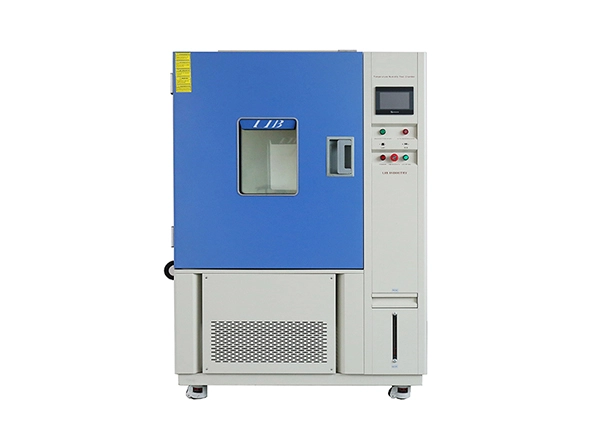
In modern environmental testing, the control system of a climate test chamber directly determines test accuracy, repeatability, and compliance reliability. Whether used in automotive validation, electronics reliability testing, or pharmaceutical stability studies, the choice between a programmable and manual control system plays a critical role in overall testing performance.
Both systems have clear advantages, but they serve different engineering needs. Understanding their differences helps laboratories and manufacturers avoid over-investment or underperformance in critical testing workflows.
A climate test chamber control system is responsible for regulating key environmental parameters such as temperature, humidity, and time-based cycling. It ensures that test conditions remain stable and repeatable according to international standards such as ASTM, ISO, and IEC.
Modern systems typically fall into two categories:
Programmable control systems
Manual control systems
Each offers a different level of automation, precision, and operational flexibility.
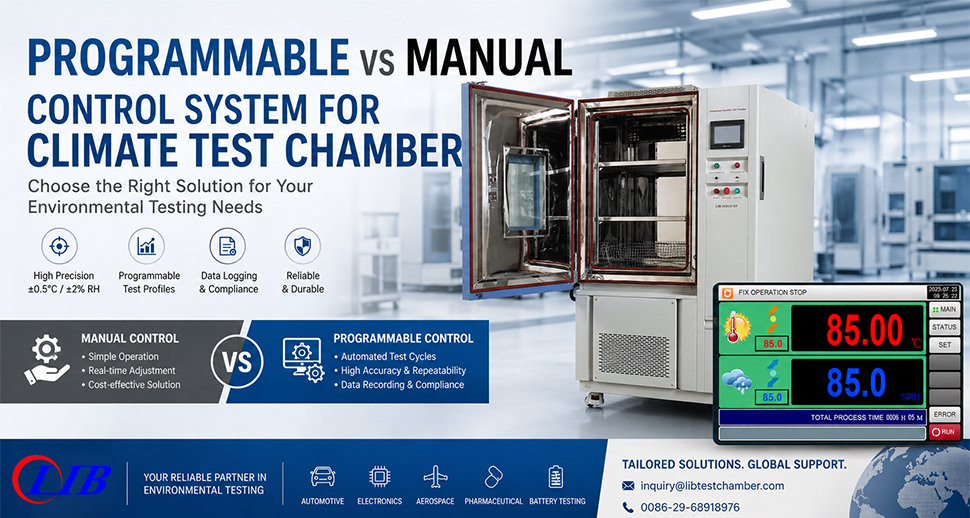
A programmable control system uses a digital interface (often PLC-based with touchscreen software) to automate environmental testing processes. Users can define complex test profiles including temperature ramps, humidity cycles, dwell times, and multi-step sequences.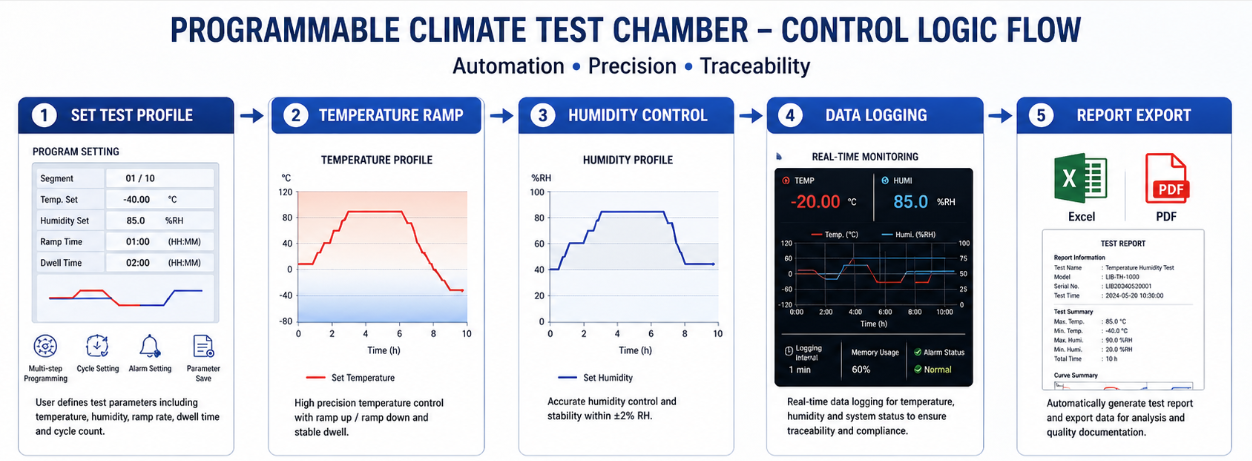
Programmable climate test chambers typically offer:
Multi-segment test programming (up to 1000 steps in advanced systems)
Temperature accuracy around ±0.5°C
Humidity control stability within ±2% RH
Automated cycle repetition and long-term operation
Data logging for compliance and traceability
USB/Ethernet export for test reports
These features make programmable systems highly suitable for industries requiring strict repeatability and documentation.
Programmable systems are widely used in:
Automotive component durability testing (ECUs, sensors, batteries)
Electronics reliability validation
Aerospace material qualification
Pharmaceutical stability testing under ICH guidelines
For example, in battery testing, programmable control allows precise thermal cycling between extreme temperature ranges, simulating real-world operating conditions over accelerated time periods.
Manual control systems rely on direct operator input through analog or simplified digital interfaces. Instead of pre-programmed cycles, technicians adjust temperature and humidity settings in real time during testing.
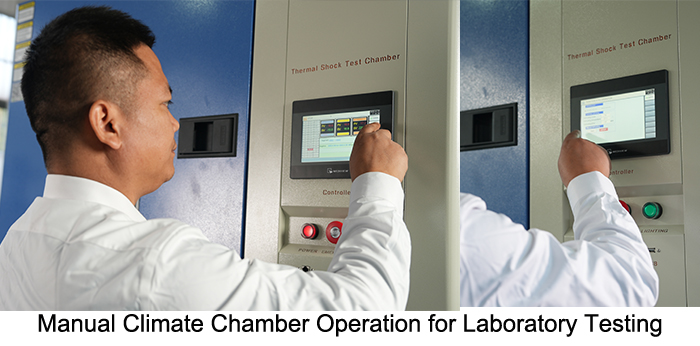
Immediate manual adjustment during experiments
Lower initial investment cost
Simpler system architecture and maintenance
Ideal for flexible or exploratory testing environments
Manual systems are especially useful in early-stage R&D environments where test conditions may change frequently based on observations.
Material research laboratories
Prototype validation testing
Small-scale industrial quality checks
Budget-sensitive testing environments
While less automated, manual systems offer strong operational flexibility and hands-on control, which is often preferred in experimental development stages.
Feature | Programmable System | Manual System |
Automation | Fully automated test cycles | Operator-controlled |
Repeatability | High consistency | Dependent on operator |
Data logging | Advanced, automatic | Limited or none |
Programming capability | Multi-step test profiles | Not available |
Cost | Higher initial investment | Lower entry cost |
Compliance support | Strong (ASTM, ISO, IEC) | Limited |
Best suited for | Industrial production & certification | R&D and small labs |
This comparison shows that neither system is universally superior. Instead, the best choice depends on testing volume, compliance requirements, and operational budget.
When selecting a climate test chamber control system, several engineering factors should be considered:
High-throughput laboratories benefit significantly from programmable systems due to reduced manual workload and improved efficiency. For occasional testing, manual systems may be sufficient.
Industries such as automotive, aerospace, and pharmaceuticals often require full traceability and data logging. Programmable systems provide built-in compliance support for ASTM and ISO standards.
While programmable systems require higher upfront investment, they reduce long-term labor costs and improve efficiency. Manual systems are more cost-effective initially but may limit scalability.
Multi-stage environmental simulations (thermal cycling, humidity aging, combined stress testing) are best handled by programmable systems.
As a professional manufacturer of environmental testing equipment, LIB industry provides both programmable and manual climate test chamber solutions designed for industrial reliability and precision.
Our systems feature:
Advanced PLC touchscreen control systems
High-precision temperature and humidity regulation
Customizable chamber sizes and configurations
Remote monitoring and data management capabilities
Compliance with international testing standards
Whether you require fully automated programmable testing or flexible manual operation, LIB industry delivers tailored solutions based on your application needs.
A leading automotive electronics manufacturer recently upgraded from a manual system to a programmable climate test chamber supplied by LIB industry. The transition significantly improved test repeatability and reduced human intervention, enabling the company to accelerate product validation cycles while meeting stricter compliance requirements.
Conversely, a materials research laboratory selected a manual control system to maintain flexibility during early-stage experiments. This allowed engineers to adjust conditions in real time and refine test parameters before scaling up to automated validation.
These examples highlight that the optimal system depends on the stage of development and testing objectives.
The decision between a programmable and manual control system for a climate test chamber should be guided by engineering requirements rather than cost alone.
Choose programmable systems for precision, automation, and compliance-heavy applications.
Choose manual systems for flexible, low-volume, or early-stage research testing.
Both systems play a critical role in environmental testing workflows when correctly matched to application needs.
At LIB industry, we help customers design the right control system configuration based on their exact testing requirements, ensuring reliable performance and long-term value.
For customized climate test chamber solutions and technical consultation:
inquiry@libtestchamber.com
0086-29-68918976
3-Year Warranty | Lifetime Technical Support | Rapid Engineering Response
 English
 русский
 français
 العربية
 Deutsch
 Español
 한국어
한국어 italiano
 tiếng việt
 ไทย
ไทย Indonesia
.webp "SO2 Gas Cyclic Salt Fog Corrosion Spray Chamber")