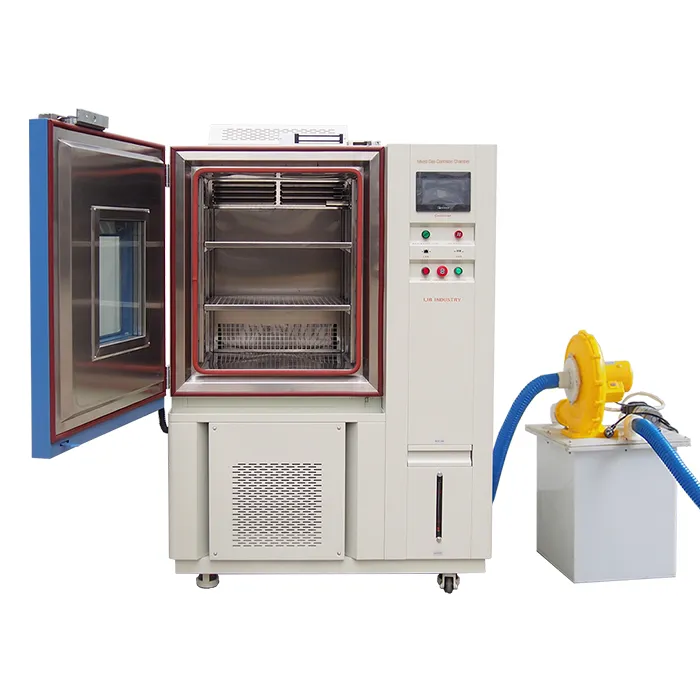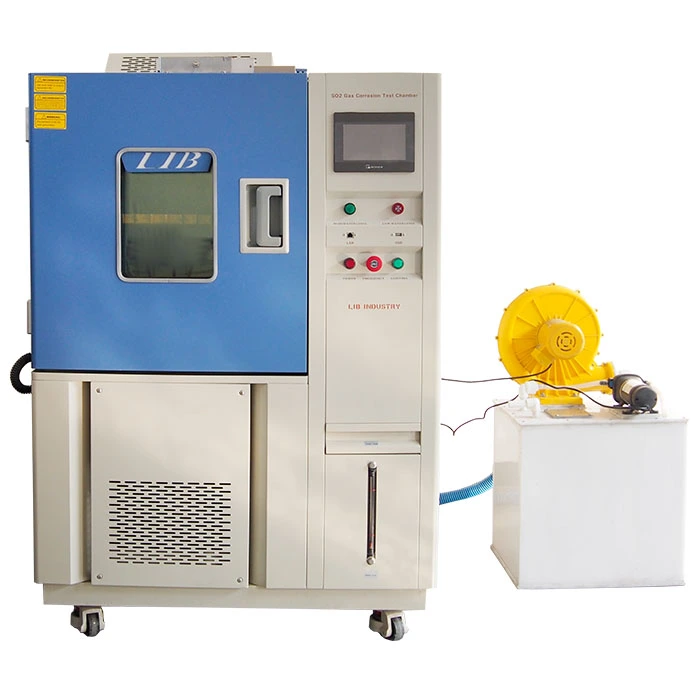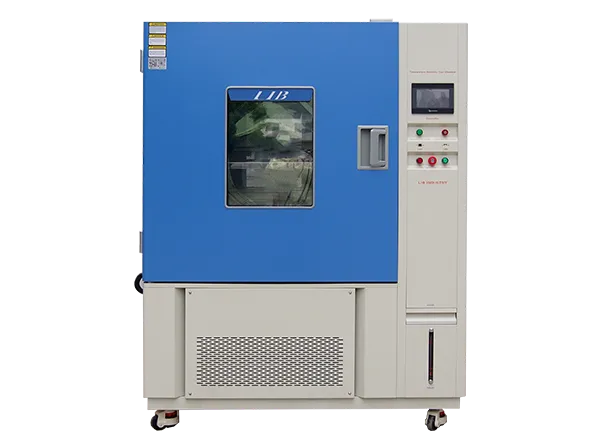
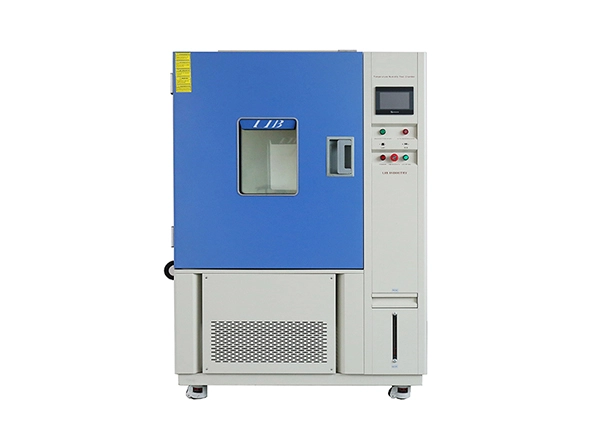
EV charging connector testing should combine several environmental tests rather than relying on a single chamber. Temperature chambers evaluate thermal resistance and performance across hot and cold conditions; IP test equipment checks protection against dust and water; and salt spray chambers evaluate corrosion resistance of metal parts, coatings, and electrical components. For charging connectors and charging stations, the appropriate equipment depends on the component size, operating condition, heat generation, and expected outdoor exposure. LIB provides temperature chambers from compact laboratory configurations to large systems, dedicated IP equipment for dust and water ingress, and salt spray chambers for corrosion evaluation. The most important selection factor is matching each test environment to the connector or charging-station failure mode.
EV charging systems operate outdoors and are exposed to temperature changes, rain, humidity, dust, road contamination, and corrosive environments. Connectors can also experience repeated insertion, electrical loading, and heat generation during charging.
Environmental testing should therefore examine both the physical protection of the enclosure and the long-term reliability of materials and electrical interfaces.
Typical test samples include:
EV charging connectors
Charging plugs and sockets
Cable assemblies
Charging station housings
Connector terminals
Sealing components
Protective covers
Control modules
Outdoor charging equipment
Different tests reveal different failure modes.
Temperature testing can identify insulation deterioration, dimensional changes, material embrittlement, thermal deformation, and performance instability.
Water and dust testing examines whether contaminants can penetrate the enclosure or connector interface. Water ingress may lead to corrosion, insulation problems, short circuits, or loss of electrical protection.
Salt spray testing focuses on corrosion of terminals, metal housings, fasteners, coatings, and other exposed materials.
For charging equipment intended for outdoor installation, these tests should be considered as complementary rather than interchangeable.
Test Type | Typical Condition | Exposure | Main Purpose |
Low/high temperature | About -20°C to +150°C depending on chamber | Defined temperature exposure | Thermal reliability |
Temperature cycling | Repeated low/high temperatures | Multiple cycles | Thermal expansion and contraction |
Humidity testing | Up to about 98% RH | Extended exposure | Moisture resistance |
Dust testing | Controlled dust circulation | Defined exposure | Enclosure protection |
Water spray | Drip, spray, jet, or high-pressure water | Defined duration | Water-ingress resistance |
Immersion | Controlled water depth | Defined duration | Water penetration |
Salt spray | Around 35°C for common salt-fog tests | Continuous or periodic fog | Corrosion resistance |
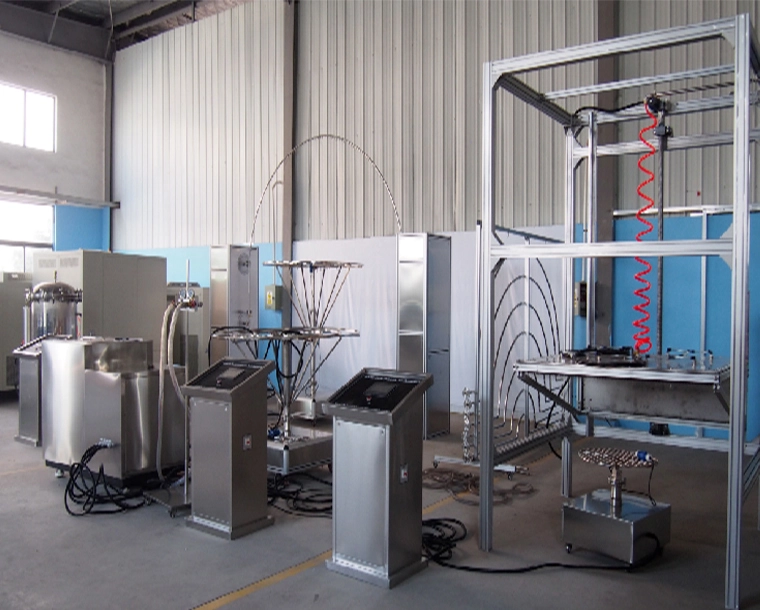
LIB's IP Test Equipment covers dust and water protection testing for electrical, electronic, automotive, aerospace, and other products. The range includes equipment for IP5X/IP6X dust tests, IPX water tests, immersion, and high-pressure water exposure.
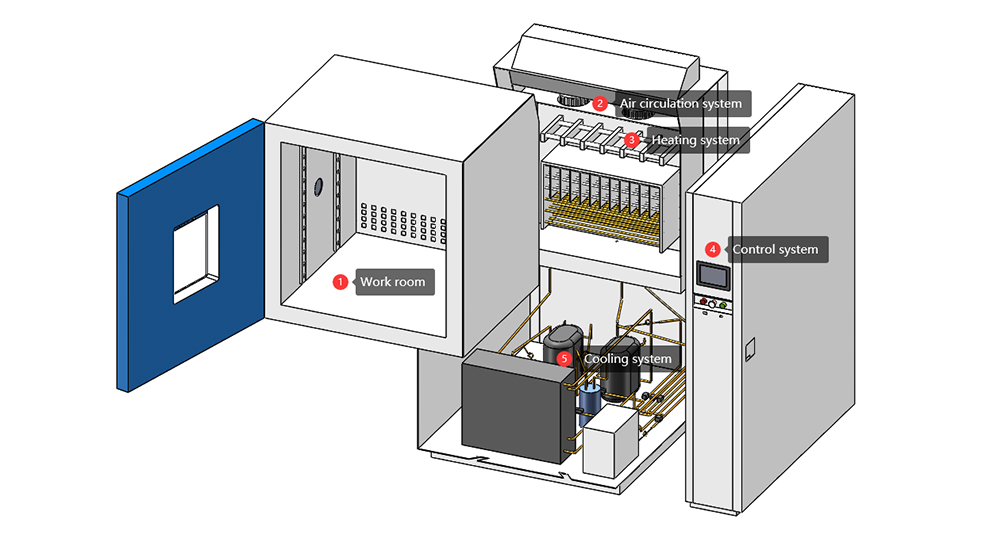
For temperature testing, LIB's Temperature Chamber provides configurations from -20°C, -40°C, or -70°C up to +150°C, with models from 100 L to 1,000 L and larger configurations available. The chamber supports programmable temperature profiles and powered sample testing.
LIB's Salt Spray Chamber range supports neutral, acidified, and copper-accelerated salt spray as well as cyclic corrosion applications. Its listed operating temperature is ambient to +60°C, with 95–98% RH and controlled salt-fog deposition.
Parameter | Temperature Chamber | IP Test Equipment | Salt Spray Chamber |
Temperature range | -70°C to +150°C depending on model | Usually secondary | Ambient to +60°C |
Humidity range | Up to about 98% RH on TH models | Usually not primary | 95–98% RH |
Chamber volume | 50–2,000 L+ depending on configuration | Depends on test type | 110–1,600 L+ |
Ramp rate | About 1°C/min cooling, 3°C/min heating on listed models | Not primary | Not primary |
Airflow | Critical for thermal uniformity | Important for dust circulation | Important for fog distribution |
Sample heat load | Important for powered EV equipment | Usually limited | Usually low |
Safety configuration | Over-temperature, over-current, refrigerant protection | Water, electrical and sealing protection | Over-temperature, water shortage, leakage protection |
Applicable standards | Temperature/environmental methods | IEC 60529, ISO 20653 and related methods | ASTM B117, ISO 9227, ASTM G85 and others |
Temperature testing is especially important for EV connectors because electrical current generates heat during charging.
A connector may perform normally at room temperature but experience higher internal temperatures under continuous electrical loading. The test should therefore consider both the environmental temperature and the sample's own heat generation.
LIB's temperature chamber range includes models such as T-100, T-225, T-500, T-800, and T-1000, with chamber volumes from 100 L to 1,000 L. The listed systems provide forced-air circulation, programmable temperature profiles, Ethernet connectivity, and safety protection.
For smaller connector components, the TH-50 Benchtop Temperature Chamber provides a compact option. LIB lists 50 L and 80 L configurations for small test pieces.
EV charger IP testing should match the actual ingress risk.
Dust testing examines whether fine particles can enter the enclosure and interfere with electrical or mechanical operation. Water testing can involve dripping, spraying, splashing, high-pressure jets, or immersion depending on the required protection level.
LIB's IP test equipment includes:
IPX1/IPX2 drip equipment
IPX3/IPX4 water spray systems
IPX5/IPX6 water-jet chambers
IPX7/IPX8 immersion equipment
IP5X/IP6X dust chambers
IP6K9K high-pressure systems
The equipment can also include water circulation, filtration, programmable control, and dedicated sample holders.
For a charging station installed outdoors, the test method should be selected according to its enclosure design and expected exposure rather than assuming that every outdoor product requires the same IP test.
Corrosion can affect terminals, metallic housings, fasteners, coatings, and exposed conductive surfaces.
LIB's salt spray chambers use salt-fog generation through an atomizing tower and spray nozzles. Models include S-150, S-250, S-750, S-010, S-016, and S-020, covering different sample capacities. The S-150 has a listed 110 L internal volume, while larger models are available for bigger or higher-volume testing.
For small connector and coating samples, the S-150 Salt Spray Chamber can be a practical laboratory-scale configuration. LIB lists continuous or periodic spraying and controlled salt-fog deposition for this model.
A charging station may pass an enclosure test while terminals, seals, cable interfaces, or fasteners remain vulnerable. The test plan should consider the complete assembly.
Powered connectors generate heat. If the chamber is expected to maintain a specific temperature while the connector is energized, the internal heat load must be included when selecting the equipment.
A connector exposed to rain faces a different environmental condition from one that may become temporarily submerged. The test equipment should reproduce the intended exposure.
Dust distribution depends on circulation. Poor sample placement can create areas with insufficient exposure.
Salt spray evaluates corrosion resistance; it does not replace a dedicated water or dust ingress test.
A larger chamber is not automatically better. Sample dimensions, fixture requirements, airflow, electrical feedthroughs, heat load, and test procedure should all be considered.
Some charging components need to operate during temperature testing. In this case, cable ports, electrical feedthroughs, safety protection, and heat-load capacity should be discussed before ordering the chamber.
For individual connectors, terminals, seals, or small electronic modules, a compact TH-50 Benchtop Temperature Chamber can reduce laboratory space requirements while providing controlled temperature testing.
A reach-in temperature or temperature-humidity chamber is more suitable when several connectors or larger charging assemblies must be evaluated simultaneously.
Large charging stations, multiple assemblies, or system-level testing may require a walk-in chamber. This approach is useful when sample dimensions exceed conventional chamber capacity.
Thermal shock equipment is appropriate when rapid transitions are required to investigate thermal expansion, contraction, sealing failure, or material stress.
The S-150 Salt Spray Chamber is suitable for smaller connector components, coatings, terminals, and metal parts, while larger S-series models can accommodate larger samples or higher test quantities.
LIB's IP Test Equipment provides dedicated dust, water spray, immersion, and high-pressure systems. This category is the primary equipment choice for EV charger IP testing.
Some charging-station projects require temperature, humidity, electrical operation, vibration, altitude, or other environmental stresses to be combined. In such cases, a customized chamber can provide the necessary feedthroughs, fixtures, control functions, and safety configuration.
LIB's Environmental Test Chamber for Automotive Industry is particularly relevant to charging equipment because its automotive applications include corrosion, temperature-humidity-vibration, thermal shock, IP dust/water ingress, and accelerated weathering.
Water-ingress testing is especially important for outdoor EV charging equipment. LIB's IPX5 IPX6 Water Spray Jetting Chamber for IEC 60529 addresses controlled water-jet exposure and is specifically relevant to EV charging components. The testing approach can help identify water-related failures such as short circuits, signal interruptions, and sensor malfunctions.
A complete program may require a temperature chamber, IP test equipment, and salt spray chamber. The combination depends on whether thermal, ingress, and corrosion performance all need to be evaluated.
IP testing evaluates protection against dust and water entering the enclosure. Salt spray evaluates corrosion resistance after exposure to a salt-containing environment. They address different failure mechanisms.
Yes, when the chamber is designed for live testing and has suitable cable ports, electrical safety protection, and sufficient heat-load capacity. The sample's electrical load should be specified before equipment selection.
There is no single duration. Temperature tests may involve hours or repeated cycles, IP tests typically use defined exposure periods, and corrosion tests can continue for many hours or longer depending on the test plan.
Measure the complete assembly, including fixtures and cable routing. Then allow enough free space for airflow and safe operation. A larger chamber may be required if the charging station operates while under test.
Usually, separate dedicated equipment provides better control because temperature, IP, and salt-fog testing require substantially different environmental mechanisms. A custom system may combine selected functions when justified by the test program.
Specify the connector or charging-station dimensions, temperature range, humidity requirements, powered or unpowered operation, heat load, IP level, water or dust exposure, corrosion method, sample quantity, fixture requirements, electrical feedthroughs, and required test duration.
 English
 русский
 français
 العربية
 Deutsch
 Español
 한국어
한국어 italiano
 tiếng việt
 ไทย
ไทย Indonesia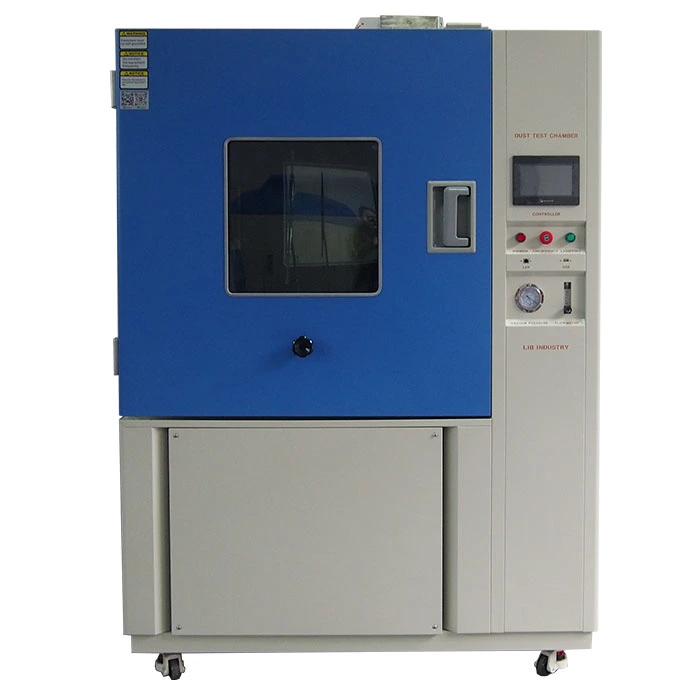
.webp "Mini Environmental Test Laboratory Kit")