Understanding IEC 60068-2-60 and the Evolution of Accelerated Atmospheric Corrosion Testing
Corrosion remains one of the most critical failure mechanisms in modern electronics, electrical assemblies, and industrial materials. What makes it particularly challenging today is that real-world environments are no longer “single-factor” systems.
Many engineers still rely on traditional salt spray or single gas corrosion testing, and products often pass laboratory qualification. However, unexpected failures still occur in the field—especially in telecom infrastructure, automotive electronics, and outdoor power systems.
The root cause is simple: real environments represent accelerated atmospheric corrosion, driven by multiple interacting pollutants rather than a single contaminant. Industrial zones, coastal cities, and transportation hubs expose materials to a complex mix of industrial pollutant simulation conditions, including humidity fluctuations, temperature cycles, and noxious gases.
This raises a critical question for R&D engineers and reliability specialists:
Is single gas testing still sufficient for modern product lifetime prediction, or is Mixed Flowing Gas Test Chamber now essential?
Single gas corrosion testing evaluates material degradation under exposure to a single controlled corrosive gas such as SO2, H2S, NO2, or Cl2. It is widely standardized under methods such as IEC 60068-2-42 and related ASTM procedures.
This approach is valuable for controlled laboratory studies because it allows engineers to isolate a single degradation mechanism and observe material response under defined conditions.
Typical test conditions include:
Temperature range: 15°C to 80°C
Humidity range: 30% to 98% RH
Controlled gas exposure in ppb to ppm levels
Single gas testing is commonly used for:
Basic material screening
Coating evaluation
Standard compliance validation
Environmental sensitivity studies
However, its limitation lies in its simplicity. Real environments rarely contain only one type of corrosive gas. This makes it difficult for single gas testing to fully represent noxious gas corrosion testing conditions found in real-world applications.
In real industrial environments, corrosion is driven by multiple interacting pollutants rather than a single dominant gas. For example:
Coastal regions combine salt aerosols with industrial emissions
Urban areas contain mixtures of SO2, NO2, and hydrocarbons
Industrial zones often include H2S and chlorine-based compounds
When multiple gases interact, they create synergistic corrosion effects, where the combined degradation rate is significantly higher than the sum of individual exposures.
For instance:
Cl2 and H2S can accelerate electrochemical reactions
NO2 enhances oxidation pathways
Moisture acts as an electrolyte, increasing conductivity and corrosion rate
This leads to a nonlinear degradation behavior that cannot be predicted by single gas exposure alone.
As a result, engineers increasingly recognize that traditional methods underestimate real-world failure rates in accelerated atmospheric corrosion environments.
Mixed Flowing Gas (MFG) testing is a more advanced corrosion simulation method designed to replicate real atmospheric conditions more accurately. It is standardized under IEC 60068-2-60, ASTM B827, and related international methods.
Unlike single gas testing, MFG introduces multiple corrosive gases simultaneously under tightly controlled conditions, typically including:
H2S (hydrogen sulfide)
SO2 (sulfur dioxide)
NO2 (nitrogen dioxide)
Cl2 (chlorine gas)
These gases are introduced at ppb-level concentrations to simulate realistic environmental exposure rather than extreme laboratory conditions.
Key characteristics of MFG testing include:
Multi-gas interaction under controlled ratios
Stable temperature and humidity coupling
Continuous airflow for uniform gas distribution
Long-term exposure capability for lifecycle simulation
This makes MFG particularly effective for industrial pollutant simulation and real-world corrosion mechanism reproduction.
Understanding the differences between these two methods is essential for selecting the correct testing strategy.
Feature | Single Gas Testing | Mixed Flowing Gas (MFG) Testing |
Environmental realism | Limited | High fidelity to real environments |
Gas composition | One gas only | Multi-gas system (H2S, SO2, NO2, Cl2) |
Corrosion behavior | Linear degradation | Synergistic accelerated corrosion |
Standards | IEC 60068-2-42 | IEC 60068-2-60 / ASTM B827 |
Application stage | Material screening | Product lifetime prediction |
The key difference lies in corrosion behavior modeling. Single gas testing assumes independent reactions, while MFG accounts for synergistic atmospheric corrosion, which is far closer to real operating conditions.
As product reliability requirements increase, more industries are shifting from basic compliance testing toward predictive environmental validation using MFG systems.
5G infrastructure, antennas, and outdoor enclosures are continuously exposed to humidity, salt, and industrial gases. Connector failure due to corrosion is a major reliability risk.
Modern vehicles contain hundreds of electronic modules. Components such as ECUs, sensors, and wiring harnesses must withstand long-term exposure to mixed atmospheric pollutants.
Even microscopic corrosion on PCB traces or connectors can lead to signal instability or system failure.
Solar inverters, wind power controllers, and outdoor cabinets operate in uncontrolled environments where industrial pollutant simulation is critical for accurate lifetime prediction.
Across all these industries, MFG testing is becoming a standard requirement rather than an optional upgrade.
While gas composition and environmental simulation are important, the most critical engineering challenge in MFG testing is safety and gas handling control.
Because MFG systems use toxic gases such as SO2, H2S, NO2, and Cl2, proper neutralization and exhaust design is essential.
A sodium hydroxide (NaOH) solution tank is integrated to neutralize toxic gases before they are released. This process:
Converts harmful gases into safer compounds
Reduces operator exposure risk
Ensures environmental compliance during long-duration tests
A controlled exhaust system ensures:
Stable dilution of residual gases
Safe discharge after neutralization
Prevention of gas leakage into the laboratory environment
These systems are critical because long-term corrosion testing often runs continuously for hundreds or thousands of hours. Without proper neutralization, safety risks and measurement instability become significant issues.
This is also a key differentiation between high-end and low-cost systems in the noxious gas corrosion testing market.
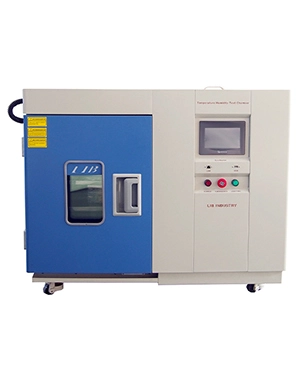
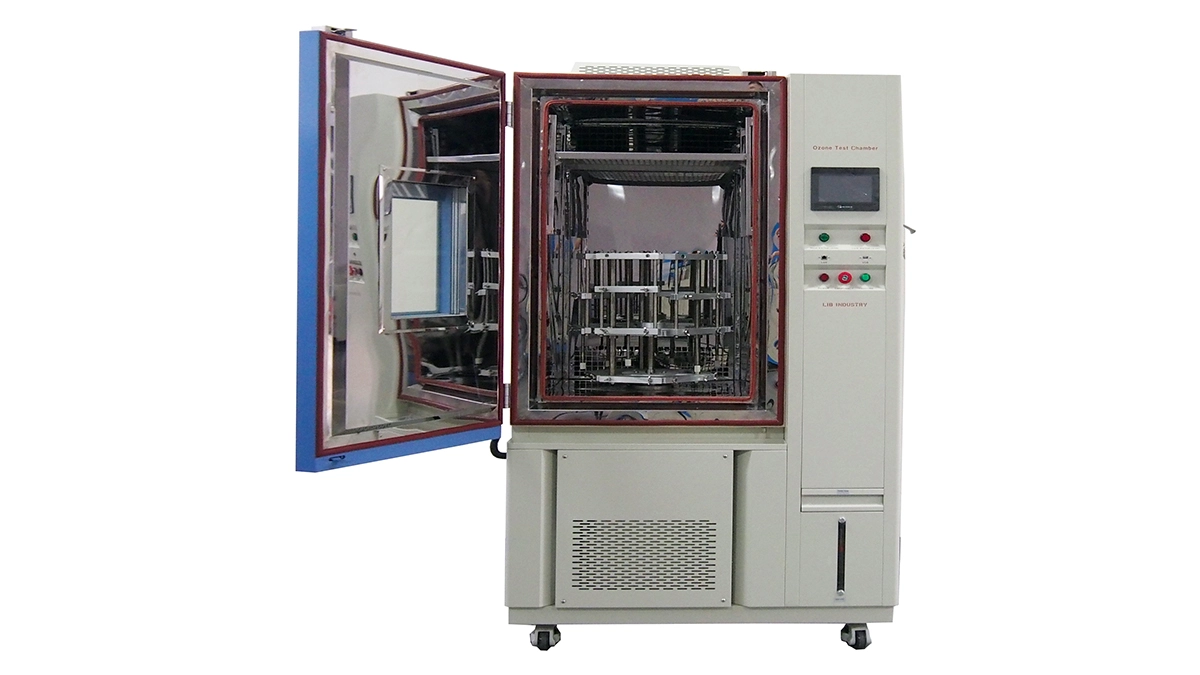
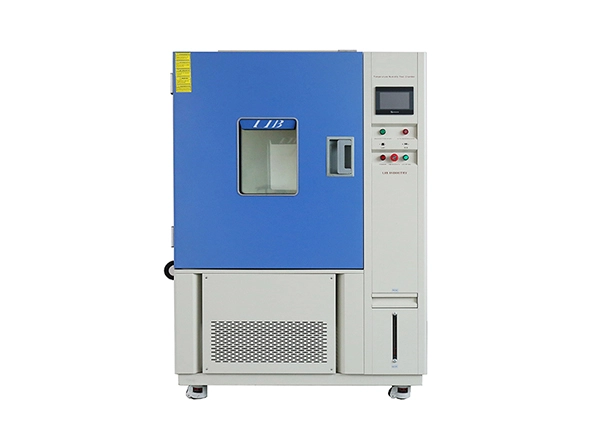
The LIB industry GCM series Mixed Gas Test Chamber is engineered to meet the demands of modern accelerated corrosion testing while ensuring safety, precision, and compliance.
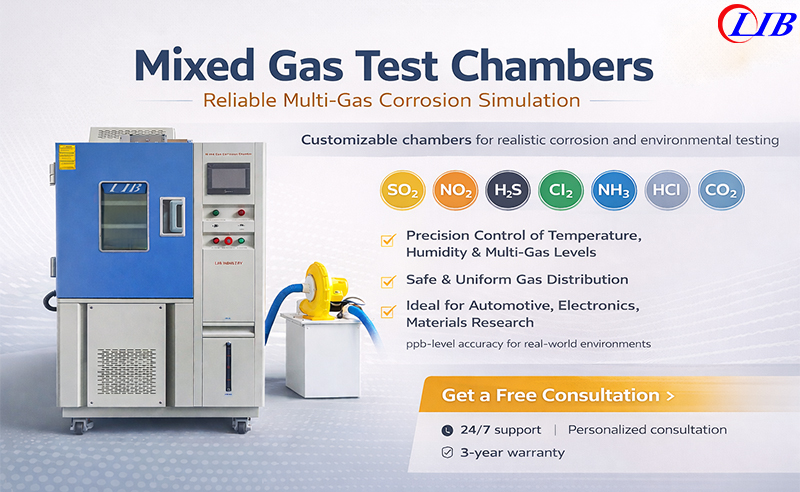
The system supports both:
Single gas corrosion testing for standard material evaluation
Mixed Flowing Gas (MFG) testing for advanced environmental simulation
This flexibility allows laboratories to use one platform across multiple testing stages.
The chamber features:
ppb-level gas concentration control
Independent gas channels for H2S, SO2, NO2, and Cl2
Stable flow regulation for repeatable test conditions
This ensures high consistency across test batches, which is essential for R&D validation and comparative material studies.
To ensure safe long-term operation, the system integrates:
NaOH gas neutralization system
Controlled exhaust and dilution mechanism
Over-temperature, leakage, and system protection layers
This makes it suitable for continuous, long-duration corrosion testing programs.
The system is designed to comply with major international standards, including:
IEC 60068-2-42
IEC 60068-2-60
ASTM B827 / B845
MIL-STD environmental testing requirements
This ensures global acceptance for qualification and certification testing.

LIB industry provides advanced GCM series Mixed Gas Test Chambers for both single gas and MFG testing, supporting full compliance with IEC and ASTM standards.
3-year warranty
Lifetime technical support
24/7 global service
Spare parts availability worldwide
Contact LIB industry today to get a customized solution for your noxious gas corrosion testing and industrial pollutant simulation needs.
 English
 русский
 français
 العربية
 Deutsch
 Español
 한국어
한국어 italiano
 tiếng việt
 ไทย
ไทย Indonesia
.webp "Walk In Mixed Noxious Gas Chamber")