In real-world environments—whether on the battlefield, in desert deployments, or during outdoor industrial operations—electronic equipment is constantly exposed to harsh conditions. Among these, water ingress and sand or dust intrusion remain the leading causes of failure. Moisture can trigger short circuits and corrosion, while airborne particles can penetrate enclosures, block ventilation paths, and accelerate mechanical wear.
For manufacturers of military electronics, automotive components, and outdoor devices, ensuring environmental durability is not optional—it is essential. This is where MIL-STD-810H testing plays a critical role. Specifically, MIL-STD-810H Method 506.6 rain test and MIL-STD-810H Method 510.7 sand and dust test define standardized procedures to evaluate how products perform under rain exposure and particulate environments.
However, achieving compliance is not just about understanding the standards—it requires precise, reliable, and well-designed test equipment. In this guide, we will break down both methods in detail and explain how to select the right blowing rain test chamber and blowing sand and dust test chamber to meet your testing requirements.
MIL-STD-810H Method 506.6 Explained: How to Test Rain Resistance Effectively
The MIL-STD-810H rain test evaluates the ability of equipment enclosures to resist water penetration under various rainfall conditions. Method 506.6 includes three procedures, each simulating different real-world scenarios.
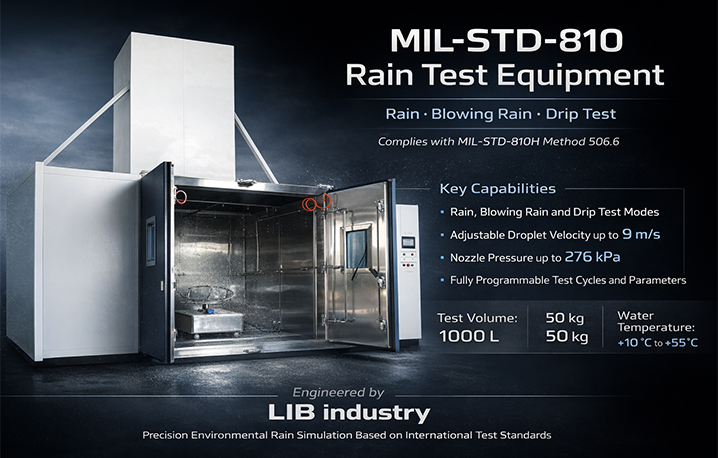
Procedure I – Blowing Rain
Blowing rain is the most critical and widely used procedure. It simulates wind-driven rain impacting equipment surfaces at high velocity. A wind speed of up to 18 m/s is typically required to replicate severe storm conditions.
This combination of wind pressure and water flow is essential because water intrusion often occurs not under static rain, but when wind forces water into seams, joints, and ventilation openings. Equipment that passes this test demonstrates strong resistance to real-world weather exposure.
Procedure II – Exaggerated / Watertightness
This procedure focuses on verifying the watertight integrity of large enclosures or systems. Instead of simulating natural rainfall, it uses intensified water exposure to identify potential leakage points.
It is particularly relevant for:
Vehicle-mounted systems
Outdoor cabinets
Large sealed housings
Procedure III – Drip
The drip test simulates water falling vertically onto equipment, representing condensation or indoor leakage scenarios. Although less aggressive, it is essential for identifying vulnerabilities in top-facing surfaces and sealing systems.
Equipment Requirements for Rain Testing
To perform accurate and repeatable MIL-STD-810H Method 506.6 rain test procedure, the test equipment must meet several critical requirements:
Wind speed control up to 18 m/s for blowing rain simulation
Adjustable spray nozzles to control water impact angles
Uniform water distribution system to ensure consistent exposure
Closed-loop control system for stable pressure and flow regulation
Programmable test cycles for automated operation
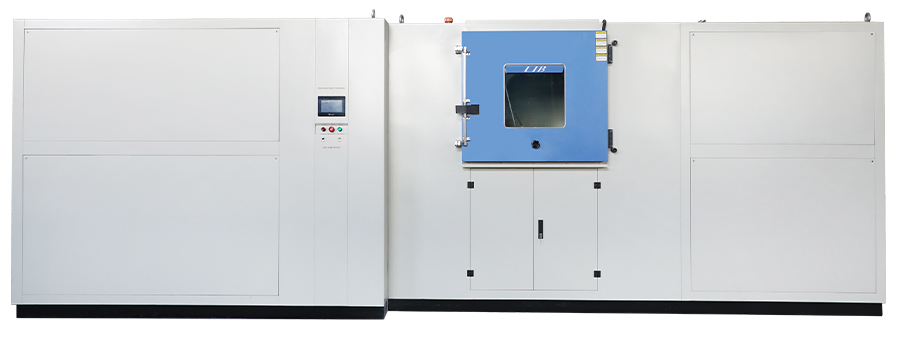
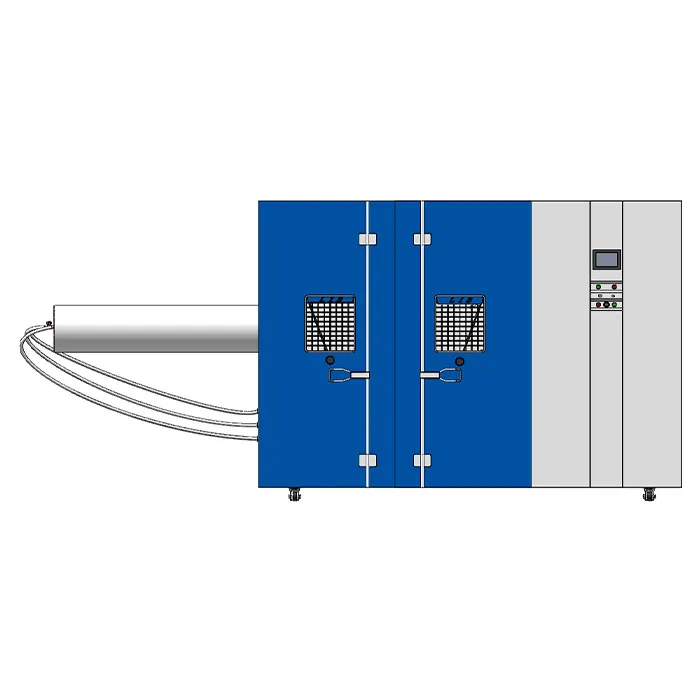
A high-performance blowing rain test chamber integrates all these functions, enabling precise simulation of real-world rain conditions. Without proper control of airflow and water distribution, test results may be inconsistent or fail to meet compliance standards.
MIL-STD-810H Method 510.7 Explained: How to Test Sand & Dust Resistance Effectively
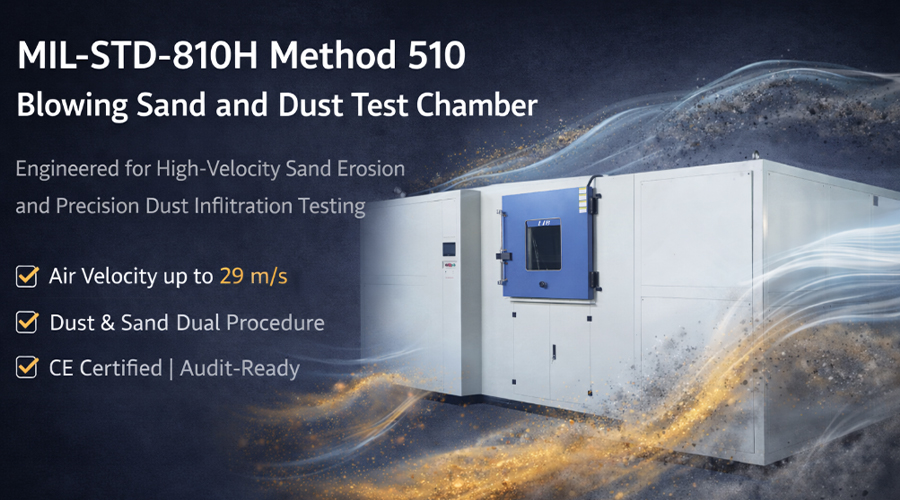
The MIL-STD-810H sand and dust test evaluates the resistance of equipment to airborne particles. Method 510.7 distinguishes between two fundamentally different test conditions: blowing dust and blowing sand.
Blowing Dust
Blowing dust focuses on fine particles that can penetrate small openings and accumulate inside equipment. These particles can:
Dust testing is especially important for electronics with ventilation systems, connectors, or unsealed interfaces.
Blowing Sand
Blowing sand involves larger particles, typically ranging from 150 to 850 micrometers, propelled at high velocity. Unlike dust, sand primarily causes mechanical damage through abrasion and erosion.
This test evaluates:
Understanding the difference between dust penetration and sand erosion is essential, as many products require both types of testing to ensure full environmental protection.
Equipment Requirements for Sand & Dust Testing
To meet MIL-STD-810H Method 510.7 dust test requirements, a reliable sand and dust test chamber must include:
Dust concentration control system for accurate particle density
Airflow circulation system to maintain consistent particle movement
High-temperature capability for realistic environmental simulation
Low humidity control (<30%) to prevent particle clumping
Particle size management for both dust and sand testing
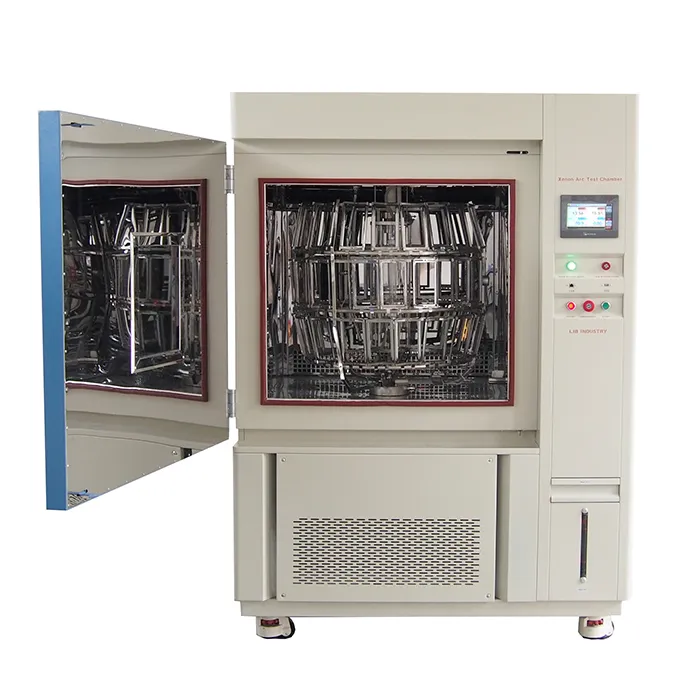
A well-designed blowing dust test chamber ensures that particles remain suspended and evenly distributed, which is critical for repeatable and valid test results.
Technical Checklist for Test Equipment
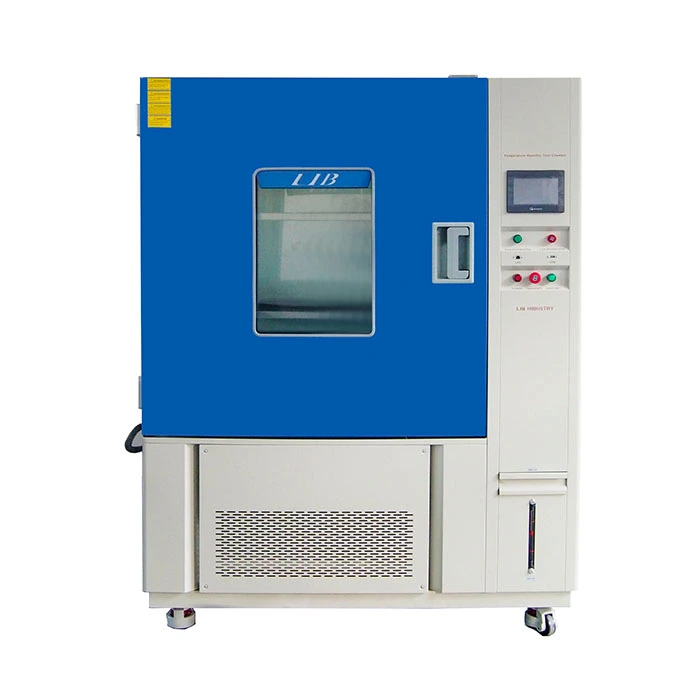
Selecting the right environmental test chamber requires a deep understanding of key performance indicators. Below are the most important technical factors to consider.
Airflow Uniformity
Airflow uniformity is one of the most critical parameters in both rain and dust testing. Uneven airflow can lead to inconsistent exposure across the test sample, resulting in inaccurate data.
In some cases, poor airflow design may even produce a “false pass,” where the product appears to meet requirements but fails in real-world conditions. High-quality chambers are designed to maintain stable and uniform airflow throughout the test space.
Temperature and Humidity Control
Environmental conditions must be carefully controlled during testing. For example, the MIL-STD-810H sand and dust test requires low humidity levels—typically below 30%—to prevent dust particles from clumping together.
Accurate temperature control is also essential, particularly for high-temperature dust testing scenarios.
Automation and Repeatability
Modern environmental test chambers should support programmable multi-stage test cycles. Automation reduces human error and ensures consistent test execution.
Key features include:
Touchscreen control systems
Data logging and monitoring
Repeatable test sequences
These capabilities are essential for laboratories conducting standardized testing or certification procedures.
How to Choose the Right MIL-STD Blowing Rain and Dust Test Chamber
Choosing the correct equipment is a crucial step toward achieving compliance and reliable results.
Based on Test Standards
Different industries may require compliance with multiple standards, such as MIL-STD-810H, IEC, or IP ratings. Selecting a chamber that supports multiple standards increases flexibility and long-term value.
Based on Product Size
The size of the test sample determines the chamber dimensions. From small electronic components to large assemblies, the chamber must accommodate the product while maintaining proper airflow and exposure conditions.
Based on Test Severity
Consider the required wind speed, rainfall intensity, dust concentration, and temperature range. High-performance applications demand chambers capable of simulating extreme conditions.
Custom vs Standard Chambers
While standard models may suit basic testing needs, many applications require custom environmental test chamber solutions. Customization options may include:
Working with an experienced test chamber manufacturer ensures that the equipment meets both technical requirements and operational needs.
Why Choose LIB industry
When it comes to MIL-STD-810H rain test chamber and sand and dust test chamber solutions, choosing the right partner is just as important as selecting the right equipment.
LIB industry offers a comprehensive range of environmental test chambers designed to meet international standards and demanding applications.
Key advantages include:
Complete MIL-STD-810H testing solutions for rain and sand & dust
Custom design capability to meet specific testing requirements
Stable and repeatable performance for reliable results
3-Year warranty and lifetime technical support
Full lineup of IP test chambers for additional waterproof testing needs
Contact LIB industry today take the next step toward reliable, compliant, and high-performance testing.

 English
 русский
 français
 العربية
 Deutsch
 Español
 한국어
한국어 italiano
 tiếng việt
 ไทย
ไทย Indonesia