How to Verify Industrial Connector Reliability Using a Mixed Gas Test Chamber
Industrial equipment connectors often fail long before the main machine reaches the end of its service life. In a motor control cabinet, a mining vehicle, a wastewater treatment plant, or an outdoor automation enclosure, connectors carry power, sensor signals, data, and safety commands. A small rise in contact resistance can lead to unstable readings, intermittent shutdowns, overheated terminals, or a full production stop.
A mixed gas test chamber helps manufacturers evaluate connector reliability under controlled corrosive gas, humidity, and temperature conditions before field deployment.
 Connectors Are Small Components with High Failure Impact
Industrial connectors are widely used in PLC cabinets, motor drives, sensors, robots, railway systems, outdoor power boxes, and process control equipment. Although small in size, they sit at critical electrical junctions.
When corrosion occurs, early signs include unstable signals, communication errors, voltage drop, or local heating at contact points. These issues may eventually lead to equipment downtime and difficult troubleshooting, even when the connector still appears visually intact.
Therefore, reliability testing should go beyond mechanical checks such as insertion force, and also verify stable electrical performance after exposure to corrosive environments.
Industrial environments often contain pollutants such as sulfur compounds, nitrogen oxides, chlorides, and moisture that are not present in clean indoor conditions.
Typical high-risk applications include:
· Outdoor control cabinets in coastal or industrial areas
· Automation systems in chemical processing plants
· Sensor and pump systems in wastewater treatment facilities
· Power, mining, and rail equipment exposed to harsh outdoor conditions
In these environments, corrosion testing becomes a necessary step to reduce unexpected field failures.
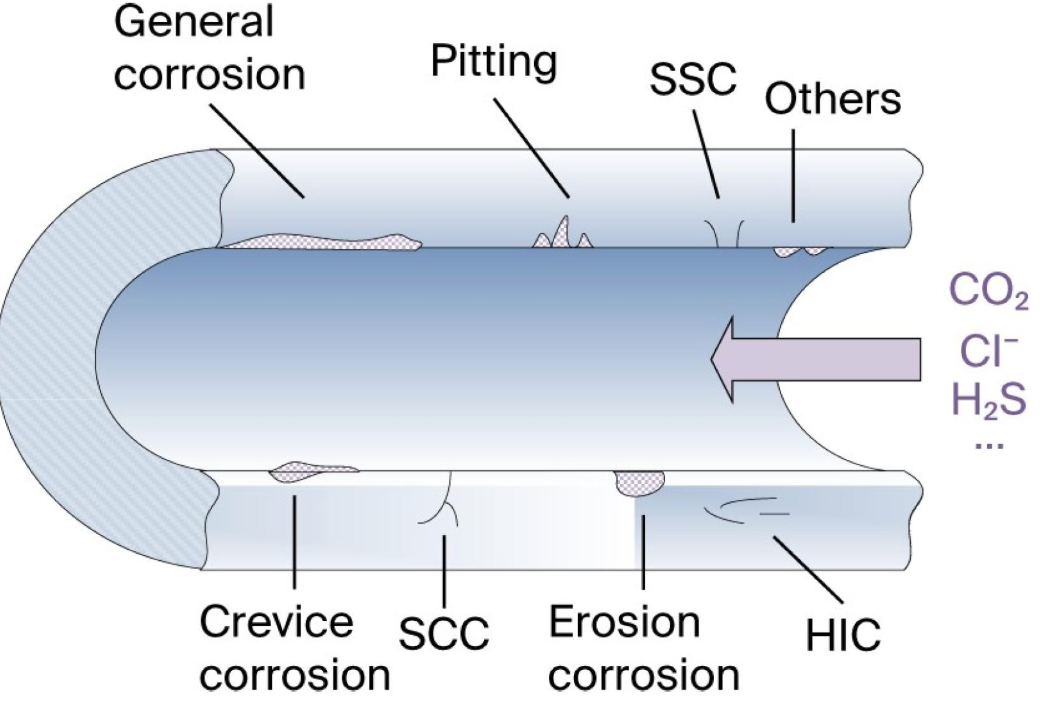
Connector corrosion is caused by the combined effects of gas type, humidity, metal material, plating quality, and exposure time. A connector may pass visual inspection but still degrade electrically after exposure.
Hydrogen sulfide can form sulfide films on copper and silver surfaces. Sulfur dioxide may accelerate acidic corrosion under humid conditions. Nitrogen oxides increase surface oxidation, while chlorine can cause rapid attack even at very low concentrations.
For connector testing, these gases are typically controlled at ppb levels because electrical contacts are highly sensitive to thin corrosion layers that can affect low-current or low-voltage signals.
Mixed flowing gas testing is especially important for plated contacts such as gold, tin, nickel, and silver systems, where weak points like pores, edges, or crimp areas may be exposed.
The most critical effect of corrosion is not appearance, but performance degradation.
Common issues include:
· Increased contact resistance
· Signal instability in low-current circuits
· Reduced mating reliability
· Formation of surface films on contact areas
For industrial connectors, contact resistance is a key evaluation metric, and allowable changes should be defined according to application type, current load, and system requirements.
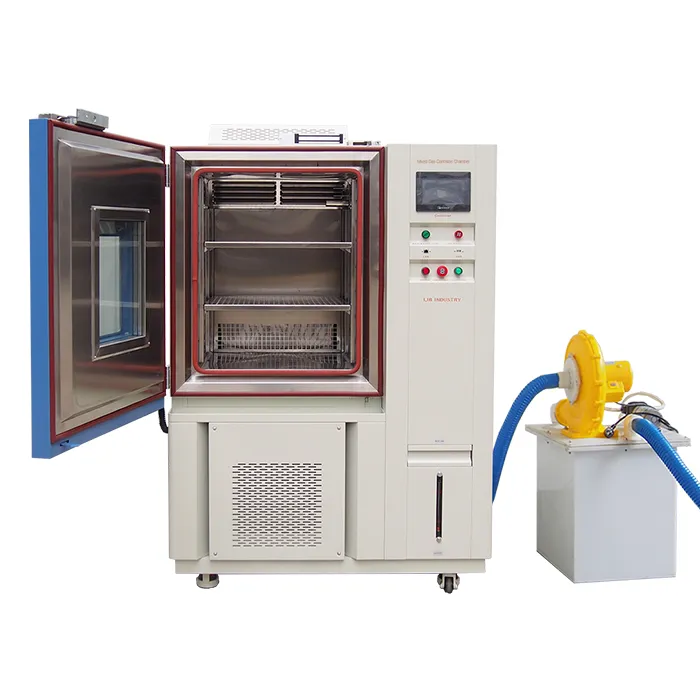 | 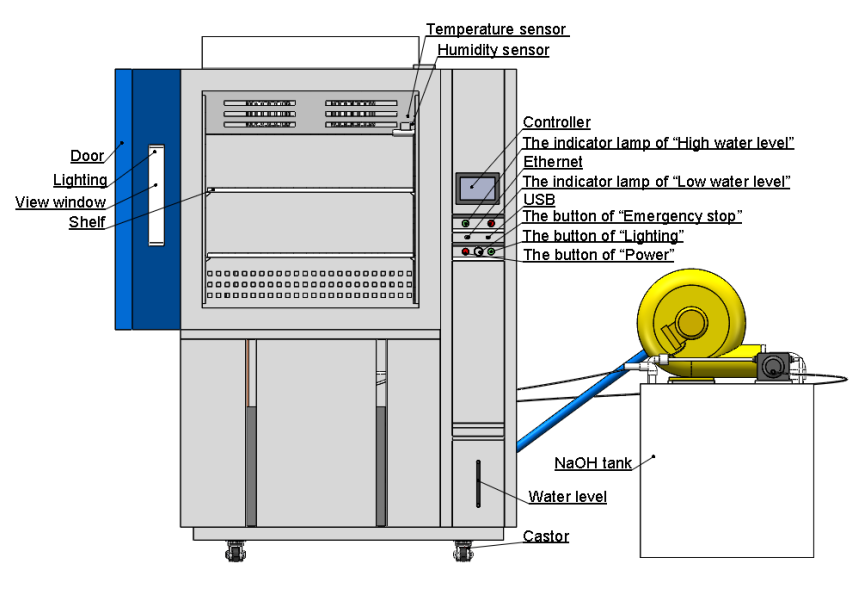 |
A mixed gas test chamber is an environmental test chamber used to expose samples to controlled corrosive gases, temperature, humidity, and airflow. For connector reliability testing, it creates a repeatable industrial atmosphere inside the workroom.
Real industrial pollution is rarely caused by one gas alone. A connector installed in a wastewater plant, chemical workshop, or outdoor control box may face a mix of H₂S, SO₂, NO₂, Cl₂, oxygen, humidity, and temperature cycling.
A mixed gas test chamber can introduce multiple gases at controlled ratios while keeping stable humidity and temperature. For industrial connector reliability testing, this is closer to field exposure than a single-gas test. It allows engineers to compare materials, plating thickness, sealing designs, contact structures, and cable assembly methods under the same stress profile.
Compared with single-factor tests such as salt spray or humidity exposure, mixed gas testing better represents the combined corrosion mechanisms found in industrial environments.
Reliable connector testing starts with well-defined parameters that match real application environments and product requirements.
Common test gases include H₂S, SO₂, NO₂, and Cl₂. LIB industry Mixed Gas Test Chamber supports both single and mixed gas corrosion testing with independent gas channel control.
Typical test conditions include:
Parameter | Typical Test Range or Setting |
SO₂ concentration | 100–500 ppb ±20 ppb, adjustable |
H₂S concentration | 10–100 ppb ±20 ppb, adjustable |
NO₂ concentration | 200 ppb ±20 ppb, adjustable |
Cl₂ concentration | 10–20 ppb ±5 ppb, adjustable |
Temperature range | 15℃–80℃ |
Humidity range | 30%–98% RH |
Air change rate | 3–10 times/h |
When IEC 60068-2-60 is applied, test atmospheres such as 25℃–30℃, 70%–75% RH, and defined ppb-level gas concentrations are typically used. Standard test durations range from 4 to 21 days depending on severity level.
In mixed gas testing, humidity and airflow directly affect corrosion consistency. Most industrial connector tests use 70%–75% RH, while higher humidity may be selected for harsher conditions.
A stable air exchange rate (3–10 times/h) ensures uniform gas distribution and improves test repeatability across samples.
Test duration depends on validation purpose:
Short cycles: material screening and comparison
10–14 days: design verification
21 days: high-reliability evaluation
Both mated and unmated conditions may be tested. Unmated exposure focuses on direct contact corrosion, while mated testing evaluates functional stability after assembly.
A structured test process ensures results reflect real-world performance rather than only laboratory exposure.
Connector assemblies, terminals, housings, and cable harnesses should be fully documented before testing. Initial electrical values (contact resistance, insulation resistance) and visual conditions must be recorded.
Samples should be positioned to avoid contact with each other, and reference coupons (such as copper) may be used to verify corrosion severity.
Program gas concentration, temperature, humidity, airflow, and duration according to test standards or customer specifications.
Example condition:
30℃, 70% RH, H₂S 10 ppb, NO₂ 200 ppb, Cl₂ 10 ppb, SO₂ 100 ppb
For IEC 60068-2-60 testing, full traceability of parameters (gas levels, tolerance, airflow, and duration) should be recorded in the report.
Stable gas concentration, temperature, and humidity are critical for repeatable results. A reliable system requires precise gas control, uniform airflow, and continuous monitoring.
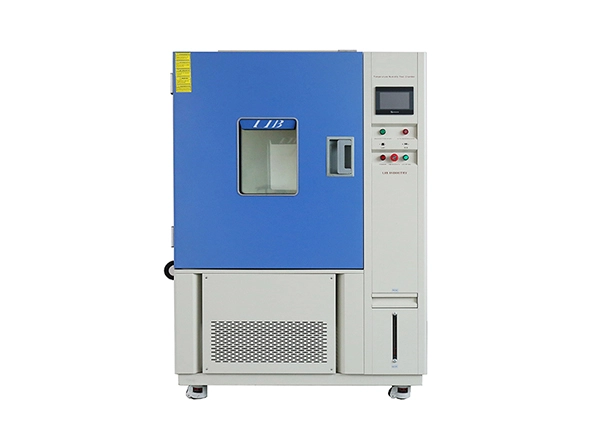
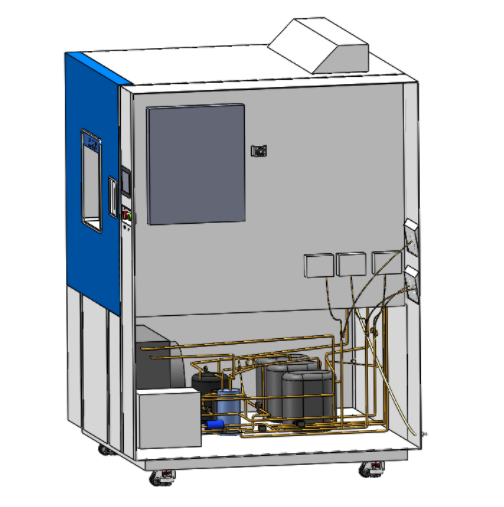
LIB industry Mixed Gas Test Chamber features independent gas sensors, centrifugal air circulation, programmable controller, Ethernet/PC connection, and corrosion-resistant SUS316 workroom design to ensure long-term stable operation.
After exposure, samples should be stabilized before measurement. Engineers typically compare pre- and post-test data to evaluate performance changes.
Key inspections include:
Contact resistance change
Insulation resistance
Electrical continuity
Surface corrosion observation
Plating condition analysis
Microstructural inspection
Mating/unmating force
Seal and housing integrity
Final acceptance criteria should be defined according to connector application type, especially between power and signal connectors.
Test data should answer one practical question: can the connector still work safely and consistently after corrosive gas exposure?
Contact resistance change is often the first data point. A connector may pass if the resistance increase remains within the agreed limit and no intermittent open circuit occurs. Insulation resistance and dielectric performance may also be checked when the connector is used in higher-voltage equipment.
For signal connectors, even minor surface degradation may cause noise. For power connectors, corrosion may increase heat at the contact point. Test reports should include initial values, final values, resistance change, visual condition, and any abnormal events during exposure.
Physical inspection helps explain the electrical results. Dark films, green corrosion products, white deposits, pitting, edge attack, or plating cracks may point to material or process weakness. Microscopic inspection can reveal corrosion at pores, scratches, crimp seams, or exposed base metal.
If two connector designs show similar resistance values but one has severe visible corrosion, the cleaner design may be safer for long-term use.
For connector manufacturers and industrial equipment suppliers, chamber capability affects test quality directly.
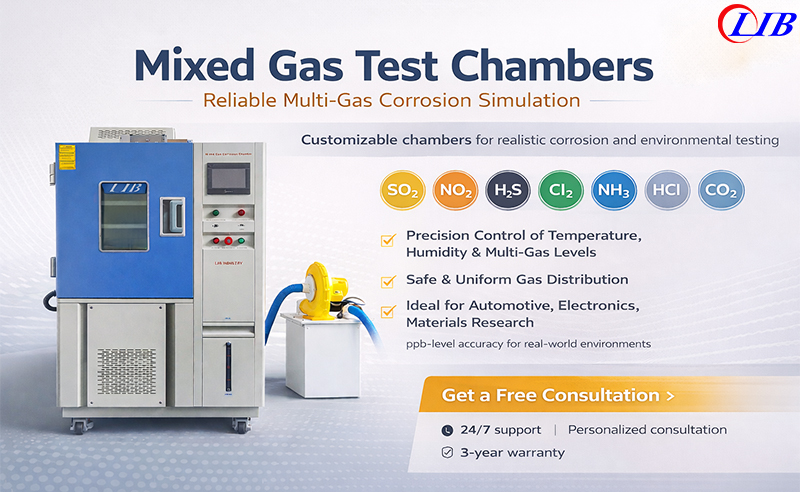
LIB Mixed Gas Test Chamber supports ppb-level control of SO₂, H₂S, NO₂, and Cl₂. Each gas channel can be monitored and controlled independently, which helps keep mixed gas testing repeatable across batches.
The chamber covers 15℃–80℃ and 30%–98% RH, with ±0.5℃ temperature fluctuation, ±2.0℃ temperature deviation, and ±2.5% RH humidity deviation. This allows connector tests to combine pollutant exposure with stable humidity stress.
Corrosive gas testing requires safe operation. The chamber includes gas exhaust, electromagnetic door lock, over-temperature protection, over-current protection, water shortage protection, humidifier dry-combustion protection, and earth leakage protection. These features are important for long tests using toxic or corrosive gases.
The programmable controller and PC connection support repeatable test programs, data handling, and long-term exposure tests. For manufacturers running R&D validation and quality control, repeatability is often as important as chamber capacity.
LIB Industry provides environmental test chambers for corrosion, climate, dust, water ingress, and weathering testing, supporting industrial reliability verification across multiple industries.
For customers testing industrial equipment connectors, LIB provides more than a chamber body. The company can support chamber selection, gas configuration, test condition discussion, and long-term operation needs. Its mixed gas test chamber is suited for electronic components, metal materials, industrial assemblies, connector samples, and other products that need corrosion resistance data before field use.
LIB industry not only provides advanced mixed gas test chambers, but also ensures long-term customer support with 3 years warranty and lifetime technical service. Our team supports installation guidance, operation training, and continuous technical consultation to help you maintain stable and reliable testing performance throughout the equipment lifecycle.
Mixed gas testing checks how industrial equipment connectors react to corrosive gases such as H₂S, SO₂, NO₂, and Cl₂ under controlled humidity and temperature. It helps reveal contact corrosion, resistance increase, plating damage, and signal instability before the connector is used in harsh environments.
Common gases include hydrogen sulfide, sulfur dioxide, nitrogen dioxide, and chlorine. Depending on the application, ammonia or other gases may also be used. For connector reliability testing, gas concentration is usually controlled at ppb level.
Corrosion creates films or deposits on metal contact surfaces. These layers can reduce conductivity and raise contact resistance. In low-current signal circuits, even a small resistance change can cause unstable readings or intermittent failure.
Industries that commonly need this testing include industrial automation, power equipment, transportation, mining machinery, wastewater treatment, telecommunications, marine equipment, chemical processing, and outdoor electronic systems.
 English
 русский
 français
 العربية
 Deutsch
 Español
 한국어
한국어 italiano
 tiếng việt
 ไทย
ไทย Indonesia