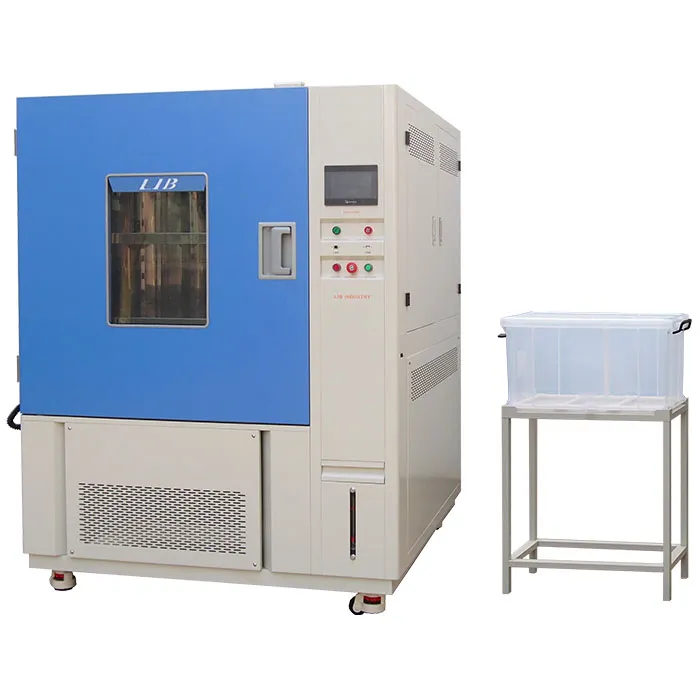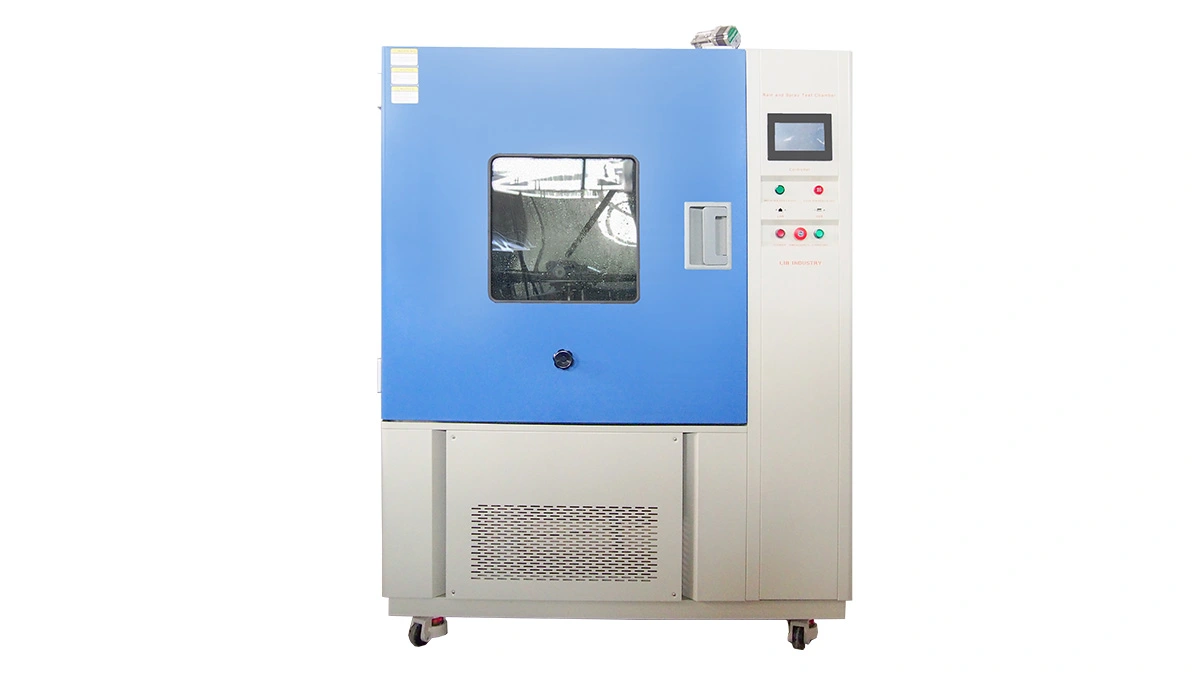
IP65 is one of the most widely referenced ingress protection ratings defined by IEC 60529, but it is often misunderstood as being verified by a single “IP65 tester.” In reality, IP65 is a combined result of two independent evaluations:
IP6X: complete dust ingress protection
IPX5: protection against water jets from any direction
This means there is no single universal device that performs “IP65 testing” in one step. Instead, manufacturers rely on two separate but complementary test systems to validate compliance. The IP65 rating is only achieved when both tests are successfully passed under controlled and repeatable laboratory conditions.
Understanding this distinction is critical for building a reliable quality assurance process and avoiding oversimplified interpretations of ingress protection testing.
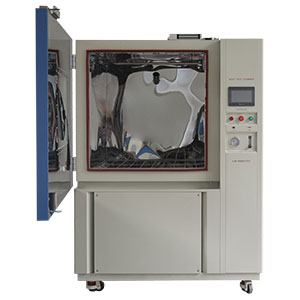
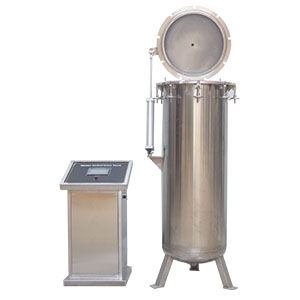
The IP6X dust test system is designed to evaluate whether an enclosure is completely sealed against fine particulate matter. It simulates environments where dust exposure is continuous, dense, and highly intrusive.
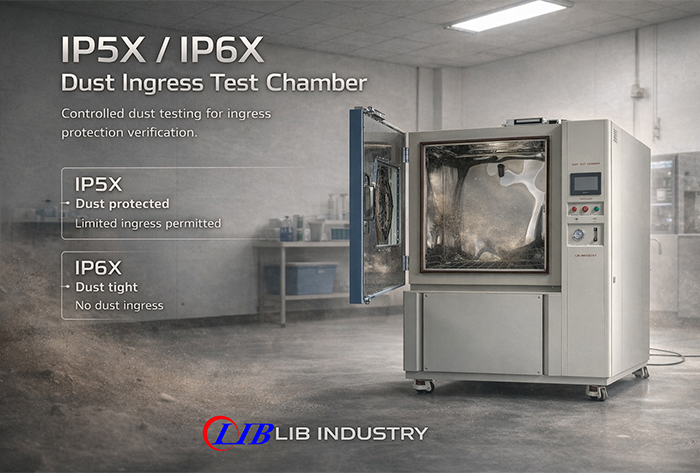
The system operates by creating a controlled dust suspension environment inside a sealed chamber:
Fine standardized talcum powder is introduced into the chamber
A circulation system maintains uniform dust suspension
Airflow dynamics ensure particles remain evenly distributed
Test samples may be subjected to negative pressure (depending on design requirements)
The goal is to simulate long-term dust exposure under accelerated conditions while maintaining repeatability and consistency.
Dust particle size consistency (typically ≤75 μm)
Stable dust concentration throughout the test cycle
Controlled airflow velocity to ensure suspension uniformity
Chamber sealing integrity to prevent external interference
The IP6X system verifies one critical performance requirement:
No dust ingress shall occur that could affect product operation or safety.
This makes it an essential step for validating sealed enclosures used in precision electronics and industrial systems.
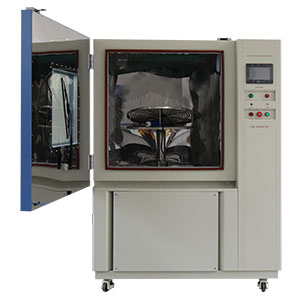
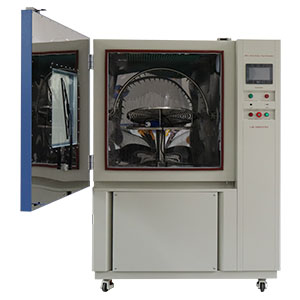
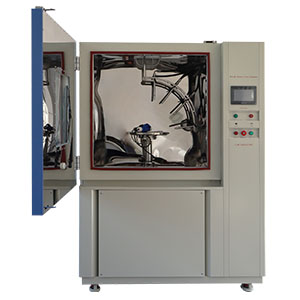
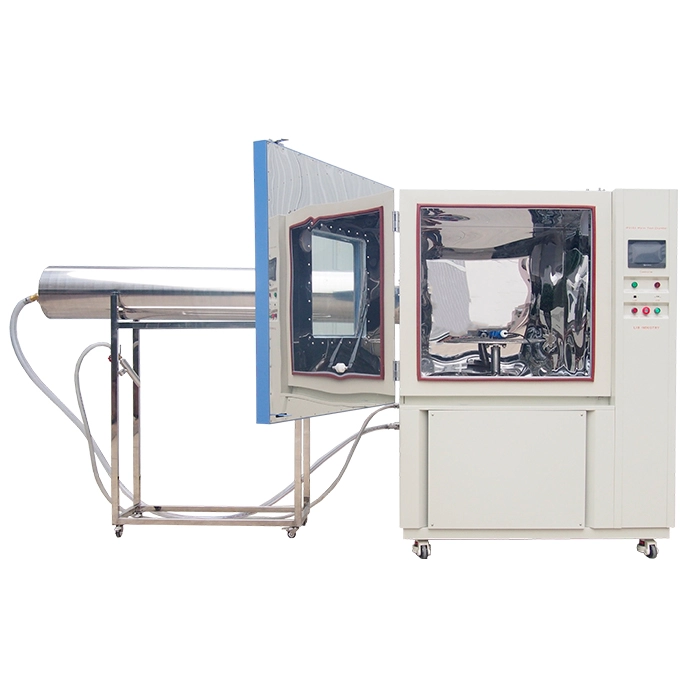
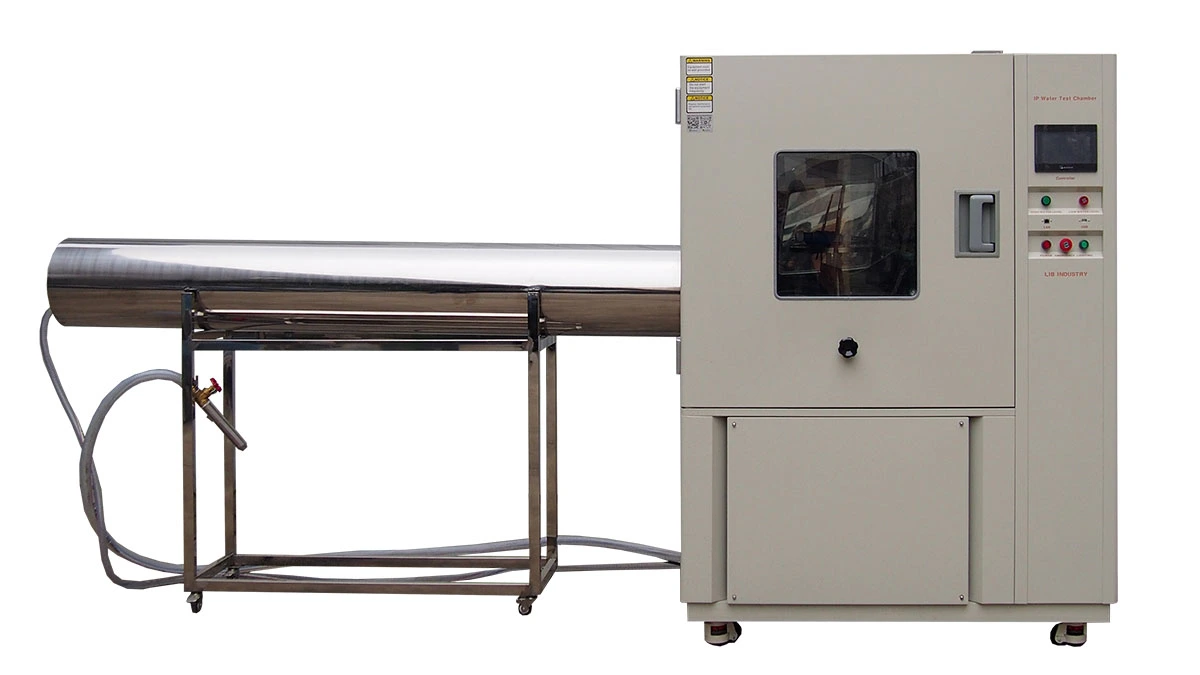
The IPX5 water jet test system evaluates the ability of an enclosure to withstand water projected from a nozzle under controlled pressure. Unlike immersion testing, IPX5 focuses on dynamic water impact resistance.
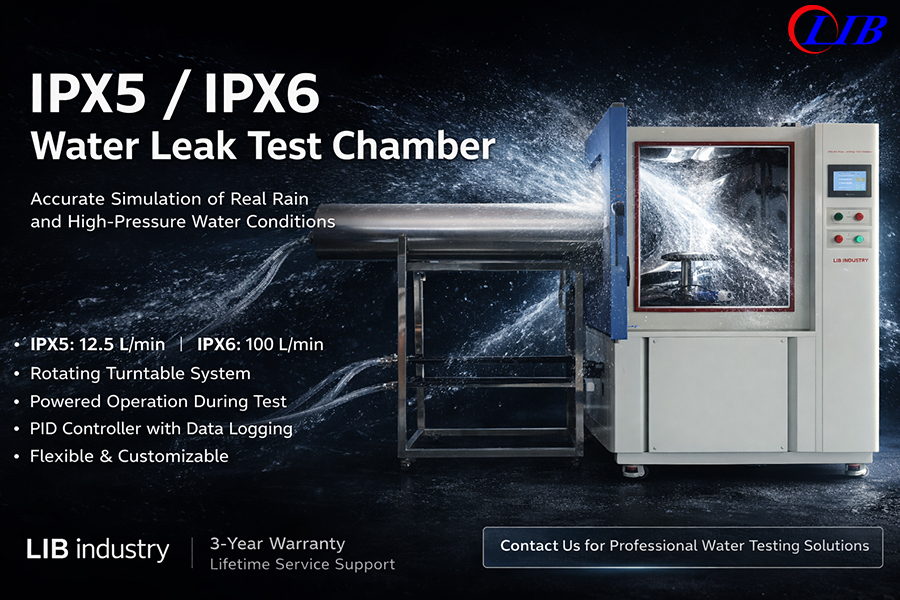
The system generates a calibrated water jet using a controlled hydraulic setup:
Water is pressurized and delivered through a standardized 6.3 mm nozzle
Jet streams are directed at the test sample from multiple angles
The sample may be rotated or repositioned for full exposure coverage
Flow and pressure remain stable throughout the test cycle
This simulates real-world exposure such as rainstorms or directional water spray.
Parameter | Typical Requirement | Function |
Nozzle diameter | 6.3 mm | Standard IPX5 jet formation |
Water flow rate | ~12.5 L/min | Ensures consistent spray intensity |
Water pressure | Controlled range | Maintains jet stability |
Spray duration | Defined by standard | Ensures repeatable exposure |
The IPX5 system verifies that:
Water jets from any direction shall not cause harmful ingress into the enclosure.
It is a critical validation step for outdoor and semi-exposed equipment.
Although IP6X and IPX5 are both part of ingress protection validation, they operate on completely different physical principles.
System | IP Level | Test Medium | Core Control Variable | Engineering Focus |
Dust Test System | IP6X | Fine dust particles | Concentration & airflow stability | Sealing + particle suspension |
Water Jet System | IPX5 | Pressurized water | Flow rate & pressure consistency | Hydraulic control + nozzle precision |
The IP6X system focuses on preventing particulate intrusion through micro-gaps, while the IPX5 system evaluates resistance against kinetic water energy.
This fundamental difference explains why the two systems must remain separate:
Dust testing requires controlled atmospheric circulation
Water testing requires hydraulic stability and nozzle calibration
Mixing both mechanisms would compromise measurement accuracy
Therefore, IP65 validation is always a process combination rather than a single-machine function.
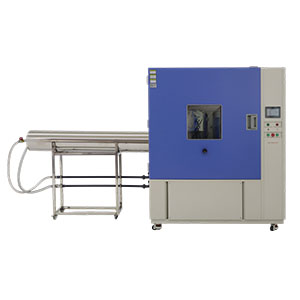
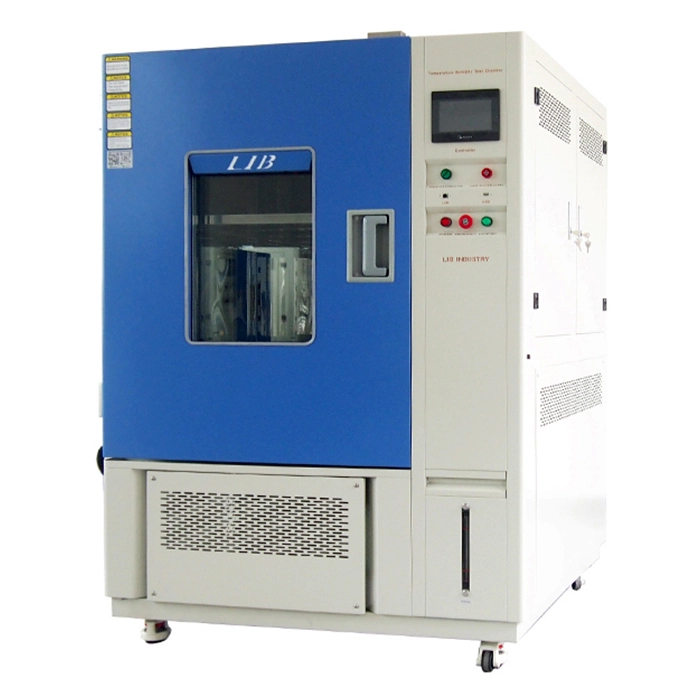
LIB industry provides a complete and modular IP protection testing ecosystem, rather than a single standalone IP tester. The system is designed to cover the full range of ingress protection levels defined by IEC 60529, from basic waterproof and dustproof validation to high-pressure and high-temperature water impact testing.
The integrated solution supports the following test categories:
· Dust Protection Testing
o IP5X (limited dust ingress protection)
o IP6X (complete dust-tight performance verification)
· Water Protection Testing
o IPX1–IPX2: Vertical dripping water and tilted dripping conditions
o IPX3–IPX4: Spraying and splashing water tests
o IPX5–IPX6: Low-pressure water jet and strong water jet resistance
o IPX7–IPX8: Temporary and continuous immersion testing
o IPX9K: High-pressure, high-temperature water jet testing
|
|
|
|
|
|
| ||
Instead of treating each IP level as an independent device, LIB industry designs the testing ecosystem as a modular and expandable platform, where different test systems share a unified engineering logic:
· Unified control architecture (PLC + HMI programming system)
· Standardized test parameter management
· Independent yet connectable test chambers
· Centralized data recording and traceability system
This structure allows laboratories to configure only required IP levels or gradually expand toward a full-range IP testing laboratory.
All systems are developed in accordance with IEC 60529 requirements, ensuring:
· Repeatable and stable test conditions
· Controlled variation in pressure, flow, and particle distribution
· Consistent test results across different IP levels
· Compliance-ready data output for certification purposes
Through this ecosystem, LIB industry enables manufacturers to move from single-point verification to a complete ingress protection validation framework covering IP5X to IPX9K standards.
No. IP65 is the result of two independent tests: IP6X dust testing and IPX5 water jet testing, performed using separate systems.
Because they rely on completely different physical principles—particle suspension versus hydraulic jet control. Combining them would reduce accuracy and repeatability.
They can be operated within a unified control framework, but remain physically independent systems to ensure measurement precision.
The enclosure must prevent any dust ingress that could affect functionality under controlled dust concentration and airflow conditions.
The enclosure must resist water jets from a 6.3 mm nozzle at controlled pressure and flow without harmful ingress.
Yes. Full installation, commissioning, and operator training are included as part of the system delivery.
All systems include a 3-year warranty and lifetime technical service support, ensuring long-term operational reliability and maintenance assistance.
 English
 русский
 français
 العربية
 Deutsch
 Español
 한국어
한국어 italiano
 tiếng việt
 ไทย
ไทย Indonesia