
Marine hardware is put through some of the harshest conditions on a daily basis to keep other metal parts functioning at optimum levels. A simple boat hinge or deck fitting, marine lock, railing clamp or even coated fastener can seem to hold up in a warehouse but can quickly fail in a few months time after being subjected to the effects of salt mist, high humidity, periodic water exposure and extreme temperature fluctuations.
Marine hardware corrosion testing is not only about finding red rust. For buyers in coastal markets, corrosion resistance testing for coastal environments is often the difference between a part that passes incoming inspection and a part that causes field complaints.
By means of this test, engineers can assess materials, coatings and merchants in a test situation which is readily reproducible.
Salt is aggressive because chloride ions can attack protective metal films. Stainless steel may resist general rust, but it can still suffer pitting when chloride deposits stay on the surface. Aluminum parts can lose their oxide layer around scratches. Zinc-plated components may show white rust first, then red rust when the steel substrate is exposed.
Humidity adds another risk. In coastal air, moisture keeps the salt layer active for long periods. A hinge installed near a marina may dry during the day and become wet again at night. This cycling is why many marine corrosion test chamber programs use cyclic exposure rather than only continuous fog.
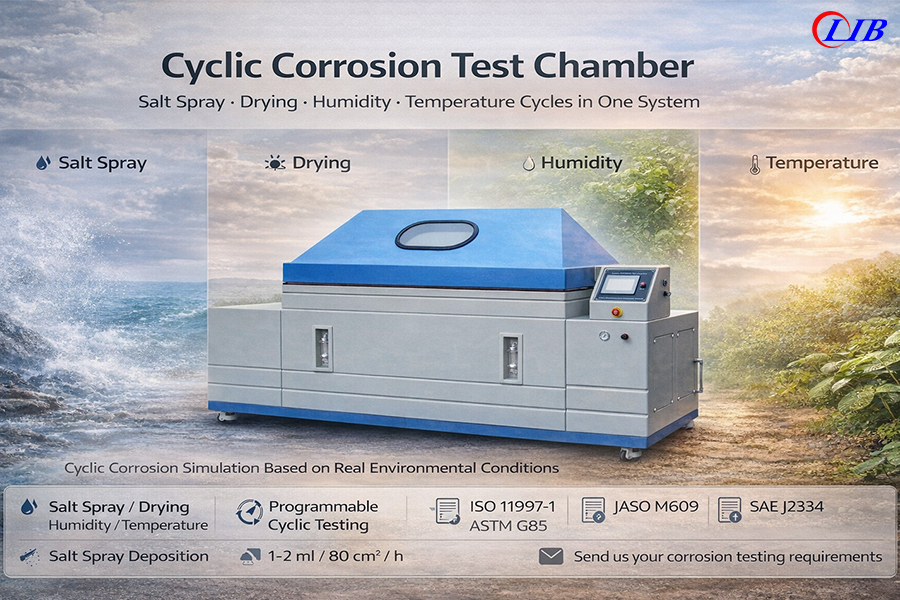
An ASTM G85 salt spray chamber is used for modified salt spray and fog testing. Unlike a basic continuous neutral salt fog test, ASTM G85 includes several acidified, cyclic, seawater, SO₂, and fog-dry methods. This makes it useful when a product needs a more demanding corrosion test that better matches marine or coastal service.
ASTM G85 covers five modified salt spray methods for ferrous metals, nonferrous metals, organic coatings, and inorganic coatings. These methods are used when a more corrosive or more specific environment than standard neutral salt fog is needed.
ASTM G85 Annex | Test Type | Typical Relevance to Marine Hardware |
A1 | Acetic acid salt spray, continuous | Decorative coatings, plated parts, acidic salt fog exposure |
A2 | Cyclic acidified salt spray | Aluminum alloys, coated metal parts, cyclic coastal corrosion |
A3 | Seawater acidified test, SWAAT | Marine exposure, synthetic seawater fog, aluminum and mixed metals |
A4 | SO₂ salt spray, cyclic | Coastal industrial areas, port zones, acid rain plus salt |
A5 | Dilute electrolyte cyclic fog-dry test | Painted steel and coated hardware exposed to fog and dry cycling |
For marine hardware, A2, A3, and A4 are often the most relevant because they reflect acidified salt, synthetic seawater, humidity cycling, and pollution-related corrosion.
ASTM B117 is widely used as a baseline neutral salt spray test. It can help compare coatings and materials in a continuous fog environment. ASTM G85 goes further by adding modified exposure conditions such as lower pH, cyclic humidity, synthetic seawater, SO₂ gas, and fog-dry cycling.
ASTM G85 A2 uses acidified salt fog (pH 2.8–3.0) at 49°C with a cyclic exposure: salt fog spray, dry-air purge, and high humidity stages.
It is commonly used to evaluate aluminum parts, coated brackets, hinges, handles, and fasteners. This test helps reveal coating porosity, underfilm corrosion, and poor edge coverage under alternating wet/dry conditions.
ASTM G85 A3 simulates marine environments using acidified synthetic seawater (pH 2.8–3.0) at 49°C with alternating spray and high-humidity cycles.
It is widely applied to marine-grade aluminum hardware, yacht fittings, deck components, and coated metal parts exposed to seawater-like conditions.
ASTM G85 A4 combines salt spray with sulfur dioxide exposure to simulate coastal-industrial atmospheres. The test typically runs at 35°C with periodic SO₂ dosing during spray cycles.
It is suitable for marine hardware used in ports, shipyards, and coastal infrastructure where salt, humidity, and industrial pollution coexist.
Pitting can start around scratches, crevices, and contact points. A salt spray test for marine hardware helps compare steel grades, passivation quality, polishing quality, and surface contamination after machining.
Aluminum hardware has problem areas with drilled holes, machined edges and anodized surfaces. Also zinc-plated screws, brackets and clamps should be checked for white rust, red rust and coating breakdown after exposure.
Painted, powder-coated, electrophoretic, and plated parts often fail first at edges. A good test sample should include real production geometry: threaded sections, stamped edges, weld seams, countersunk holes, and assembly marks. Flat coupons alone can miss these weak areas.
Samples should represent normal production, not special pieces made only for testing. If the product has a cut edge, screw hole, weld point, sliding surface, or plastic-metal contact area, the test set should include it. For assembled hardware, the test may include both open and closed positions if the mechanism traps moisture.
Before testing, the team should record:
· Material grade and surface treatment
· Coating thickness or plating thickness
· Sample batch number
· Cleaning method before exposure
· Test angle and sample position
· Inspection interval and acceptance criteria
A3 may fit synthetic seawater exposure. A4 may fit ports and coastal industrial areas. A2 may fit acidified salt cycling for aluminum or coated parts. A5 may be chosen for painted steel when fog-dry behavior is the main concern.
For example, a marine fastener may be judged by hours to first red rust, while a coated hinge may be judged by blister size, rust creep from a scribe, and smooth opening after exposure. A marine lock may need a function check after the test, not just a surface rating.
 |
|
|
| Corrosion-Resisitant Workroom | Modular grooves are used for holding samples |
salt spray tower |
cylinder |
spray collector |
LIB ASTM G85 Salt Spray Chamber supports modified corrosion testing such as continuous acidified salt fog, cyclic acidified salt spray, seawater acidified testing, dilute electrolyte fog-dry testing, and salt spray conditions used for coastal corrosion evaluation.
The chamber provides a temperature range of +10℃ to +90℃, a humidity range of 30% to 98%RH, and salt fog deposition of 1 to 2ml/80cm²·h.
Cyclic testing requires timing control. Spray, humidity, purge, and temperature steps must repeat without manual error. A programmable controller helps laboratories create repeatable profiles for marine corrosion test chamber operation.
Marine hardware is rarely flat. It may include long hinges, curved handles, heavy brackets, threaded rods, locks, screws, and mixed assemblies. Flexible sample holders allow parts to be mounted at suitable angles while keeping enough space for fog distribution and drainage.
For manufacturers testing several production lots, chamber space matters. Larger chambers can hold more finished hardware, while still allowing correct spacing and fog circulation. This is useful for supplier approval, incoming quality control, and batch release testing.
Xi’an LIB Environmental Simulation Industry manufactures environmental test chambers for corrosion, temperature, humidity, weathering, dust, rain, and other reliability testing needs.
For corrosion testing, LIB offers chambers that support international test methods such as ASTM G85, ASTM B117, ISO 9227, IEC 60068, and related cyclic corrosion procedures. Its broader product range also covers temperature and humidity chambers, thermal shock chambers, xenon arc chambers, rain test chambers, dust chambers, and walk-in environmental chambers.
For marine hardware suppliers, this matters because corrosion testing is often only one part of a larger reliability program. A product used near the sea may also need heat, humidity, UV, rain, and dust exposure testing. A supplier with a wider environmental chamber portfolio can help build a more complete test plan for long-term product validation.
For stainless steel fittings, aluminum parts, zinc-plated fasteners, coated hinges, marine locks, and deck hardware, ASTM G85 testing can expose weak coatings, poor edge protection, early pitting, and process variation. With controlled temperature, humidity, fog deposition, and cyclic operation, LIB ASTM G85 Salt Spray Chamber supports corrosion resistance testing for coastal environments and helps quality teams make better decisions before shipment.
The best salt spray test for marine hardware depends on the part and service environment. ASTM G85 A3 is often relevant for seawater-related exposure. A2 can fit cyclic acidified salt fog needs. A4 is useful when salt and industrial pollution may appear together.
Yes. ASTM G85 can be used to evaluate stainless steel marine hardware, especially for pitting, surface contamination, passivation quality, and corrosion around crevices or machined edges. The result should be judged according to the buyer’s acceptance criteria or product specification.
Buyers should check temperature range, humidity range, salt fog deposition, cyclic programming, chamber material, sample holder design, data recording, safety features, and service support. For ASTM G85 testing, the marine corrosion test chamber should support stable fog and humidity cycles.
Coastal environments contain salt particles, moisture, heat, and sometimes acidic pollutants. These factors can speed up rust, pitting, blistering, and coating failure. Corrosion resistance testing for coastal environments helps manufacturers find these risks before products are installed in boats, docks, ports, or seaside buildings.


 English
 русский
 français
 العربية
 Deutsch
 Español
 한국어
한국어 italiano
 tiếng việt
 ไทย
ไทย Indonesia