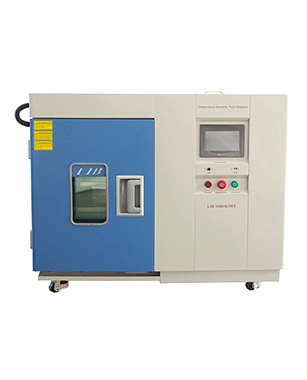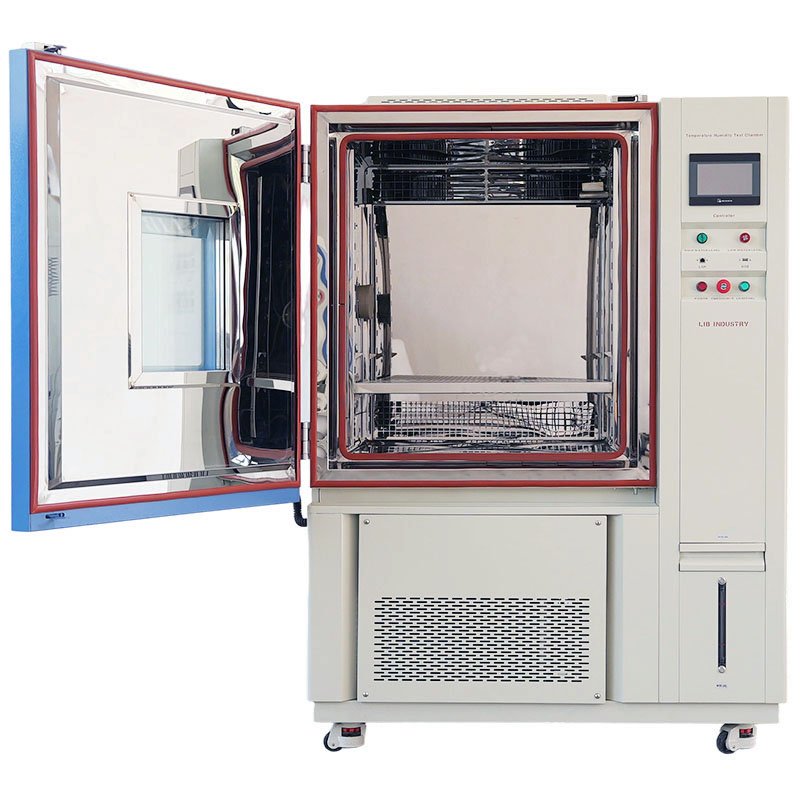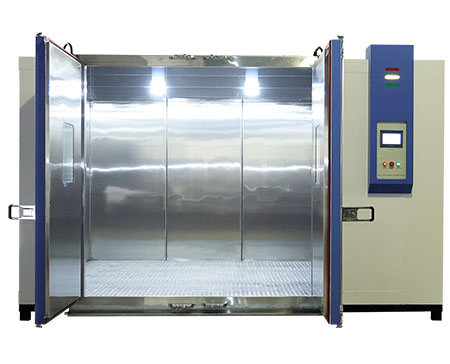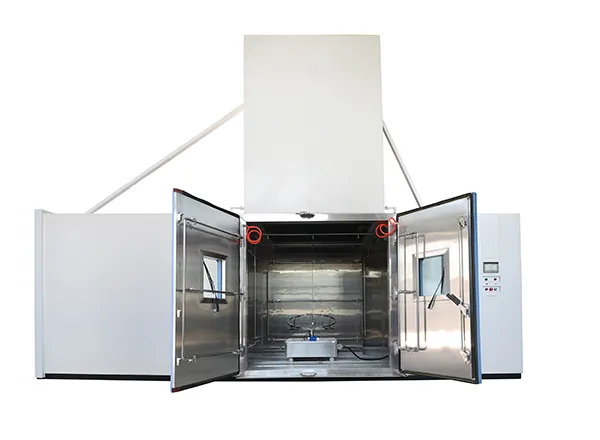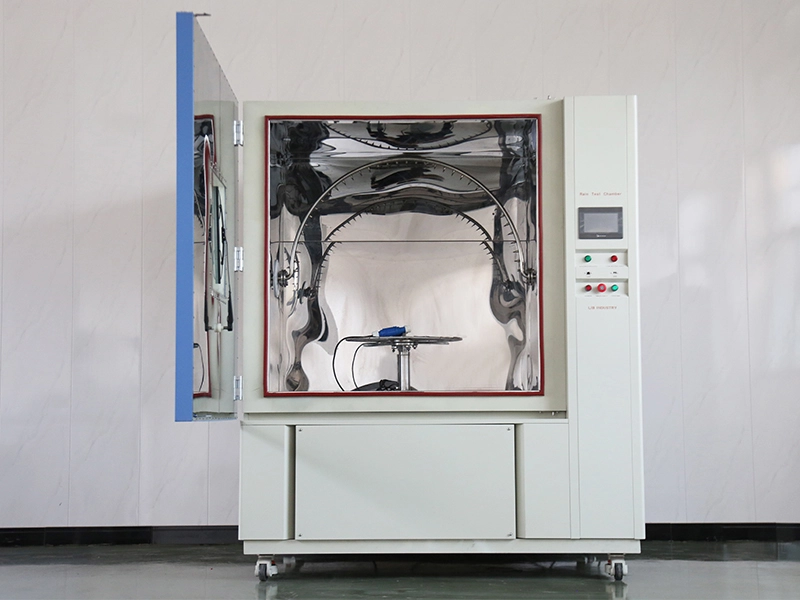
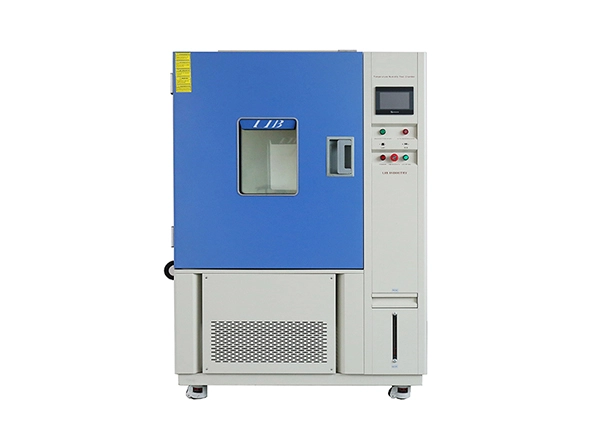
Selecting an environmental stress chamber is not a simple volume choice. A 225L chamber can be more reliable than a larger unit when the sample is small, airflow is open, and the test calls for tight temperature and humidity control. A 1000L chamber becomes the better choice when fixtures, cables, powered samples, or batch loading take up the working space.
Chamber size affects temperature uniformity, humidity stability, and test throughput. Empty space inside the chamber is part of the test system — it lets conditioned air move around the sample instead of forming hot spots, cold pockets, or wet areas near the surface.
A practical rule is to keep samples below about one-third of usable working volume. This applies to PCB trays, battery modules, metal parts, powered devices, and mounted samples.
Chamber volume | Internal space, mm | Best-fit use | Typical examples |
100L | 400 × 500 × 500 | Small parts and early R&D | Sensors, connectors, PCB samples |
225L | 500 × 600 × 750 | Medium samples and flexible lab work | Control modules, small assemblies |
500L | 700 × 800 × 900 | Batch testing and larger assemblies | PCB trays, instrument housings |
800L | 800 × 1000 × 1000 | Larger fixtures or higher throughput | Battery modules, subassemblies |
| 1000L | 1000 × 1000 × 1000 | Large products and production validation | Telecom units, larger electronic systems |
| |||
Final selection should still check fixture size, cable routing, weight, heat output, and test profile — the table below walks through how.
Measure the sample in its real test condition, not as a bare product. Add brackets, trays, cables, thermocouples, supports, shelves, and safety spacing.
For one sample, check side, top, and rear airflow clearance. For batch testing, avoid dense stacking — ten small parts placed too close together can block air more severely than one larger sample.
The same product may need different chamber sizes at different project stages. R&D needs fast setup changes. Quality control needs repeatable placement. Production screening cares most about pieces per run. Here's how that plays out at each size:
100L — small components and early R&D. Suitable for sensors, connectors, PCB coupons, rubber samples, coatings, adhesives, and small electronic subcomponents — useful when tests change often and loading needs to be quick. It becomes a poor fit once the fixture fills most of the chamber; if cables, brackets, or supports crowd the air path, move up to 225L.
225L — the flexible middle ground. More height and depth than a compact chamber while staying manageable in floor space. A common choice for electronic assemblies, PCB trays, and powered devices with signal wiring, especially for mixed R&D programs that alternate between damp heat (e.g. 40°C / 93% RH) and low-temperature checks in the same week.
500L and 800L — batch testing and larger assemblies. 500L is the standard pick for repeatable batch testing, incoming inspection, materials comparison, and reliability screening. Step up to 800L when fixtures get larger or the item is tall — battery modules, instrument panels, cable-heavy setups — where the extra volume buys stable airflow and safe access, not just fit.
1000L — large products and high-throughput validation. Fits large products or repeated validation runs where smaller chambers would mean too many cycles. Also the right scale for powered equipment, since wiring, heat removal, and sensor placement all need room. The real question isn't just "will it fit," but "will it fit with stable airflow and safe access."
Quick reference by application: component R&D → 100L or 225L. Electronic assemblies needing room for powered operation and wiring → 225L or 500L. Automotive electronics, battery modules, telecom equipment, larger housings → 500L, 800L, or 1000L. High-frequency production screening → size up to cut queue time on repeated long profiles.
Volume is only one part of the decision. Before buying, compare the test profile — and the chamber's real-world performance data — against each of these.
Internal dimensions. Check width, depth, and height against the largest sample orientation, including fixtures and cable bend radius.
Usable working volume. Usable space is smaller than total internal volume. Samples should never block the fan outlet, return air path, humidity sensor, drain area, or shelf airflow.
Temperature range. LIB chambers offer -20°C to +150°C, -40°C to +150°C, or -70°C to +150°C options. Choose the low-end range with margin below your actual test point.
Humidity range. A 20% to 98% RH range covers most storage, transport, and damp heat tests — but check humidity performance at the actual temperature point, not just the rated range.
Heating and cooling performance. Ramp rate matters for thermal cycling and door-opening recovery. LIB chambers run 3°C/min heating and 1°C/min cooling, which fits most climate test profiles.
Heat load and powered-sample testing. Powered samples release heat. LIB chambers support a 1000W heat load rating, which matters for electronics, battery work, and live functional testing.
Service and support behind the chamber. A chamber is a long-term lab asset, not a one-time purchase. Installation guidance, calibration, and how fast a supplier can turn around maintenance or repairs directly affect uptime on multi-week reliability programs — worth weighing alongside the spec sheet, not after the sale.
Standards define the conditions that must be held around the sample. If samples are crowded, the display may reach setpoint while the product surface sees a different condition entirely.
Standard | Key chamber-related parameters |
IEC 60068-2-78 damp heat steady state | Typical severities include 30°C ± 2°C at 85% or 93% RH, and 40°C ± 2°C at 85% or 93% RH. Duration may run from 12 hours to 56 days. Humidifying water conductivity is commonly limited to ≤20 µS/cm. |
IEC 60068-2-30 damp heat cyclic | Uses a 24-hour cycle: a 12-hour warm humid period, heating toward 55°C over about 3 hours while RH stays above 95%, followed by the lower-temperature part of the cycle. |
IEC 60068-2-14 temperature change | Test Na uses rapid air-to-air transfer, often below 1 minute. Test Nb uses a controlled temperature change rate, so ramp rate and uniformity must match the written test plan. |
The most common mistake is choosing a chamber that only fits the product — leaving no space for airflow, shelves, wiring, sensors, and future samples. Others include:
· Treating total chamber volume as usable volume
· Ignoring sample heat output during powered testing
· Choosing a low-temperature range with no margin
· Packing samples too close together in batch tests
· Forgetting loading height, drainage, water supply, and lab power
· Using one chamber size for every test profile
A larger chamber is not always better. The best choice is the smallest chamber that still gives enough working space, airflow, and performance margin.
LIB environmental stress chambers are used for temperature, humidity, and reliability testing across electronics, automotive, aerospace, materials, battery technology, and related fields. The 100L to 1000L range gives labs a path from compact R&D work to larger validation tasks, backed by the service structure below.
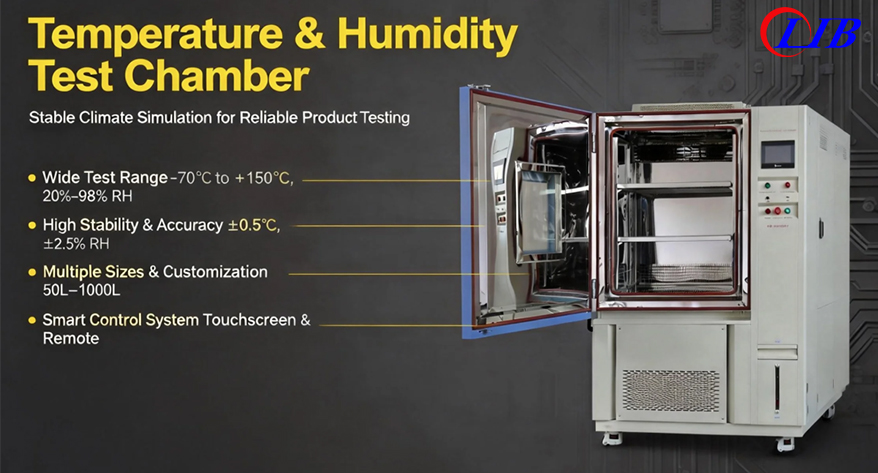
Key parameter | LIB environmental stress chamber capability |
Volume options | 100L, 225L, 500L, 800L, 1000L |
Temperature range options | -20°C to +150°C, -40°C to +150°C, -70°C to +150°C |
Humidity range | 20% to 98% RH |
Temperature fluctuation | ±0.5°C |
Temperature deviation | ±2.0°C |
Humidity deviation | ±2.5% RH |
Heating / cooling rate | 3°C/min heating, 1°C/min cooling |
Heat load | 1000W |
Control system | Programmable color LCD touch screen with Ethernet connection |
Water system | Automatic water supply with water purification |
Uniform air circulation reduces variation between shelves. A viewing window, interior lighting, programmable control, cable ports, and stable humidity generation make long tests easier to run and record. Non-standard samples can be accommodated through customized chamber solutions.
Manufacturer and service background: Xi'an LIB Environmental Simulation Industry has manufactured and supplied environmental test chambers since 2009, covering design, production, sales, and service for customers worldwide, with a product range spanning temperature and climate chambers, corrosion chambers, dust and water ingress chambers, weathering chambers, and special environmental simulation systems. The service structure runs from technical discussion and chamber design through production, inspection, calibration, international shipping, installation guidance, training, and ongoing maintenance and repair — backed by a 36-month warranty and lifelong follow-up service, which matters for labs running long reliability programs where downtime is costly.
The right environmental stress chamber size is the size that fits the sample, fixture, airflow path, test standard, and lab workflow at the same time. For small components, 100L or 225L may be enough. For batch testing and powered assemblies, 500L or 800L often gives a better working margin. For large products or high-throughput validation, 1000L is usually safer.
A final decision should compare internal dimensions, usable working space, temperature range, humidity range, ramp rate, heat load, and service support together. Once these points are clear, chamber selection becomes a practical engineering decision rather than a guess based on volume.
Q: Is a 100L environmental chamber enough for electronics testing?
Yes, if the electronics are small components, PCB coupons, sensors, or compact modules with light wiring. If the device is powered, a 225L chamber is often easier to use.
Q: When should I choose a 225L test chamber?
For medium-size electronic assemblies, mixed R&D tasks, and small batch testing — cases where a compact chamber is too tight but a large chamber is more than needed.
Q: What is the difference between a 500L and 800L environmental test chamber?
500L is the typical size for batch testing and medium-size test assemblies. 800L offers more space for larger fixtures, very tall samples, large battery tests, and greater airflow margin around the samples.
Q:When should I choose a 1000L test chamber?
For larger products, for running many samples at once, or for powered products that need more space for heat dissipation, wiring, and sensor placement.
 English
 русский
 français
 العربية
 Deutsch
 Español
 한국어
한국어 italiano
 tiếng việt
 ไทย
ไทย Indonesia
_20260803163531.webp "IEC 61215 MQT10 UV Preconditioning Test Chamber")