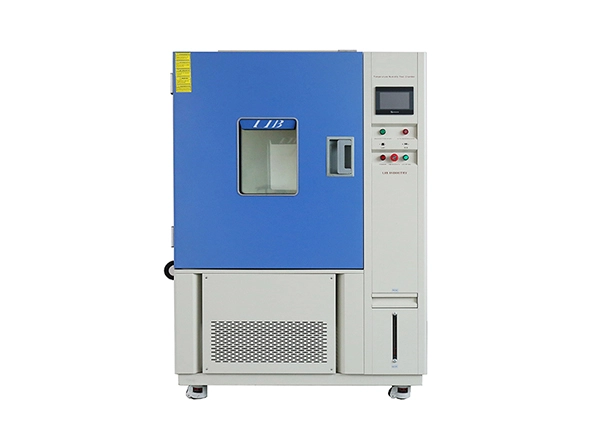
Choosing between ASTM B117, ISO 9227, and ASTM G85 starts with the required corrosion environment rather than the standard name alone. ASTM B117 is commonly used for continuous neutral salt fog, while ISO 9227 covers neutral, acidified, and copper-accelerated salt spray methods. ASTM G85 is intended for modified salt spray procedures, including more specialized or cyclic exposure conditions. A conventional Salt Spray Chamber can handle many ASTM B117 and ISO 9227 NSS applications, while ASTM G85 or acidified procedures may require additional control functions. The key selection factors are test method, solution chemistry, spray sequence, sample size, exposure duration, and fog uniformity.
Salt spray testing is used to accelerate corrosion on metals, coatings, plating, and finished components.
Typical samples include:
Painted metal panels
Zinc-plated components
Fasteners
Automotive parts
Metal housings
Aluminum components
Protective coatings
Electroplated products
The test helps identify corrosion-related failure modes such as red rust, white corrosion products, blistering, coating peeling, pitting, edge corrosion, and surface discoloration.
The three methods differ mainly in how the corrosive environment is created.
ASTM B117 represents conventional neutral salt fog exposure. A salt solution is atomized into a continuous mist, creating a stable wet and chloride-rich environment.
ISO 9227 covers several salt spray methods. Its neutral salt spray approach is broadly comparable to conventional salt fog, while acidified and copper-accelerated methods introduce more aggressive environments.
ASTM G85 covers modified salt spray procedures. Depending on the selected procedure, the test may use acidic solutions, changing spray conditions, or cyclic exposure.
Consequently, ASTM B117 vs ISO 9227 vs ASTM G85 should be viewed as a comparison of different test approaches rather than three interchangeable chamber labels.
Test Method | Typical Temperature | Environment | Spray Mode | Main Purpose |
ASTM B117 | About 35°C | Neutral salt solution | Continuous fog | General corrosion comparison |
ISO 9227 NSS | About 35°C | Neutral salt solution | Continuous spray | Metals and coatings |
ISO 9227 AASS | About 35°C | Acidified salt solution | Continuous spray | More aggressive coating evaluation |
ISO 9227 CASS | About 50°C | Copper-accelerated solution | Continuous spray | Accelerated corrosion testing |
ASTM G85 | Procedure-dependent | Modified salt solution | Continuous or cyclic | Specialized corrosion evaluation |
For conventional NSS testing, the salt solution, chamber temperature, pH, and fog deposition must remain controlled throughout the exposure. LIB's salt spray systems are designed for ASTM B117 and ISO 9227 NSS/AASS/CASS applications, with controlled fog generation and corrosion-resistant construction.
The actual exposure duration is product-specific. Common programs may use dozens or hundreds of hours, with longer exposures used for demanding coating or component evaluations. A test duration should not be interpreted as a direct prediction of service life.
ASTM B117 is widely used when manufacturers need a repeatable neutral salt-fog environment for comparing corrosion resistance.
The basic process is straightforward:
Salt solution → atomization → salt fog → sample exposure
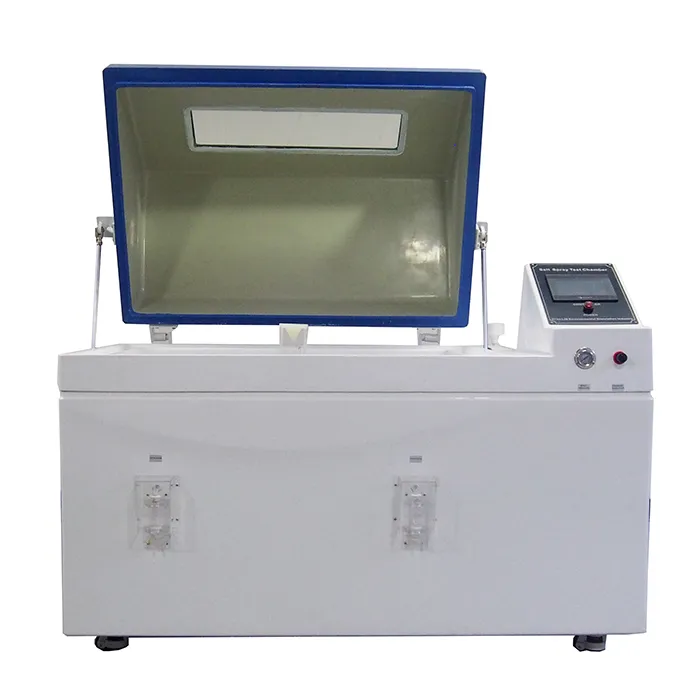
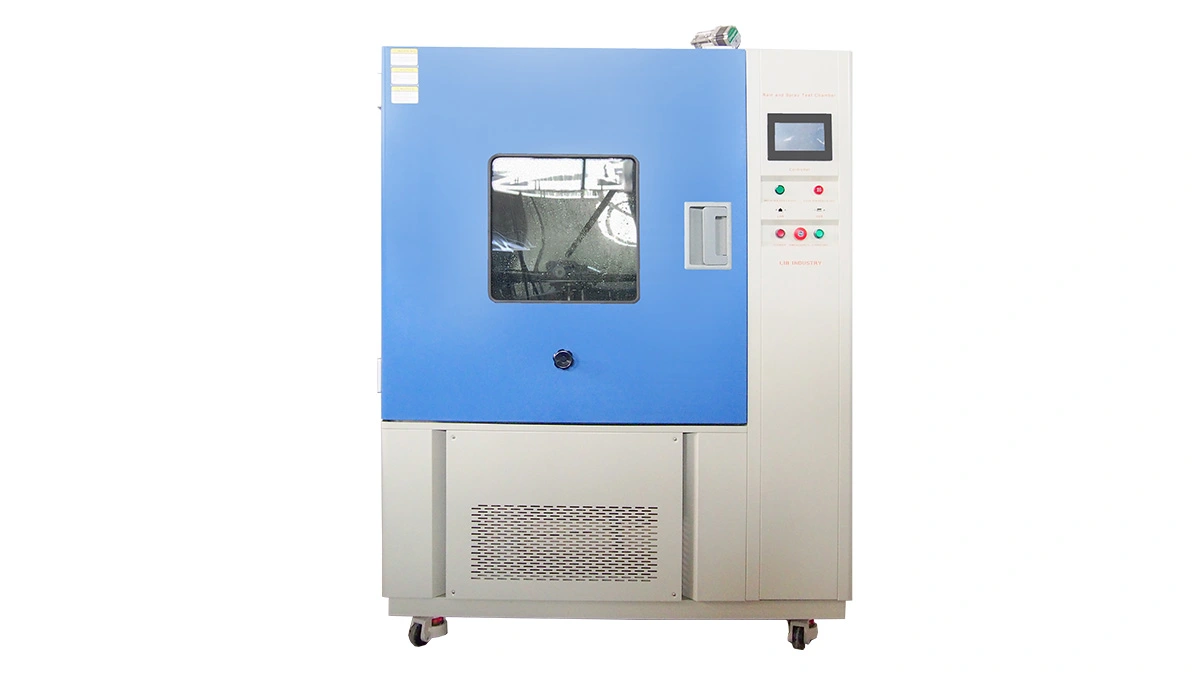
LIB's ASTM B117 Salt Spray Environmental Test Chamber is configured for conventional salt-fog testing. LIB lists a 5% salt solution, approximately 35°C chamber temperature, and controlled fog deposition for its ASTM B117 chamber.
This configuration is suitable for painted panels, plated parts, fasteners, and other metal products where continuous neutral salt exposure is required.
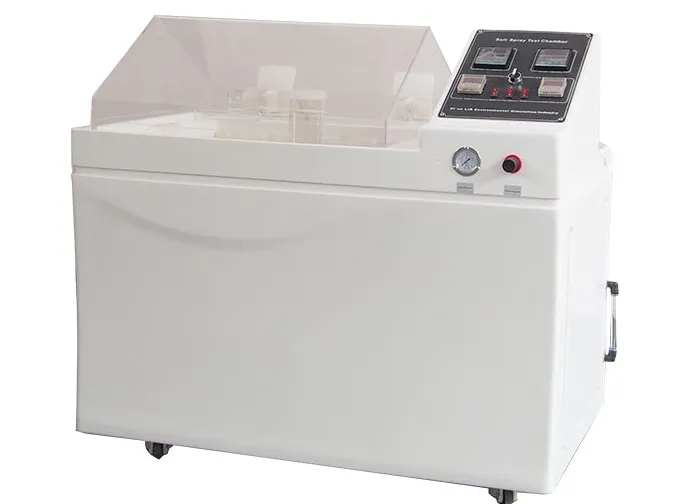
One important difference in ASTM B117 vs ISO 9227 is that ISO 9227 contains multiple salt spray methods.
Neutral Salt Spray (NSS) uses a neutral salt solution and is suitable for general corrosion testing. Acidified Salt Spray (AASS) introduces a more acidic environment, while Copper Accelerated Salt Spray (CASS) uses a more aggressive copper-containing solution.
This means that a chamber configured only for basic NSS should not automatically be assumed to support every ISO 9227 method.
LIB's Salt Spray Chambers range includes configurations for NSS, AASS, and CASS testing. The equipment uses corrosion-resistant materials and controlled spray systems to maintain stable test conditions.
ASTM G85 is more flexible than conventional neutral salt fog testing because it covers modified procedures.
Depending on the selected procedure, environmental conditions may include:
Acidified salt solution
Cyclic salt spray
Controlled wet and dry stages
Modified exposure sequences
This makes the ASTM G85 comparison particularly important during equipment selection. A chamber designed for continuous ASTM B117 fog may require additional functions before it can perform a particular ASTM G85 procedure.
A dedicated ASTM G85 Salt Spray Chamber can incorporate programmable control and spray-cycle functions for applications requiring modified corrosion exposure.
Parameter | ASTM B117 | ISO 9227 | ASTM G85 |
Temperature range | Typically around 35°C for NSS | Method-dependent | Procedure-dependent |
Humidity range | High humidity environment | High humidity environment | May require additional control |
Chamber volume | Sample-dependent | Sample-dependent | Sample and cycle-dependent |
Ramp rate | Usually secondary | Usually secondary | May matter in cyclic procedures |
Airflow | Important for fog distribution | Important for fog distribution | Important for changing exposure conditions |
Sample heat load | Usually low | Usually low | Depends on test setup |
Safety configuration | Corrosion-resistant construction | Corrosion-resistant construction | May require additional solution and cycle controls |
Applicable standards | ASTM B117 | ISO 9227 NSS/AASS/CASS | ASTM G85 procedures |
Chamber volume alone does not determine test quality.
The salt fog must reach the samples consistently. Spray towers, atomizing nozzles, saturated-air systems, collectors, and sample holders all influence the exposure environment.
LIB salt spray chambers use an atomizing spray system and corrosion-resistant chamber construction. The product range includes models such as S-150, S-250, S-750, S-010, S-016, and S-020 for different testing capacities.
Sample positioning is equally important. Flat panels are relatively easy to arrange, while fasteners, brackets, housings, and irregular assemblies may need dedicated fixtures.
Knowing that a customer requires ASTM G85, for example, is not enough. The specific G85 procedure and exposure sequence must also be identified.
A small laboratory chamber may work well for coated panels but become unsuitable for large automotive components or multiple assemblies.
Samples should be arranged to avoid shielding one another and to allow salt fog to reach the intended surfaces.
Salt concentration, pH, solution preparation, and contamination control can strongly affect corrosion results.
Salt spray is an accelerated comparative test. A 500-hour or 1,000-hour exposure should not automatically be converted into a specific number of years outdoors.
Blocked or incorrectly adjusted nozzles can change fog distribution and produce inconsistent corrosion results.
Temperature control, spray uniformity, deposition rate, solution management, sample arrangement, and corrosion-resistant construction should be evaluated together.
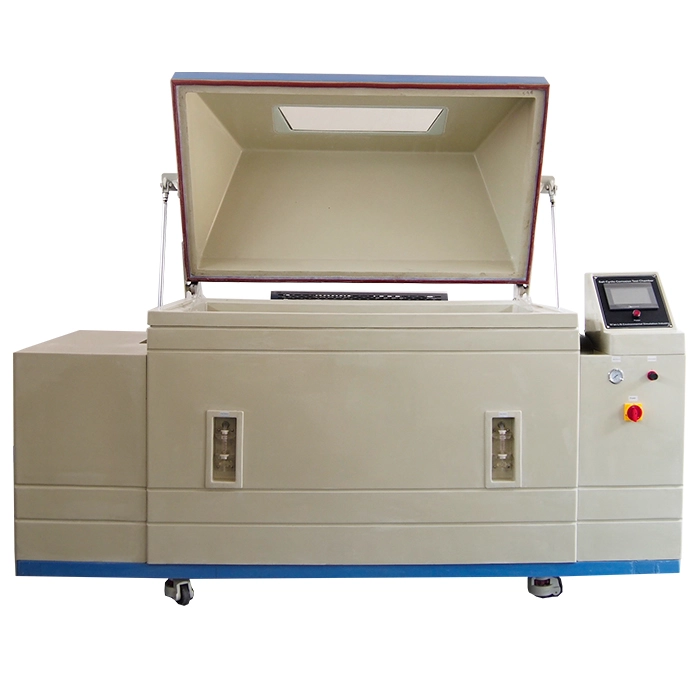
The appropriate LIB configuration depends on the test method, sample dimensions, quantity, and exposure sequence.
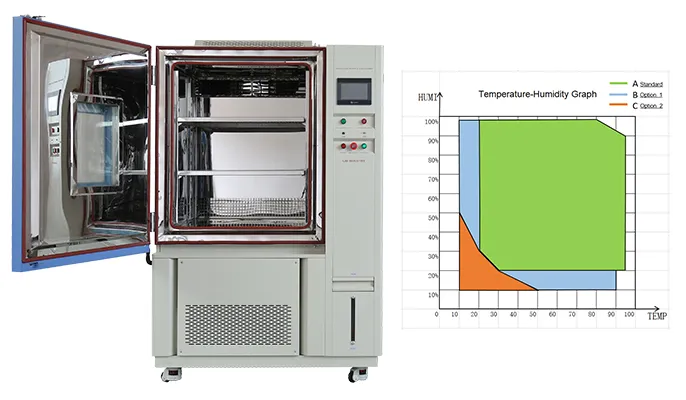
Benchtop: Suitable for small panels, coatings, fasteners, and laboratory development.
Reach-In: Appropriate for larger components and higher sample quantities.
Walk-In: Suitable for large assemblies, appliances, vehicles, and production-scale samples.
Thermal Shock: Useful when corrosion evaluation must be combined with rapid temperature transitions.
Salt Spray: The primary equipment category for ASTM B117, ISO 9227, and applicable ASTM G85 testing.
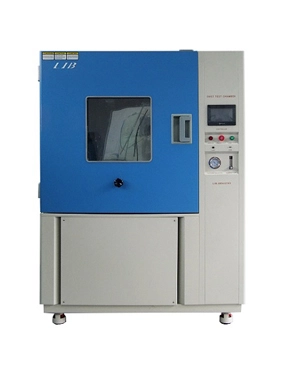
IP: Better suited to dust and water-ingress evaluation.
Special Custom Chamber: Appropriate when salt spray must be combined with humidity, drying, temperature cycling, or other environmental sequences.
The LIB Salt Spray Chambers category covers multiple chamber sizes and configurations. LIB lists support for ASTM B117, ISO 9227, ASTM G85, and other salt spray and corrosion-testing methods.
For conventional neutral salt fog, the ASTM B117 Salt Spray Environmental Test Chamber provides a targeted configuration for coatings, metal parts, and plated products.
The ASTM G85 Salt Spray Chamber is more appropriate when the test requires modified spray sequences or cyclic exposure.
The industry application can also extend beyond traditional metal-component testing. LIB's Environmental Test Chamber in Pharma provides an environmental-testing context for pharmaceutical applications and related products where controlled environmental conditions are part of product evaluation.
For related technical reading, LIB's real article Salt Spray Testing for Marine Fasteners (ASTM B117 Guide for Corrosion Resistance Evaluation) explains how salt spray testing is applied to marine fasteners, coatings, and assemblies. It also emphasizes that salt spray is a controlled comparative test rather than a direct simulation of real seawater service life.
ASTM B117 focuses on conventional neutral salt fog, while ISO 9227 includes neutral, acidified, and copper-accelerated salt spray methods.
ASTM G85 covers modified salt spray procedures. Depending on the selected procedure, it can include acidic solutions or cyclic exposure instead of continuous neutral fog.
It can, provided the chamber has the required temperature, spray, solution, control, and cycling functions for the specific procedures being performed.
There is no universal winner. ASTM B117 and ISO 9227 NSS are useful for conventional comparative salt-fog testing, while modified procedures may be more appropriate when a different corrosion environment is required.
The duration depends on the product specification and test objective. Exposure can range from relatively short screening tests to several hundred or more hours.
Consider sample dimensions, quantity, holder requirements, spacing, and whether complete components or small test panels will be tested.
Not necessarily a completely different chamber, but the equipment must provide the functions required by the selected G85 procedure, particularly when cyclic or modified exposure is involved.
Specify the test method and procedure, solution type and concentration, temperature, spray sequence, exposure duration, sample dimensions, quantity, fixture requirements, chamber volume, deposition requirements, and any customized environmental conditions.
 English
 русский
 français
 العربية
 Deutsch
 Español
 한국어
한국어 italiano
 tiếng việt
 ไทย
ไทย Indonesia
.webp "CO₂ Carbonation Curing Chamber Automation Kit")