Need a laboratory high temperature oven for drying, curing, thermal aging, heat treatment, or dry-heat testing? The right choice depends on more than the maximum temperature listed in a catalog. Chamber capacity, temperature uniformity, airflow, heating rate, sample load, safety, and the required process all affect the final result.
For applications involving moisture-sensitive materials, degassing, or reduced oxidation, a vacuum oven may be more suitable than a conventional high-temperature oven.
LIB Industry provides laboratory high temperature ovens and vacuum ovens for R&D, quality control, materials testing, electronics, automotive, manufacturing, and laboratory applications. Configurations can be selected according to temperature, chamber size, load, heating process, and other application requirements.
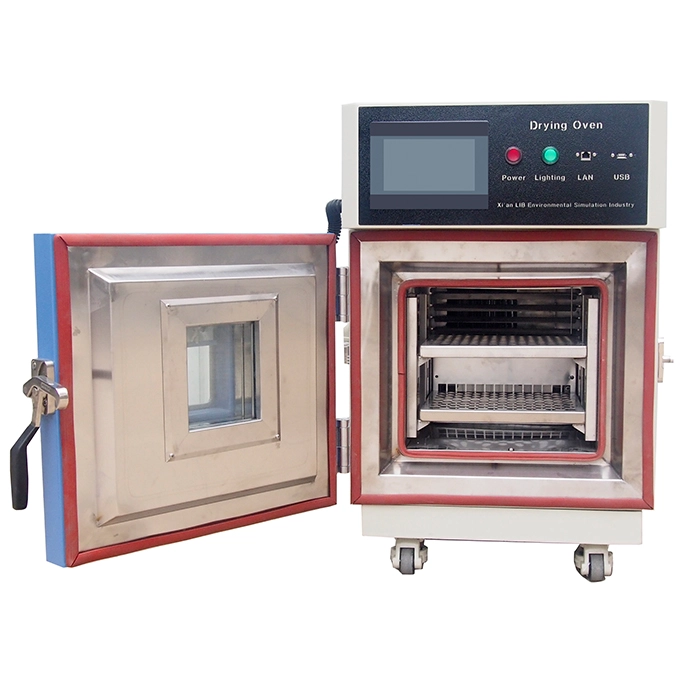 Before selecting an oven, define the actual process. Common applications include:
Drying materials and components
Curing coatings, adhesives, and composites
Thermal aging of polymers and electrical components
Heat treatment
Material conditioning
Moisture or solvent removal
Dry-heat testing
Laboratory research and process development
A conventional high temperature laboratory oven is generally suitable when samples can be heated under normal atmospheric conditions. Forced-air circulation can provide effective heat transfer for multi-shelf loading and applications requiring relatively fast heating and recovery.
However, not every material should be heated in normal atmospheric conditions. If your process requires vacuum drying, degassing, moisture removal, or reduced oxygen exposure, a vacuum oven may provide a better solution.
Selecting an oven based only on its maximum temperature can create problems during actual testing or processing.
Uneven heating: Poor airflow, excessive loading, or unsuitable chamber design can create hot and cold zones.
Slow heating and recovery: An oven that is too small or poorly matched to the load may take longer to reach the target temperature or recover after door opening.
Insufficient capacity: Overloading shelves can restrict airflow and make sample temperatures less consistent.
Material oxidation: Some materials require reduced atmospheric exposure during heating and may be better suited to vacuum processing.
For this reason, oven selection should start with the sample, process, and required test conditions, rather than simply choosing the highest available temperature.
Choose a temperature range that covers the highest required process temperature while leaving reasonable operating margin. A process should not continuously run at the absolute maximum rating of the equipment.
ASTM E145 covers general-purpose air ovens, including gravity-convection and forced-ventilation types, with forced-ventilation configurations covering portions of a range extending up to 500°C. IEC 60068-2-2 specifies dry-heat environmental testing conditions across a wide range of temperatures. The actual temperature and exposure time should always follow the applicable test method or process specification.
LIB Industry offers high-temperature oven configurations including ambient to 250°C, ambient to 400°C, and ambient to 900°C, covering routine laboratory drying through more demanding high-temperature applications.
Chamber volume should match the size and quantity of your samples while leaving enough space for effective airflow.
Consider:
Sample dimensions
Number of samples per batch
Shelf spacing
Fixture size
Load weight
Airflow clearance
Future increases in batch size
LIB high-temperature ovens are available in capacities from 100 L to 1000 L, providing options for laboratory testing and larger batch processing.
For smaller vacuum applications, LIB vacuum ovens range from 20 L to 125 L.
Temperature accuracy tells you how close the measured temperature is to the set point, while temperature uniformity indicates how evenly heat is distributed throughout the working space. Both are important when samples at different positions need comparable thermal exposure.
ASTM E145 uses multiple temperature measurement points to evaluate oven uniformity after the chamber reaches steady state.
LIB high-temperature ovens provide listed temperature fluctuation of ±0.5°C and temperature deviation of ±2.0°C. The heating and air-duct design is intended to reduce hot and cold zones under normal loading conditions.
Forced-air circulation is particularly useful for multi-shelf loading and applications requiring effective heat transfer and recovery.
When comparing ovens, check the heater type, heating rate, controller, safety protection, and communication functions.
LIB high-temperature ovens use Nichrome heating elements with a listed heating rate of approximately 6°C/min. The programmable color LCD touch-screen controller supports controlled heating processes, while Ethernet/PC Link is available as an option.
Safety functions include:
Over-temperature protection
Over-current protection
Earth leakage protection
Phase sequence protection
These functions provide additional protection during high-temperature operation and long-duration testing.
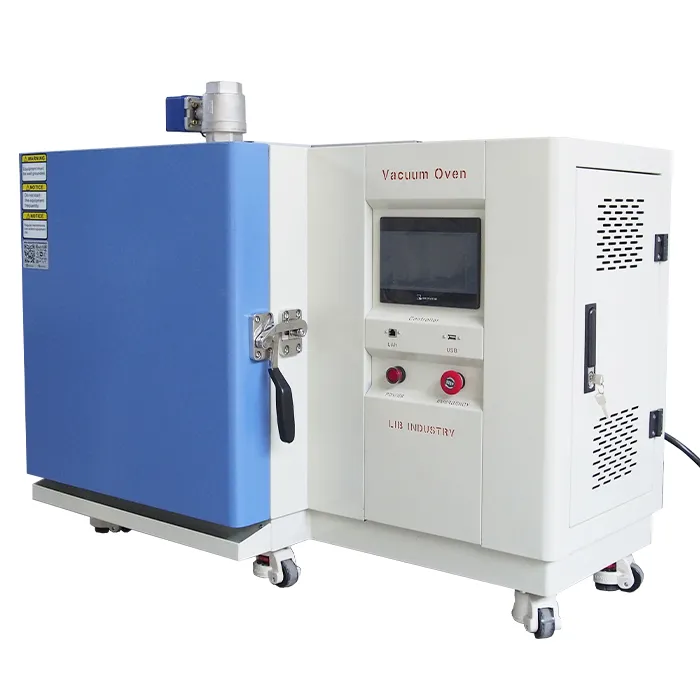
The two oven types serve different process requirements.
Selection Point | High Temperature Oven | Vacuum Oven |
Heating environment | Controlled hot air | Reduced-pressure environment |
Main applications | Drying, curing, aging, heat treatment | Vacuum drying, degassing, moisture removal |
Temperature range | Up to 250°C, 400°C, or 900°C depending on model | +35°C to +350°C |
Capacity | 100–1000 L | 20–125 L |
Atmospheric exposure | Normal atmosphere | Reduced atmospheric exposure |
| Best suited for | General thermal processing | Moisture-sensitive or oxidation-sensitive materials |
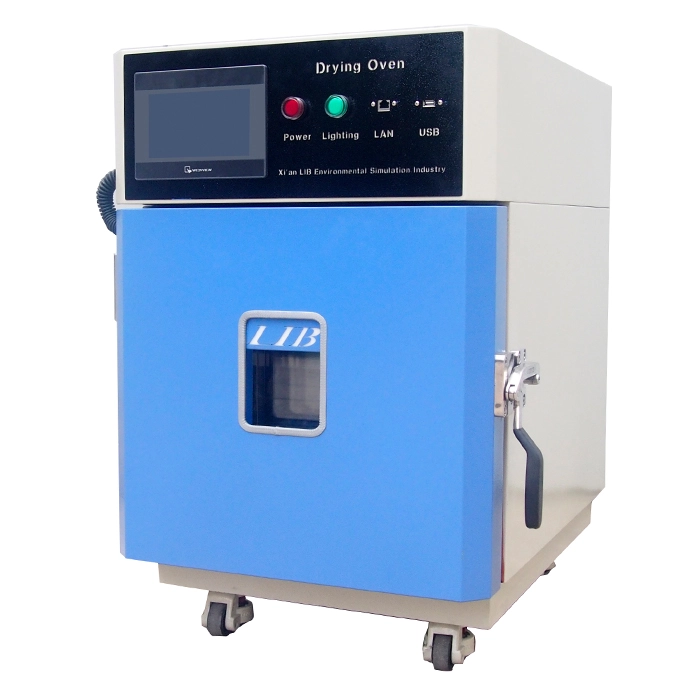 |  |
Choose a high temperature oven for general drying, curing, thermal aging, heat treatment, and dry-heat testing.
Choose a vacuum oven when your process requires vacuum drying, degassing, moisture removal, or reduced exposure to oxygen.
A vacuum oven heats samples under reduced pressure and is especially useful when conventional atmospheric heating is not ideal.
Typical applications include:
Vacuum drying
Moisture removal
Degassing
Drying moisture-sensitive materials
Heating with reduced oxygen exposure
Controlled laboratory drying
LIB vacuum ovens operate from +35°C to +350°C, with capacities from 20 L to 125 L and a listed vacuum degree of -133 Pa.
The vacuum oven uses a Nichrome heating element, SUS316 stainless steel interior, programmable color LCD touch-screen controller, and built-in vacuum connection tube and vacuum pump. A PT100 Class A temperature sensor provides temperature measurement, while multiple electrical and over-temperature protections support safe operation.
This gives customers two complementary heating solutions from one supplier: high-temperature hot-air heating for general applications and vacuum heating for specialized drying and material requirements.
Your Requirement | Recommended Solution |
General laboratory drying | High Temperature Oven |
Thermal aging | High Temperature Oven |
Coating or adhesive curing | High Temperature Oven |
High-temperature heat treatment | High Temperature Oven |
Dry-heat testing | High Temperature Oven |
Vacuum drying | Vacuum Oven |
Moisture removal | Vacuum Oven |
Degassing | Vacuum Oven |
Reduced-oxidation heating | Vacuum Oven |
Larger batch processing | High Temperature / Industrial Drying Oven |
Not sure which configuration fits your process? Provide LIB Industry with your sample material, required temperature, chamber volume, load weight, heating process, and vacuum requirements for a more suitable recommendation.
A reliable laboratory oven manufacturer should do more than provide a standard model. The equipment should be matched to the sample, process, site conditions, and acceptance requirements.
LIB Industry provides heating solutions covering different temperature and chamber-volume requirements, from compact laboratory systems to larger industrial configurations.
Depending on the application, LIB can customize:
Chamber dimensions
Shelf quantity and spacing
Cable ports
Observation windows
Exhaust systems
Fixtures
Electrical requirements
Controller functions
Ethernet/PC communication
Safety functions
LIB provides both high temperature ovens and vacuum ovens, allowing customers to select the appropriate heating environment without sourcing different equipment from multiple suppliers.
LIB Industry provides:
3-year warranty
Lifetime technical support
Professional installation and commissioning
Spare parts support
Operator training
Customized engineering solutions
Long-term after-sales service
Whether you need a laboratory high temperature oven, vacuum oven, temperature test chamber, or benchtop temperature chamber, LIB Industry can configure the equipment according to your temperature range, chamber capacity, sample load, airflow, vacuum, safety, and testing requirements.
Need help choosing the right oven? Contact LIB Industry for technical advice, configuration recommendations, and a customized quotation.
Email: inquiry@libtestchamber.com
Choose a range that covers your highest required process temperature with sufficient operating margin. The final selection should be based on the material, process, and applicable testing standard.
A high-temperature oven normally heats samples using controlled hot air and is suitable for general drying, curing, aging, and heat treatment. A vacuum oven heats samples under reduced pressure and is better suited to vacuum drying, degassing, moisture-sensitive materials, and applications where reduced oxidation is beneficial.
Select capacity based on sample dimensions, batch quantity, shelf arrangement, load weight, and airflow requirements. Avoid filling the chamber so tightly that circulation is restricted. LIB high-temperature ovens cover approximately 100–1000 L, while vacuum ovens are available from 20–125 L.
Yes. LIB can customize chamber dimensions, shelves, cable ports, observation windows, exhaust, fixtures, electrical requirements, communication functions, and other configurations according to the application.
Yes. LIB Industry provides both high temperature ovens and vacuum ovens, allowing customers to select conventional controlled-air heating or vacuum heating according to their material and process requirements.
Compare temperature performance, chamber capacity, airflow, safety systems, customization capability, documentation, warranty, and technical support. A reliable manufacturer should recommend equipment based on your actual process rather than simply offering a standard model.
 English
 русский
 français
 العربية
 Deutsch
 Español
 한국어
한국어 italiano
 tiếng việt
 ไทย
ไทย Indonesia
.webp "Portable Temperature Humidity Calibration Chamber for Thermometers and Hygrometers")