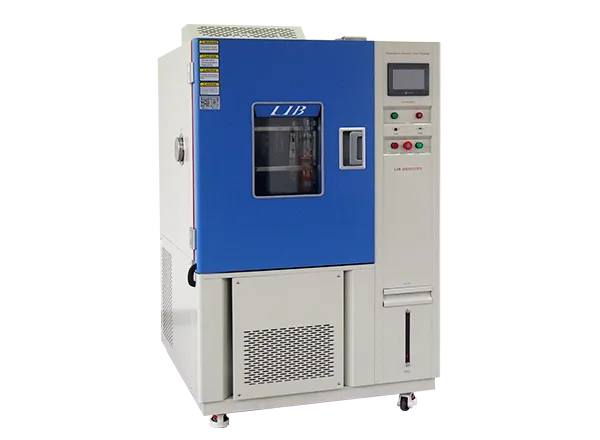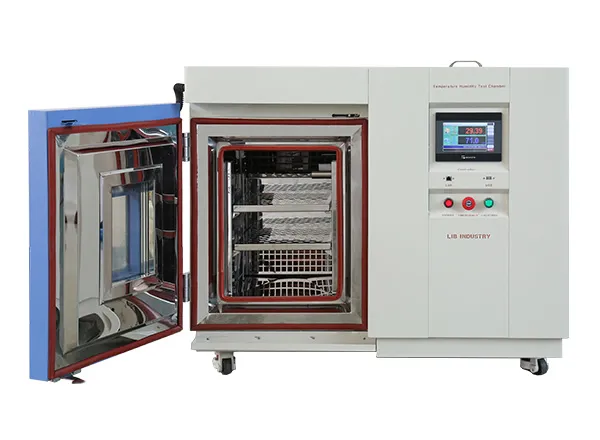
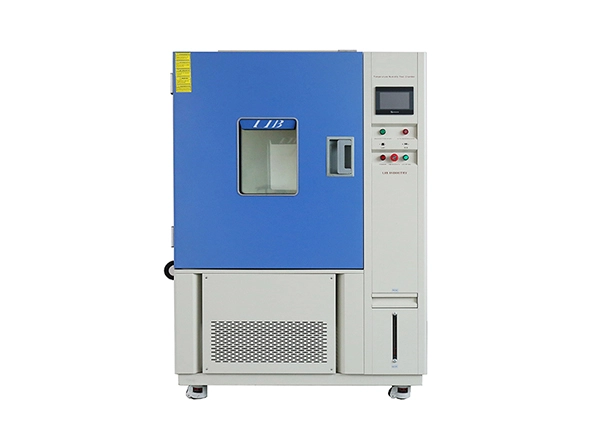
Choose an IP dust chamber when the primary requirement is enclosure ingress protection, especially IEC 60529 IP5X or IP6X verification. Choose a blowing sand and dust chamber when the product must be evaluated under wind-driven particulate exposure, abrasion, erosion, clogging, or desert-type operating conditions covered by MIL-STD-810 Method 510.7. The two systems differ mainly in test objective, particle characteristics, airflow and test procedures. The most important selection factor is therefore not chamber size or temperature range, but the exact standard and failure mechanism being evaluated. If both IEC 60529 and MIL-STD-810 are required, a combined or specially configured chamber may be more practical than treating one test as equivalent to the other.
The question “dust chamber vs sand dust chamber” is often asked because both types of equipment use airborne particles. However, they are designed to answer different engineering questions.
An IP dust chamber primarily evaluates whether a product enclosure prevents dust from entering in a way that could affect safety or operation. For IP6X, the objective is dust-tightness; the test uses a controlled dust environment and, where applicable, a vacuum inside the enclosure to create a pressure differential.
Typical products include:
Electrical enclosures
Outdoor electronic equipment
Lighting fixtures
Sensors and instruments
Communication equipment
Automotive components
Consumer electronics
LIB's IP dust chamber is designed for IEC 60529 IP5X and IP6X testing and uses controlled dust circulation, dust concentration and a built-in vacuum system for IP6X testing.
A blowing sand and dust chamber, in contrast, focuses on how equipment performs when exposed to moving particles. The concern may be penetration, filter blockage, abrasion, erosion, interference with moving components, optical degradation or reduced cooling performance.
MIL-STD-810H Method 510.7 separates the test into Procedure I – Blowing Dust and Procedure II – Blowing Sand. It defines dust as particles below 150 μm and sand as particles from 150 to 850 μm.
This distinction is particularly important for military, aerospace, automotive, outdoor and desert-use equipment.
The two test families should be specified separately because their objectives and test parameters are different.
Standard / Test | Main purpose | Temperature | Humidity | Particle / Airflow condition | Typical exposure |
IEC 60529 IP5X | Protection against dust ingress | Test-specific / normally ambient conditions | Test-specific | Controlled dust environment | Standard-defined exposure |
IEC 60529 IP6X | Dust-tight enclosure verification | Test-specific | Test-specific | Dust circulation + enclosure pressure differential | Standard-defined exposure |
IEC 60068-2-68 | Dust and sand environmental testing | According to test plan | According to method | Controlled particulate exposure | Method-dependent |
MIL-STD-810H Method 510.7 Procedure I | Blowing dust | Ambient and high operating/storage temperature as tailored | RH ≤30% for typical blowing dust | 1.5 ±1 m/s conditioning; 8.9 ±1.3 m/s typical desert wind | Commonly at least 6 h at ambient plus 6 h at high temperature unless tailored |
MIL-STD-810H Method 510.7 Procedure II | Blowing sand | High operating/storage temperature as tailored | Test-specific | High-velocity sand exposure | Duration and velocity tailored to application |
MIL-STD-810H Method 510.7 states that blowing-dust testing should normally control chamber relative humidity to no more than 30% because high humidity can cause dust particles to cake. It also specifies a typical desert-wind velocity of 8.9 ±1.3 m/s, while a lower velocity of 1.5 ±1 m/s can be used during temperature conditioning.
For Procedure I, the standard gives a default blowing-dust concentration of approximately 10.6 ±7 g/m³ and, unless otherwise specified, at least six hours at standard ambient temperature plus an additional six hours at high storage or operating temperature. The method emphasizes tailoring rather than applying one universal profile to every product.
For Procedure II, the larger particles and higher airflow create a different mechanical challenge. MIL-STD-810H identifies sand particles in the 150–850 μm range and notes that the test is intended to evaluate effects such as abrasion, erosion and clogging.
Selection Factor | IP Dust Chamber | Blowing Dust Chamber | Blowing Sand & Dust Chamber |
Temperature range | Typically ambient to +50°C | Application-dependent | Application-dependent |
Humidity range | Usually dry test environment | Controlled; often ≤30% RH | Tailored to environment |
Chamber volume | Approx. 200 L to 2,000 L+ | Application-dependent | Application-dependent |
Ramp rate | Usually secondary | Secondary to airflow | Secondary to airflow |
Airflow | Controlled dust circulation | High controlled airflow | Higher airflow for sand exposure |
Sample heat load | Normally limited importance | Important for operating equipment | Important for high-temperature operation |
Safety configuration | Door interlock, electrical protection, dust sealing | Dust containment and filtration | Abrasion-resistant ducts and dust containment |
Applicable standards | IEC 60529, IP5X/IP6X, ISO 20653 | MIL-STD-810 Method 510.7 Procedure I | MIL-STD-810 Method 510.7 Procedures I & II |
LIB's standard dust-test range includes DI-800, DI-1000, DI-1500 and DI-2000 configurations, with useful volumes from 800 to 2,000 L. The listed standard configuration includes a SUS304 stainless-steel working chamber, dust circulation system, vibration motor, vacuum system and dust-proof specimen power outlet.
For a dedicated blowing sand and dust chamber, LIB provides a configuration designed for both MIL-STD-810 blowing-dust and blowing-sand procedures, with automatic control of air velocity, dust concentration, temperature and test duration.
It is not. IP6X primarily evaluates enclosure dust ingress. MIL-STD-810 Method 510.7 evaluates resistance to blowing dust and/or sand under tailored environmental conditions.
A buyer should identify whether the requirement is IP ingress protection, blowing dust, blowing sand, settling dust or another environmental method.
Particle size directly affects the failure mechanism. MIL-STD-810H distinguishes dust below 150 μm from sand in the 150–850 μm range.
For blowing-dust and blowing-sand tests, airflow is a major test variable. A chamber that can circulate powder but cannot reproduce the required air velocity may not be suitable for the specified test.
The sample must have adequate clearance for representative airflow and particle exposure. Large products may require a walk-in configuration rather than simply removing shelves from a standard cabinet.
If the equipment is powered during testing, internal heat generation can affect both the sample temperature and the chamber's ability to maintain the required environment.
For dust testing, particle concentration, airflow, particle size, circulation pattern and pressure conditions can be more important than a wide temperature range.
Fine particles can enter fans, filters, electrical components and vacuum systems. Sealing, filtration, dust recovery and cleaning access should be included in the equipment specification.
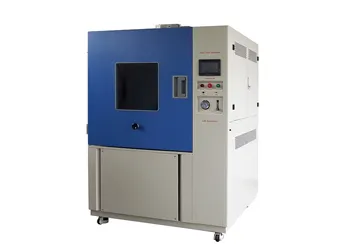
The appropriate chamber depends on the required test method and specimen scale.
Benchtop: Suitable for small electrical components, sensors, connectors and compact enclosures when the test volume is limited.
Reach-In: A practical option for medium-sized electronic, automotive and industrial products requiring repeatable dust exposure.
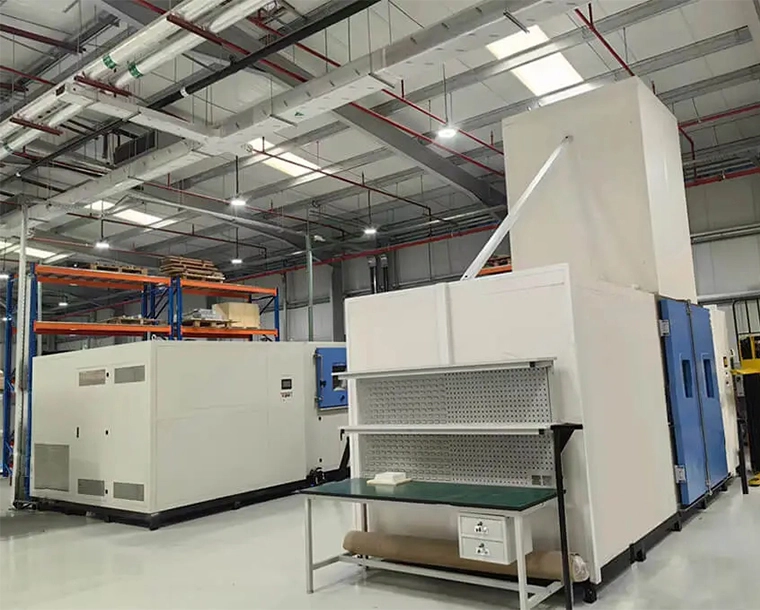
Walk-In: Recommended for large enclosures, vehicle components, large lighting products or batch testing. LIB's walk-in dust chamber uses multiple dust outlets and circulation loops to maintain a more consistent particulate environment across a large working area.
Thermal Shock: Select only when rapid hot/cold temperature transitions are part of the test requirement. It does not replace an IP or MIL-STD-810 dust system.
Salt Spray: Appropriate for corrosion testing rather than particulate ingress or abrasion.
IP: The preferred configuration for IEC 60529 IP5X/IP6X enclosure verification. LIB's IP Dust Test Chamber includes a vacuum system for IP6X testing.
Special Custom Chamber: Recommended when a project combines IP testing with MIL-STD-810 blowing dust/sand, temperature conditioning, electrical operation, large specimens or customized airflow.
For general product selection, LIB's Dust Test Chamber category covers IP dust chambers, IP6X equipment, MIL-STD-810 dust chambers, blowing dust chambers, blowing sand and dust chambers and walk-in configurations.
For a specific IEC 60529 program, the IEC 60529 Dust Chamber is designed around IP5X and IP6X requirements, including controlled dust concentration and circulation.
For military and aerospace applications, LIB's Military Environmental Testing product and application range can be connected to sand-and-dust testing where MIL-STD-810 methods are part of a broader qualification program.
A useful related resource is LIB's “Blowing Sand and Dust Test Chamber for Outdoor Power Equipment: MIL-STD-810 Reliability Testing Guide”, which provides additional guidance on MIL-STD-810 sand and dust testing for outdoor equipment and helps readers understand when blowing sand and dust exposure is required.
An IP dust chamber designed for IEC 60529 is generally appropriate. IP6X testing requires a controlled dust environment and an enclosure pressure condition that can be created using a vacuum system where specified.
An IP6X chamber is primarily intended to evaluate dust ingress into an enclosure. A MIL-STD-810 dust chamber is designed to reproduce tailored blowing-dust conditions, including controlled airflow, particle concentration, temperature and exposure duration.
Not necessarily. MIL-STD-810H Method 510.7 treats blowing dust and blowing sand as separate procedures. Dust is below 150 μm, while sand is defined as 150–850 μm. The larger particles can introduce stronger abrasion and erosion effects.
The duration is application-dependent because Method 510.7 requires tailoring. As a default for Procedure I, the method describes at least six hours at standard ambient temperature and an additional six hours at high storage or operating temperature unless otherwise specified.
Choose a chamber based on the complete enclosure dimensions, required internal pressure/vacuum connections, fixture arrangement and airflow clearance. For large products or batch testing, a walk-in chamber may be more appropriate.
Yes, a suitably engineered chamber can potentially support both, but the configuration must reproduce the different test conditions. LIB specifically lists customized combinations of standard and MIL-STD-810 dust chambers as an available configuration.
Specify the required standard and procedure, sample dimensions and weight, IP rating, dust or sand particle size, concentration, airflow velocity, temperature, humidity, exposure duration, sample orientation, powered/unpowered status, vacuum requirement and whether multiple standards must be performed in the same chamber.
 English
 русский
 français
 العربية
 Deutsch
 Español
 한국어
한국어 italiano
 tiếng việt
 ไทย
ไทย Indonesia
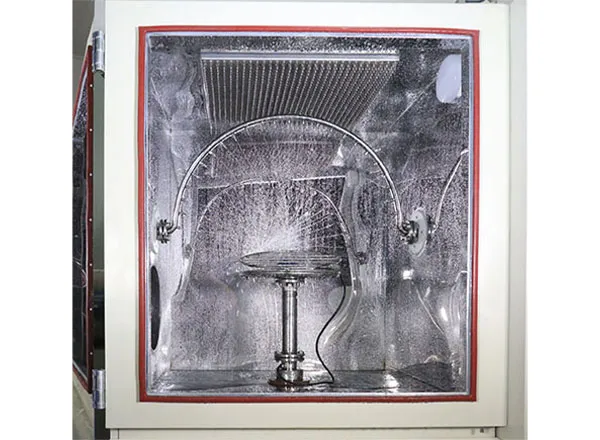
_20260824102429.webp "IPX7 IPX8 Pressurized Water Ingress Protection Tester")

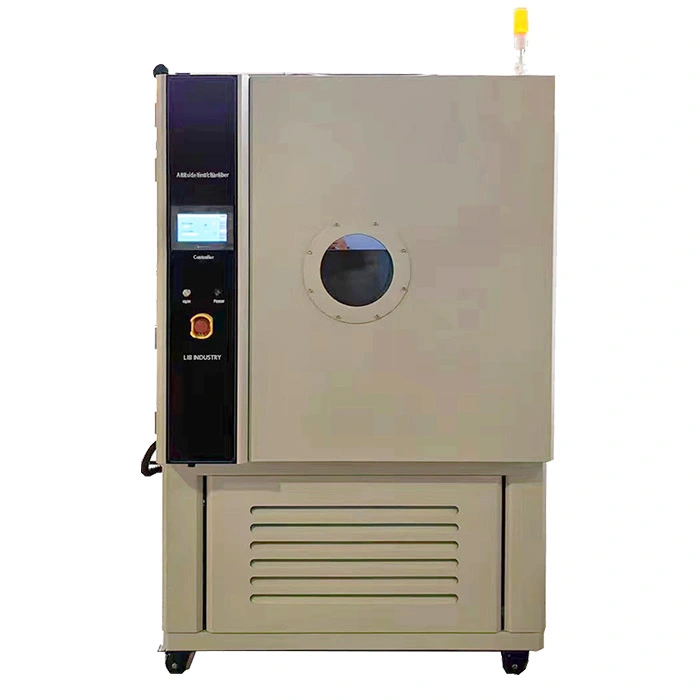
.webp "ISO 7326 Static Dynamic Ozone Chamber for Hose")