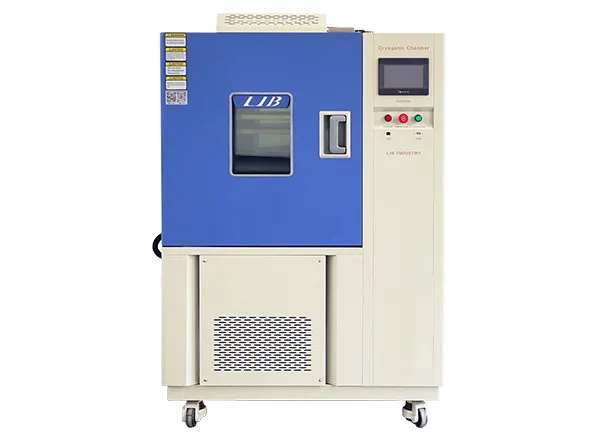
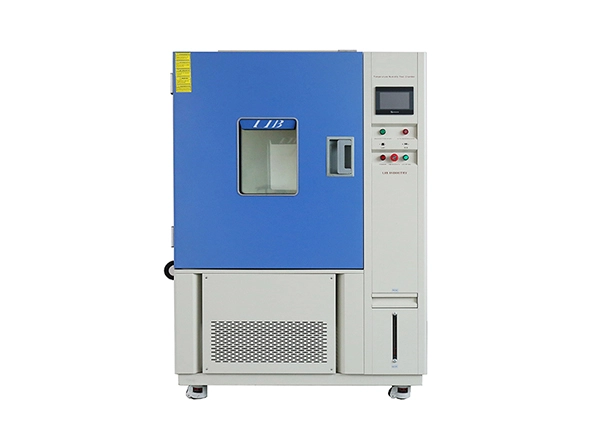
For data center hardware environmental testing, a temperature and humidity chamber is the primary equipment for evaluating servers, storage systems, networking equipment and other electronics under controlled climatic conditions. The key difference is between a standard chamber for components or individual servers and a high-capacity system designed for powered equipment with substantial heat generation. Common test programs may reference IEC 60068, JEDEC procedures and customer-specific requirements. The most important selection factor is not temperature range alone. Engineers should evaluate sample heat load, chamber volume, airflow, humidity control, temperature stability, ramp rate and cable access under actual operating conditions.
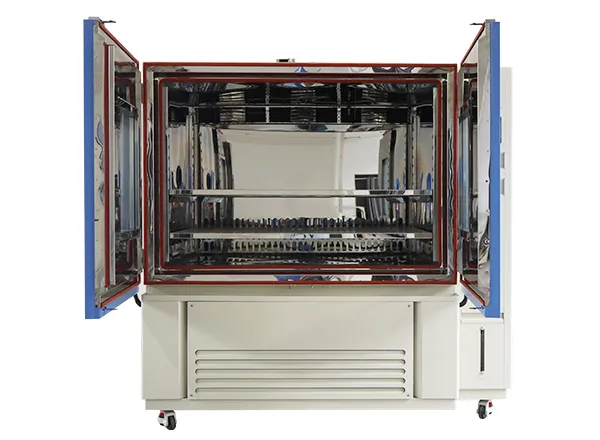
AI servers and data-center hardware operate under increasingly high computational loads. GPU servers, CPUs, storage devices, network equipment and power supplies can generate considerable heat while operating continuously.
This makes environmental testing different from testing an unpowered electronic component.
A server thermal testing program may evaluate:
Thermal stability during continuous operation
Performance at high and low temperatures
Cooling-system limitations
Fan and power-supply reliability
PCB and connector durability
Condensation risks
Long-duration operation under heat and humidity
Recovery after environmental cycling
An AI server reliability test should ideally reproduce realistic operating conditions. Engineers may operate CPUs and GPUs under defined workloads while monitoring temperature, system stability, power consumption and fault conditions.
Humidity testing adds another dimension. Excessive moisture can contribute to condensation, corrosion, insulation degradation and electrical leakage. Temperature-humidity cycling can reveal failures that may not appear during dry thermal exposure.
LIB's Temperature and Humidity Chamber portfolio is designed for controlled temperature and humidity testing of electronic products, components and assemblies.
For larger systems, chamber capacity and thermal management become critical. A complete server rack may occupy substantial space while simultaneously introducing a large heat load into the test area.
There is no single environmental standard covering every AI server or data-center application. Test programs are normally developed from applicable environmental standards, component-level procedures and customer specifications.
Test requirement | Example reference | Environmental condition | Main purpose |
Cold testing | IEC 60068-2-1 | Low-temperature exposure | Evaluate low-temperature performance |
Dry heat | IEC 60068-2-2 | Elevated temperature | Assess thermal durability |
Damp heat cycling | IEC 60068-2-30 | Temperature/humidity cycles | Evaluate moisture-related reliability |
Temperature cycling | IEC 60068-2-14 | Repeated temperature changes | Identify thermal expansion effects |
Electronic components | JEDEC JESD22 series | Defined thermal/humidity profiles | Semiconductor reliability |
Customer qualification | OEM/data-center specification | Application-specific profile | System-level validation |
Actual temperature, humidity, dwell time and cycle count should always be taken from the applicable test procedure.
LIB's published temperature and humidity chamber specifications include temperature options such as –20°C, –40°C or –70°C to +150°C, depending on model, with humidity control from 20% to 98% RH on listed TH configurations. Chamber volumes include options such as 100 L, 225 L, 500 L and 1000 L. The listed specifications also provide a 1000 W heat-load capability for the relevant configuration.
For high-power servers, however, engineers should confirm the required heat-load capacity with LIB based on the actual operating power rather than assuming that a standard specification is sufficient.
Selection Factor | Standard Chamber | High-Load / Large Chamber |
Temperature range | Various standard ranges | Customized if required |
Humidity range | Typically 20–98% RH | Customized according to test |
Chamber volume | Approx. 100–1000 L options | Large working volume |
Ramp rate | Model-dependent | Customized according to load |
Airflow | Forced circulation | Engineered for large equipment |
Sample heat load | Must be confirmed | Critical selection parameter |
Safety configuration | Over-temperature and refrigeration protection | Additional high-load safety |
Applicable standards | IEC, JEDEC, customer procedures | Same, subject to configuration |
For an individual server or electronic assembly, LIB's Temperature and Humidity Test Chamber is a relevant equipment category to consider. The appropriate volume and temperature range should be determined from the sample dimensions, environmental profile and operating load.
For rack-level testing, the selection changes considerably. A complete server rack may occupy substantial chamber space while releasing several kilowatts of heat. In this situation, chamber cooling capacity and airflow can become more important than nominal chamber volume.
A powered AI server continuously releases heat into the chamber. If this is underestimated, the chamber may struggle to maintain the required temperature.
An idle server does not represent a high-performance computing workload. If the objective is reliability under realistic operation, the test plan should define CPU/GPU utilization and other relevant loads.
Two chambers may both reach +85°C but behave very differently under high internal heat loads. Cooling capacity, airflow, recovery performance and uniformity must also be considered.
Large servers, racks, cables and fixtures can obstruct circulation. Adequate clearance is necessary to maintain representative environmental conditions.
Powered servers may require power, monitoring and network connections throughout testing. Cable ports and their locations should therefore be specified before purchase.
A precise controller reading does not mean every point in the chamber has the same temperature. Spatial uniformity should be considered when testing large equipment.
High-power server testing may require substantial electrical capacity, ventilation, cooling and floor loading. These requirements should be evaluated before installation.
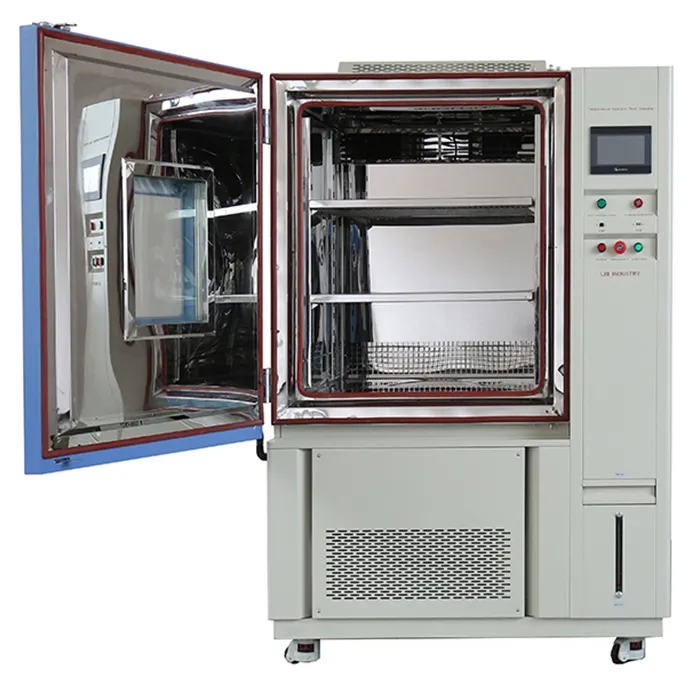
A benchtop chamber is suitable for smaller server components, PCBs, storage devices and power modules. It is a practical option for R&D teams that need basic climatic testing without a large installation footprint.
A reach-in temperature and humidity chamber is suitable for individual servers and medium-sized assemblies. It provides greater working volume while remaining practical for laboratory environments.
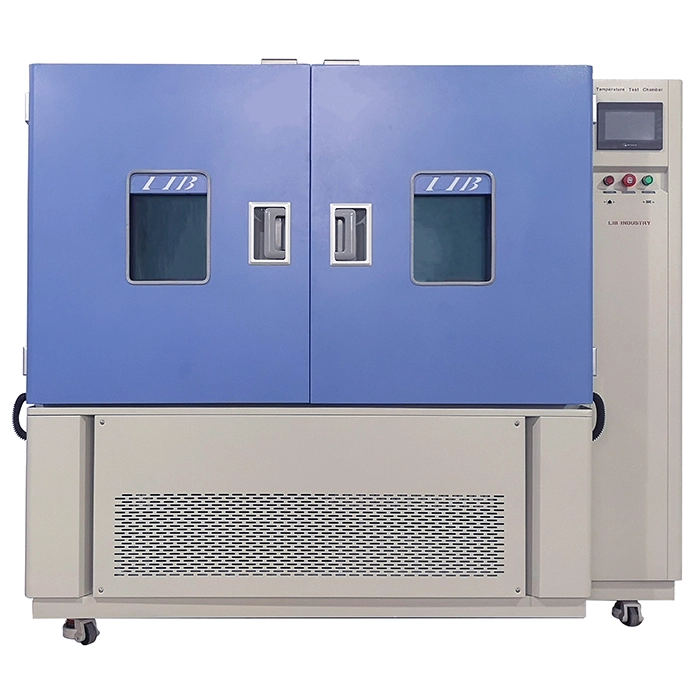
For complete server racks, multiple systems or high heat loads, a walk-in environmental chamber may be more appropriate.
LIB's automotive and electronics environmental testing experience also extends to large equipment applications. Its Environmental Test Chamber for Automotive Industry page demonstrates the company's broader approach to environmental simulation, including temperature, humidity, thermal shock and other reliability testing technologies.
Although the application is automotive-focused, the same equipment-selection principles—sample size, heat load, airflow and environmental profile—are relevant when designing chambers for data-center hardware.
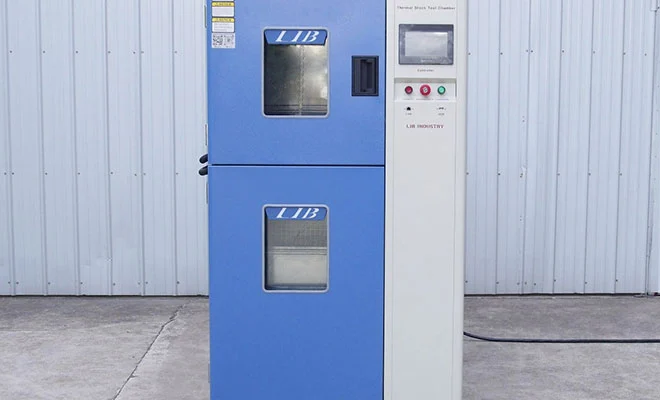
Thermal shock equipment is appropriate when the objective is to expose hardware to rapid temperature transitions rather than simply maintain a high or low temperature.
Salt spray is generally not a primary AI server test, but it can be relevant to outdoor or harsh-environment equipment where corrosion resistance is part of the qualification program.
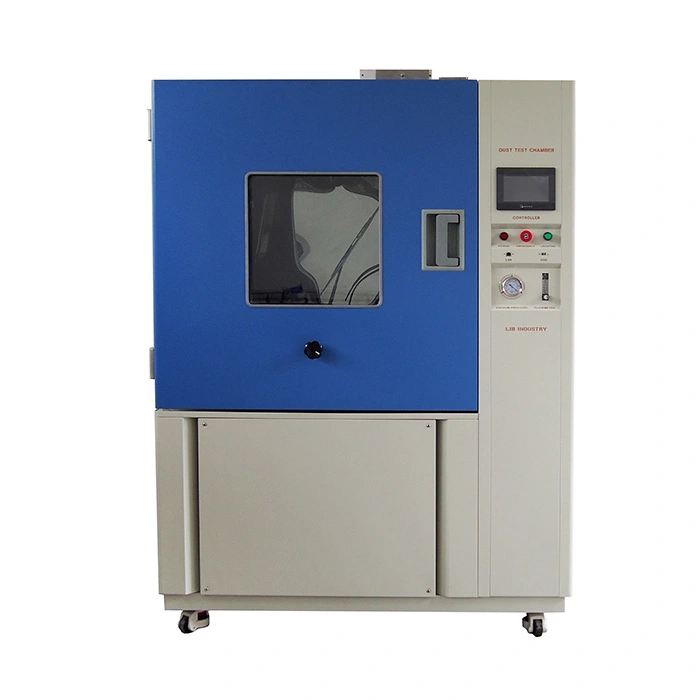
For outdoor data-center hardware or equipment requiring protection from dust and water, dedicated IP test equipment should be used. IP testing evaluates ingress protection rather than replacing temperature and humidity testing.
Custom equipment becomes useful when standard chambers cannot accommodate the required rack dimensions, heat load, cable routing or test profile.
A particularly relevant LIB resource is How Do You Test Corrosion When Servers Generate 5000 W of Heat With LIB Industry?. The case specifically discusses environmental testing of servers generating a 5000 W heat load, illustrating why server power consumption must be included in chamber design rather than treated as a secondary specification.
For general chamber selection, LIB's temperature and humidity chamber range provides different chamber sizes and configurations for component-level and system-level testing.
A temperature and humidity chamber is generally the starting point. For complete racks or high-power systems, a larger or customized chamber may be necessary.
Heat load is one of the most important factors. The chamber must be capable of maintaining the required environmental condition while the server is operating.
Duration depends on the applicable standard and test profile. It may involve short exposures, repeated thermal cycles or long-duration operation.
Consider the server or rack dimensions, number of samples, fixtures, airflow clearance, cable routing and future testing requirements.
It can if its cooling capacity, airflow and heat-load capability are adequate. The nominal temperature range alone is not enough to determine suitability.
Provide sample dimensions, total power consumption, operating workload, temperature and humidity ranges, ramp rate, test duration, number of samples, cable requirements and applicable standards.
 English
 русский
 français
 العربية
 Deutsch
 Español
 한국어
한국어 italiano
 tiếng việt
 ไทย
ไทย Indonesia
.webp "Uniform Salt Deposition in Salt Spray Chambers for Electronics")