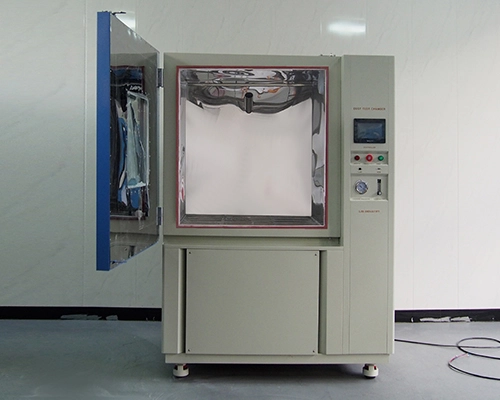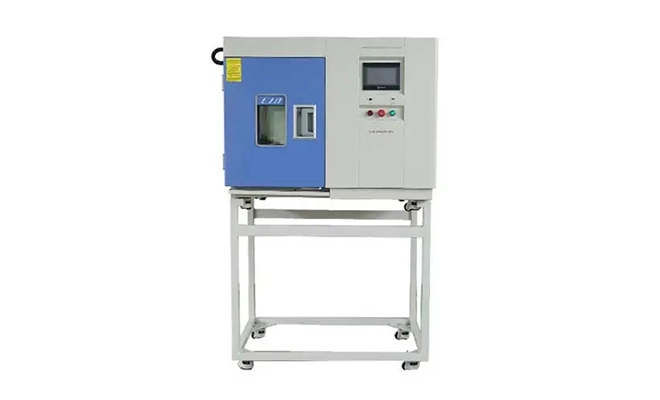
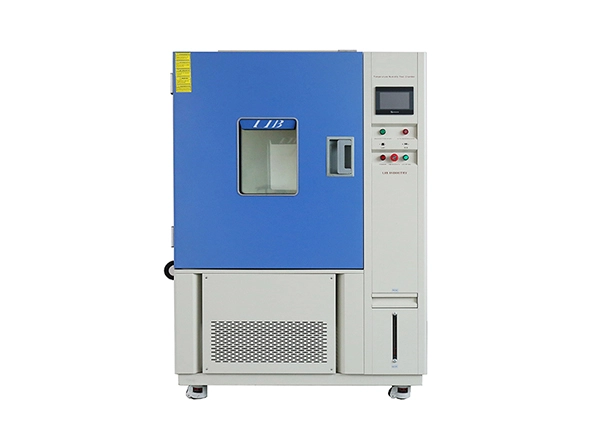
For IPX6 vs IPX9K testing, the equipment choice should start with the required water-jet severity and applicable standard. An IPX5/IPX6 water jet test chamber is designed for powerful water jets at controlled flow rates and distances, while an IPX9K test chamber uses high-temperature, high-pressure water jets at close range. IPX5 and IPX6 are commonly specified under IEC 60529, while the “K” designation is associated with ISO 20653 for road vehicles. The key selection factors are nozzle type, water flow, pressure, spray distance, water temperature, specimen size, turntable configuration, and whether the product must withstand ordinary powerful jets or high-pressure hot-water cleaning.
Water-ingress testing is not simply a matter of spraying more water at a product. Different IP levels reproduce different environmental and operational hazards.
IPX5 evaluates protection against water jets. IPX6 increases the severity to powerful water jets, making it relevant to products exposed to heavy rain, strong outdoor water streams, cleaning processes, or other high-intensity water exposure.
Typical products include:
Outdoor electrical enclosures
Industrial control cabinets
Lighting equipment
Automotive electronic components
EV charging equipment
Sensors and connectors
Communication equipment
Household appliances
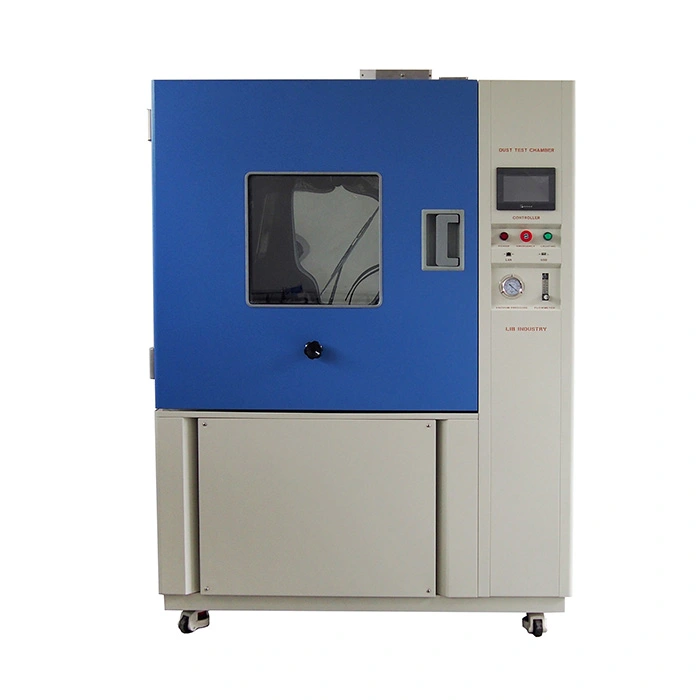
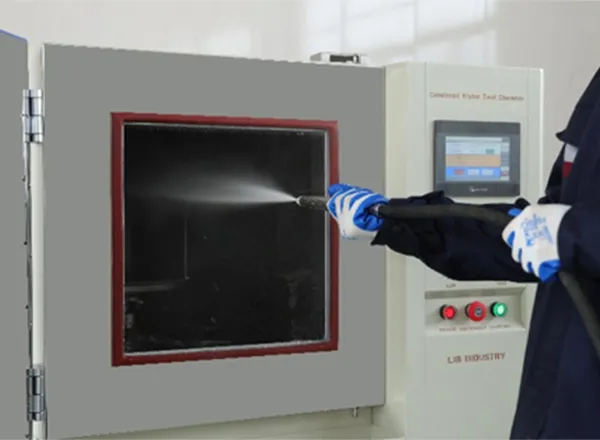
LIB's IPX5/IPX6 water spray jetting chamber is designed for electrical and electronic products exposed to powerful water jets and uses dedicated 6.3 mm and 12.5 mm nozzles for IPX5 and IPX6 respectively. The listed system controls water flow through an electromagnetic flowmeter and programmable controller.
IPX9K addresses a substantially different scenario. It evaluates protection against high-temperature, high-pressure water jets applied at close range. This makes the test particularly relevant to automotive components and equipment that may encounter pressure washing or severe washdown conditions.
ISO 20653:2023 applies specifically to electrical equipment of road vehicles and defines IP codes, including requirements and test methods. It also notes that the “K” codes describe special requirements for road vehicles that are not covered by IEC 60529.
Therefore, IPX6 is not simply a lower version of IPX9K. The tests represent different water-exposure mechanisms.
The following comparison illustrates why separate equipment configurations are normally required.
Test | Standard | Water condition | Nozzle / flow | Spray distance | Temperature | Typical exposure |
IPX5 | IEC 60529 | Water jet | 6.3 mm nozzle; 12.5 L/min ±5% | Approx. 2.5–3 m | Ambient test water | From all practicable directions |
IPX6 | IEC 60529 | Powerful water jet | 12.5 mm nozzle; 100 L/min ±5% | Approx. 2.5–3 m | Ambient test water | From all practicable directions |
IPX9K | ISO 20653 / applicable vehicle specification | High-temperature, high-pressure jet | Special high-pressure nozzle; 14–16 L/min | Close range | 80°C ±5°C | Four specified directions / positions |
LIB's IPX5/IPX6 chamber lists flow rates of 12.5 L/min ±5% for IPX5 and 100 L/min ±5% for IPX6, with the nozzle positioned approximately 2.5–3 m from the test area.
For IPX9K, LIB's technical information specifies water at approximately 80°C ±5°C and injection pressure in the 8,000–10,000 kPa range. Independent descriptions of the IPX9/IPX9K test similarly identify 80°C water, 14–16 L/min and 8–10 MPa, with close-range spraying.
The distinction is important because ISO 20653:2023 has been technically revised and specifically expanded the IPX9K test conditions, including impact-force measurement and tolerances.
Selection Factor | IPX5/IPX6 Water Jet Chamber | IPX9K High-Pressure Chamber |
Temperature range | Normally ambient water conditions | Heated water, typically around 80°C |
Humidity range | Not the primary parameter | Not the primary parameter |
Chamber volume | Small to large | Small to large, depending on specimen |
Ramp rate | Usually not applicable | Water-heating rate matters |
Airflow | Not normally controlling | Not normally controlling |
Sample heat load | Usually low importance | Usually secondary to water-heating capacity |
Water pressure | Lower-pressure jet system | Very high pressure |
Safety configuration | Water shortage, leakage and electrical protection | High-temperature, high-pressure, leakage and over-temperature protection |
Nozzle system | 6.3 mm / 12.5 mm typical | Dedicated high-pressure nozzle |
Main application | Powerful water-jet resistance | High-pressure hot-water resistance |
Applicable standards | IEC 60529, ISO 20653 and product standards | ISO 20653, IEC 60529 IPX9 where applicable, automotive specifications |
LIB's current water-spray jetting chamber uses a SUS304 stainless-steel interior, water circulation and filtration, waterproof sample power supply and programmable controls. The R56-800 model listed by LIB has a 510 L working volume and a 600 mm turntable.
For IPX9K, LIB lists dedicated models including R9K-600, R9K-1200 and R9K-1900, with configurations designed for ISO 20653 and related standards.
The difference in equipment architecture reflects the difference in the test itself: IPX5/IPX6 emphasizes high-volume directional water jets, while IPX9K combines high pressure, high temperature and close-range impact.
Passing IPX6 does not automatically demonstrate resistance to IPX9K conditions. The latter introduces hot water, much higher pressure and close-range jet impact.
Water flow, nozzle geometry, spray distance and temperature are all part of the test. A pump with high pressure but the wrong nozzle or flow rate does not reproduce the required test.
For IPX9K, water temperature is a critical parameter. The chamber must have sufficient heating capacity to maintain the required temperature during continuous spraying.
IPX5 and IPX6 use different nozzle diameters and flow requirements. LIB's equipment uses 6.3 mm and 12.5 mm nozzles for the two test levels.
The product must be positioned correctly relative to the nozzle and turntable. Large housings, vehicle components and complete assemblies may require open or walk-in systems.
IPX6 requires a substantially greater flow rate than IPX5. The laboratory needs adequate water storage, pumping capacity, drainage and water recycling.
If the product must operate during testing, the system should include suitable waterproof electrical connections and electrical protection.
The IPX9K procedure is a controlled standardized test. A commercial pressure washer may produce high pressure but cannot automatically reproduce the required temperature, flow, distance, nozzle and test sequence.
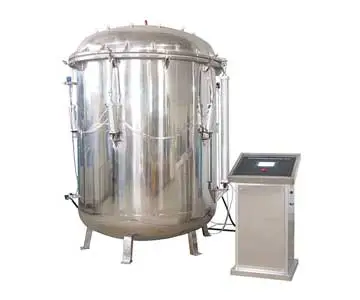
The appropriate equipment depends on the required IP level and specimen size.
Benchtop: Suitable for small connectors, sensors, compact electrical housings and development-stage products where water flow and specimen dimensions are limited.
Reach-In: A good option for medium-sized electrical, electronic and automotive components requiring repeatable IPX5/IPX6 testing.
Walk-In: Recommended for large cabinets, vehicle components, EV battery enclosures and complete assemblies. LIB's walk-in IPX1–IPX9K system can integrate multiple water-ingress methods in one large-scale test environment.
Thermal Shock: Not a substitute for water-jet testing. Select it when the primary requirement is rapid temperature transition.
Salt Spray: Appropriate for corrosion testing, not IP water-jet verification.
IP: The preferred equipment category when the requirement is enclosure ingress protection. LIB's IP Test Equipment portfolio includes IPX5/X6 water-jet systems, IPX9K equipment, immersion systems and other IP configurations.
Special Custom Chamber: Consider this option when the specimen is oversized, the product must remain electrically active, or several IP methods need to be integrated into one test laboratory.
For conventional powerful water-jet testing, LIB's Rain Test Chamber range covers IPX5, IPX6, IPX6K and IPX9K, as well as lower-level rain and splash testing.
For IPX5/IPX6 specifically, the IPX5/X6 Water Spray Jetting Chamber provides dedicated nozzles, controlled flow, a turntable and water circulation system.
For high-temperature, high-pressure testing, LIB's IPX9K Test Equipment provides a dedicated configuration rather than adapting a conventional water-jet system.
For automotive applications, LIB's Environmental Test Chamber for Automotive Industry connects IP dust and water ingress testing with other automotive environmental reliability tests.
A useful related resource is LIB's How Does an IPX5 X6 Water Spray Jetting Chamber Improve Household Appliance Reliability?, which provides a practical application perspective on IPX5/IPX6 water-jet testing and enclosure reliability.
An IPX5/X6 water spray jetting chamber with the correct nozzle, flow control, spray distance and test controls is appropriate. LIB offers dedicated IPX5/X6 equipment designed around IEC 60529 and ISO 20653.
IPX6 evaluates powerful water jets under controlled flow conditions, while IPX9K uses close-range high-temperature, high-pressure water jets. IPX9K therefore introduces significantly different thermal and mechanical water-jet conditions.
It is more severe in terms of water temperature, pressure and close-range jet impact, but it should not be interpreted simply as a numerical extension of IPX6. The two tests address different exposure conditions.
The duration depends on the applicable standard, specimen size and test arrangement. IPX9-type testing commonly uses specified exposure periods at multiple spray positions, while large specimens may require a different test arrangement. The complete product standard should be checked before defining the test duration.
Measure the complete product, including mounting fixtures, cables and required clearance from the spray nozzle. For large automotive assemblies or complete vehicle components, a walk-in system may be more practical than a conventional cabinet.
It can be technically possible with a purpose-designed multi-function system. LIB offers walk-in configurations covering IPX1 through IPX9K, but the individual test systems still need to reproduce the required nozzle, flow, pressure, temperature and distance conditions.
Choose IPX9K when the product specification or intended application involves high-temperature, high-pressure, close-range water exposure, such as automotive components subjected to severe washdown conditions. For ordinary powerful water-jet resistance, IPX5/IPX6 equipment is normally the more direct choice.
Specify the required IP rating, standard, specimen dimensions and weight, nozzle type, flow rate, pressure, spray distance, water temperature, test duration, turntable requirements, sample operating status, water supply, drainage and available laboratory space.
 English
 русский
 français
 العربية
 Deutsch
 Español
 한국어
한국어 italiano
 tiếng việt
 ไทย
ไทย Indonesia