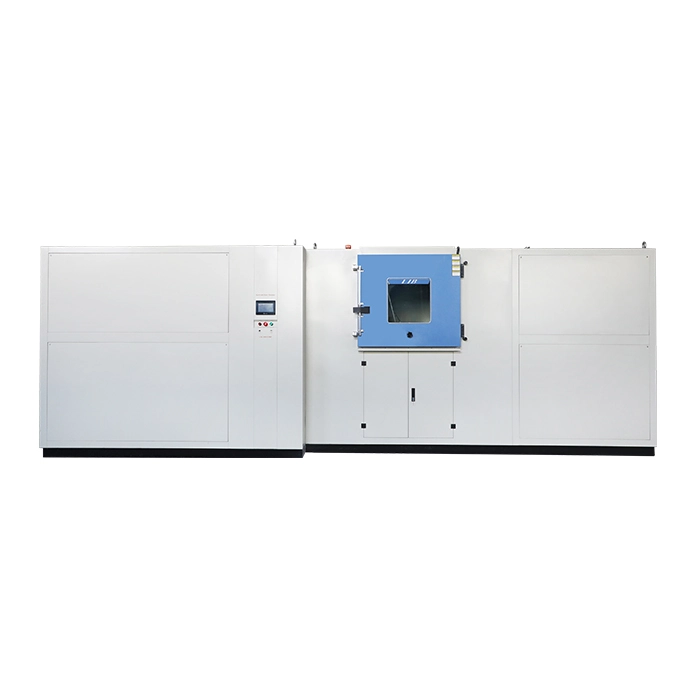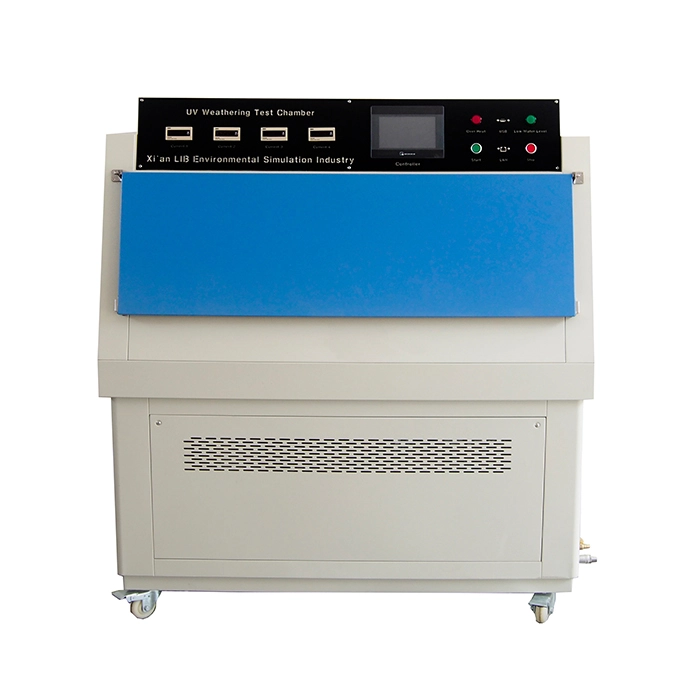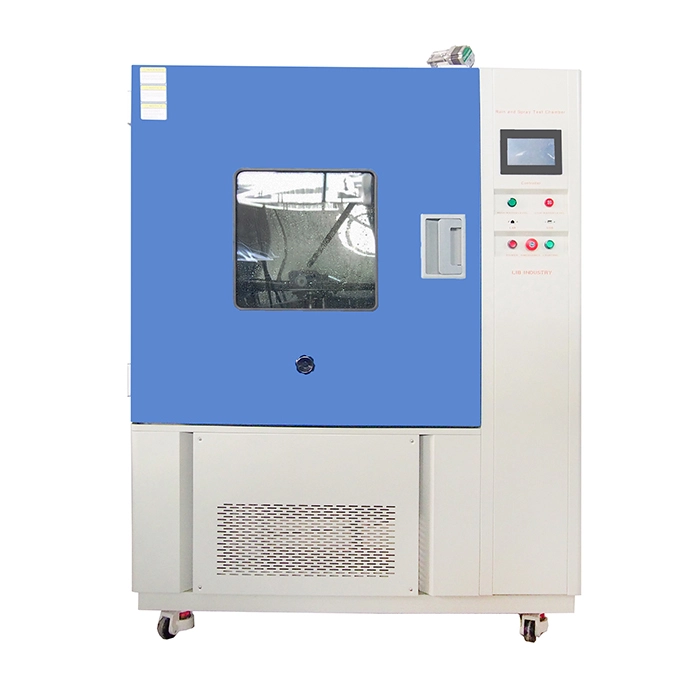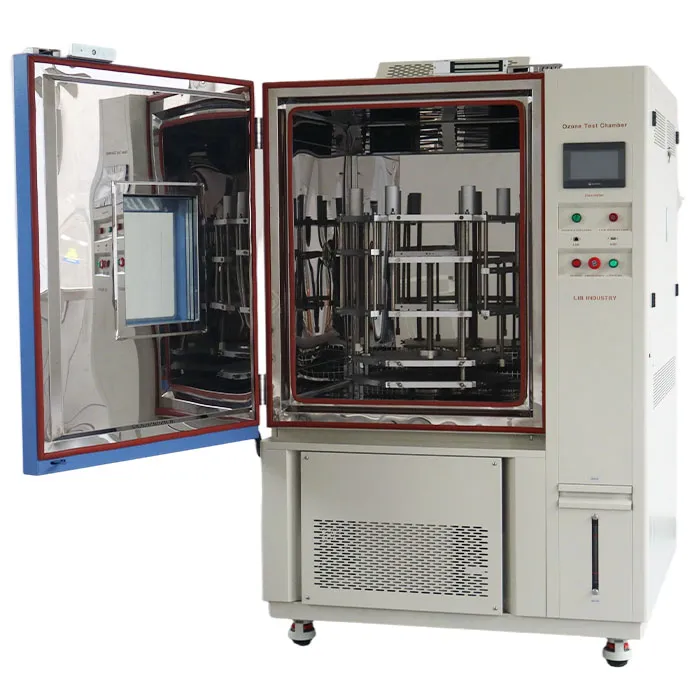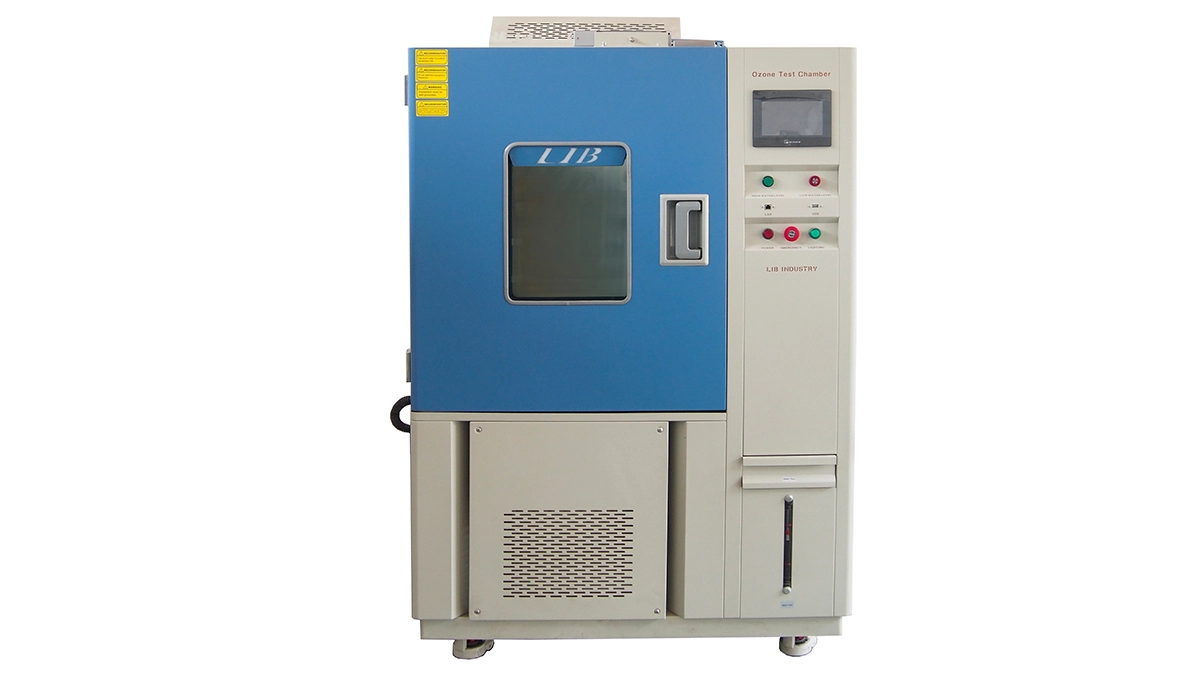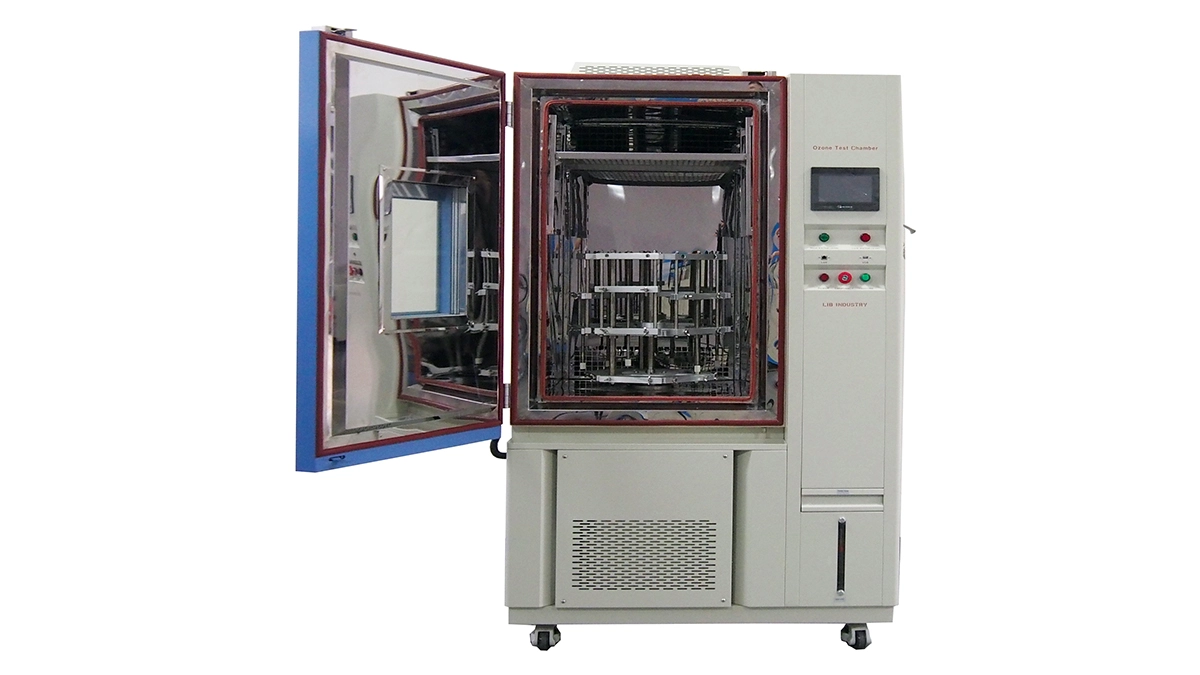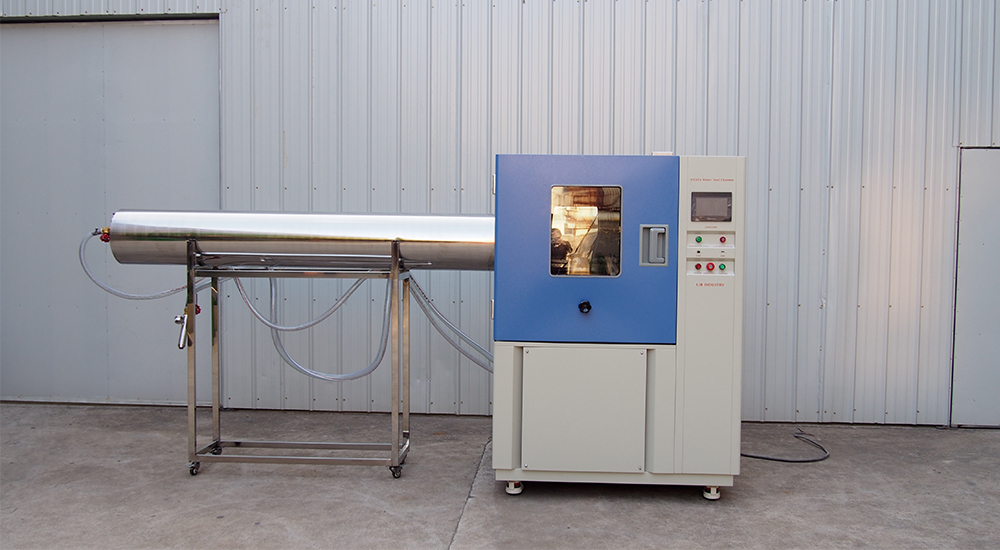
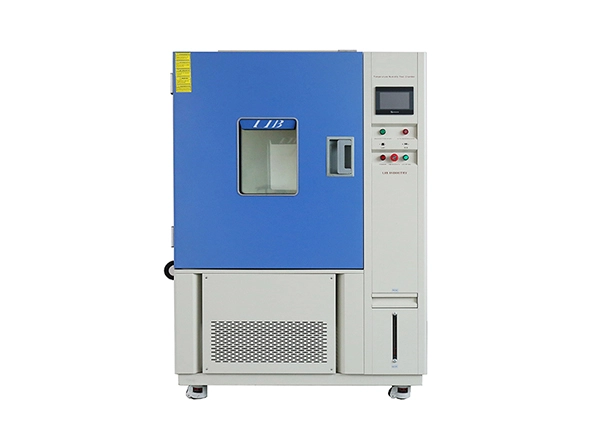
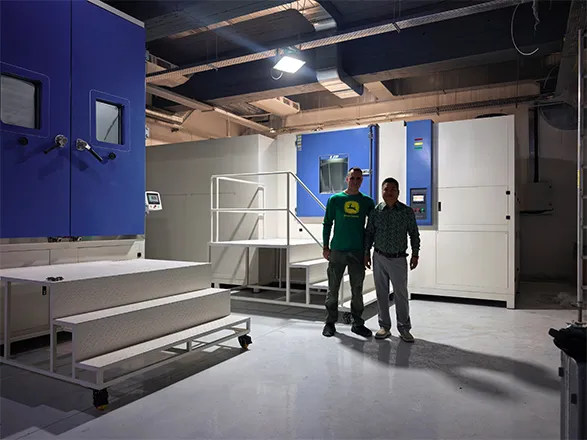
 Greece, September 2026. LIB Industry has completed the installation of a multi-chamber environmental testing facility for a customer in Greece. Installation took place over three days, from September 21 to 23, 2026. The project brings together several environmental simulation systems for sand and dust, water ingress, and corrosive (noxious) gas testing, allowing the customer to conduct different environmental durability and protection tests within one testing facility.
The installed equipment includes a walk-in IEC 60529 IP5X/IP6X dust test chamber, a MIL-STD-810 sand and dust test chamber, IPX1–IPX6 water ingress test systems, and a noxious gas test chamber.
What made this project particularly demanding was not only the range of testing equipment, but also the customer's building conditions. The equipment needed to be installed across the ground floor and basement, while the basement had limited access and space. Different testing methods also created different requirements for ventilation, exhaust, water drainage, moisture control, and equipment separation.
The testing facility was divided between two floors according to the customer's available space and testing requirements.
The noxious gas test chamber was installed on the ground floor.
Unlike conventional temperature, humidity, or dust testing, noxious gas testing requires additional attention to the management of the test atmosphere. The customer therefore arranged a dedicated ventilation and exhaust system for the entire floor, discharging air outdoors to help maintain a controlled working environment around the test chamber.
The four gas cylinders required for testing were placed inside a sealed gas-cylinder cabinet, and the cabinet itself was equipped with an independent ventilation system.
This created a complete arrangement around the gas testing equipment:
Gas Cylinder Storage → Noxious Gas Test Chamber → Room Ventilation → Outdoor Exhaust
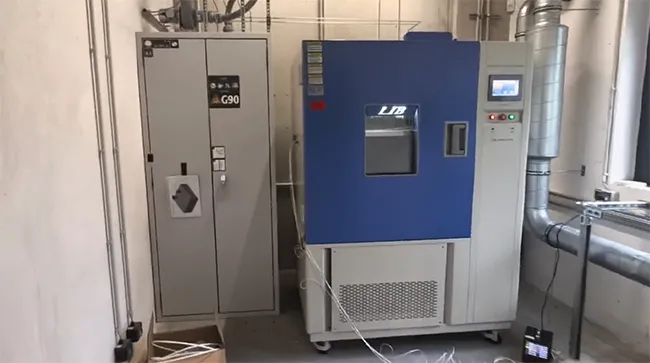
LIB Industry's noxious gas test chambers are designed for controlled gas exposure testing, with temperature, humidity, and gas concentration control. Typical configurations provide a 15–80°C temperature range and 30–98% RH humidity range, with controlled concentrations available for gases such as SO₂ and H₂S. The equipment can be used for applications involving corrosive gas exposure and material or component durability testing.
The remaining environmental test equipment was installed on the basement level.
Because of the building structure and available access, the larger equipment could not simply be transported into the basement as complete units. LIB Industry therefore arranged sectional transportation, with the equipment delivered in separate sections and assembled after reaching the installation area.
The installation process followed a practical sequence:
Sectional Shipment → Basement Transportation → On-Site Assembly → System Connection → Commissioning
Building entrances, corridors, elevators, stairways, door dimensions, and available working space can all affect how large equipment is moved into an existing facility. By using sectional transportation and on-site assembly, LIB Industry adapted the installation to the customer's actual building conditions rather than requiring major structural changes. The full on-site installation was completed in three days.
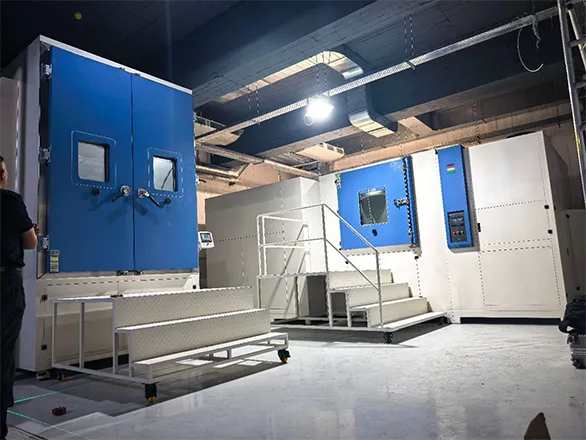
Two different sand and dust testing requirements were included in the project: IEC 60529 IP5X/IP6X and MIL-STD-810.
Although both involve sand or dust exposure, they serve different testing purposes and use different test conditions.
The walk-in dust test chamber is designed for IEC 60529 IP5X and IP6X testing of larger products and equipment such as vehicles, electrical equipment, and enclosures. The walk-in configuration provides a larger test space and makes loading and positioning easier than a compact benchtop-style chamber.
Key specifications include:
Parameter | Specification |
Protection levels | IP5X / IP6X |
Dust concentration | 2 kg/m³ per IEC 60529 (adjustable up to 4 kg/m³) |
Test powder | Talcum powder, passing a 75 μm square-mesh sieve (50 μm wire diameter) |
Test duration | 0–99 h 59 min |
IP6X testing | Vacuum system |
Chamber construction | SUS304 stainless steel |
The controlled dust concentration and circulation system help provide repeatable test conditions, while the IP6X vacuum system supports the pressure-difference requirements used during IP6X testing.
The project also includes a dedicated MIL-STD-810 sand and dust test chamber for harsh-environment testing, designed around Method 510 and supporting both blowing dust and blowing sand procedures.
Key capabilities include:
Blowing dust air velocity: 1.5–8.9 m/s
Blowing sand air velocity: 18–29 m/s
Temperature range for sand testing: 23–60°C
The system uses controlled airflow to expose products to fine dust or sand, making it suitable for evaluating sealing, protection, abrasion resistance, and environmental durability under demanding conditions.
Having separate equipment for IEC 60529 and MIL-STD-810 allows the customer to conduct testing according to the corresponding standard instead of relying on one system for different test methodologies.
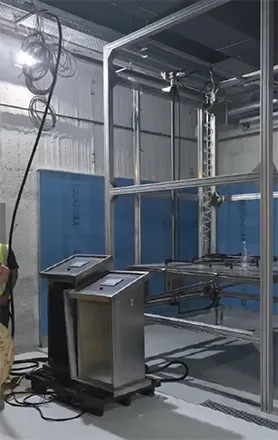
Water ingress testing is another major part of the Greek customer's new testing facility.
The project includes IPX1–IPX6 rain and water ingress test systems, covering different levels of protection against water exposure under IEC 60529. IPX1 and IPX2 are drip tests, with a vertical drip rate of 1 mm/min for IPX1 and 3 mm/min with the specimen tilted 15° for IPX2.
For IPX3 and IPX4 testing, LIB Industry's no-housing water spray test device uses an open-frame structure rather than enclosing the specimen inside a chamber. This is particularly useful for large, heavy, or irregularly shaped products because specimens can be positioned directly within the testing area.
The oscillating tube system can be configured with different radii from R200 to R1600 mm, and the oscillation angle can be adjusted up to ±180° according to the test requirement.
The water circulation and filtration system helps reduce the risk of nozzle blockage during repeated testing. The main wetted components use SUS304 stainless steel for durability.
For higher water ingress levels, the IPX5 and IPX6 systems provide water flows of approximately 12.5 L/min and 100 L/min, respectively.
Because all of these water testing systems were installed in the basement, LIB Industry incorporated a dedicated drainage system for the IP rain testing area. Water generated during testing is collected and discharged efficiently, reducing the risk of standing water around the equipment.
Another challenge came from the limited basement space.
The IP rain testing systems and sand and dust testing equipment needed to be installed within the same general area. However, their operating environments are fundamentally different.
Rain testing requires water spray and moisture, while sand and dust testing requires a controlled dry environment.
To prevent interference, LIB Industry installed a glass enclosure around the open-frame rain testing systems. The enclosure:
Contains water spray and moisture within the rain testing area
Separates water testing from sand and dust testing
Makes more effective use of the limited basement space
This solution demonstrates why environmental test chamber installation cannot always be separated from laboratory layout and infrastructure planning. The physical relationship between different testing systems can directly affect their operation.
The Greek project demonstrates LIB Industry's approach to environmental test chamber projects: the equipment is only one part of the complete solution.
LIB Industry supported the customer from equipment selection and site planning through sectional transportation, on-site assembly, supporting infrastructure (ventilation, exhaust, gas-cylinder storage, drainage, test-area separation), commissioning, training, and technical support.
This one-stop approach is particularly valuable for customers installing several different environmental test systems within an existing building. Instead of handling equipment supply, transportation, installation, utilities, and commissioning separately, the customer can coordinate these requirements as part of an integrated project.
LIB Industry also supports customers after installation with a 3-Year Manufacturer Warranty and Lifetime Technical Service, covering equipment operation, maintenance, troubleshooting, and future testing requirements.
Planning an environmental testing laboratory or expanding your existing testing capabilities? Contact LIB Industry to discuss your testing standards, equipment requirements, and available installation space.
What should I look for in a walk-in dust test chamber manufacturer?
Look for IEC 60529 IP5X/IP6X capability, controlled dust concentration, and a vacuum system for IP6X. A manufacturer that can ship in sections and commission on site is also valuable for existing buildings.
What is the difference between IP5X and IP6X dust testing?
IP5X is dust-protected: some dust may enter, but not enough to affect operation. IP6X is dust-tight: no dust enters, and testing uses a vacuum system.
Can an environmental test chamber manufacturer ship large chambers in sections?
Yes. Large chambers can be built in sections, moved in batches and assembled on site, as LIB Industry did for the basement equipment in Greece.
How does MIL-STD-810 sand and dust testing differ from IEC 60529 dust testing?
IEC 60529 verifies an enclosure's IP5X/IP6X rating in a talcum powder atmosphere. MIL-STD-810 Method 510 tests resistance to blowing dust and sand at controlled air velocities.
What should I ask an IPX1–IPX6 rain test equipment manufacturer?
Ask which IPX levels are covered, whether an open-frame design is available for large products, and how water circulation and drainage are handled.
What ventilation does a corrosive gas test chamber need?
A dedicated exhaust discharging outdoors, plus a sealed, ventilated cabinet for gas cylinders. Confirm exact requirements with your corrosive gas test chamber manufacturer and local regulations.
Can water and dust test equipment share one room?
Yes, with separation. In this project, a glass enclosure around the rain test systems kept moisture away from the dust testing area.
 English
 русский
 français
 العربية
 Deutsch
 Español
 한국어
한국어 italiano
 tiếng việt
 ไทย
ไทย Indonesia