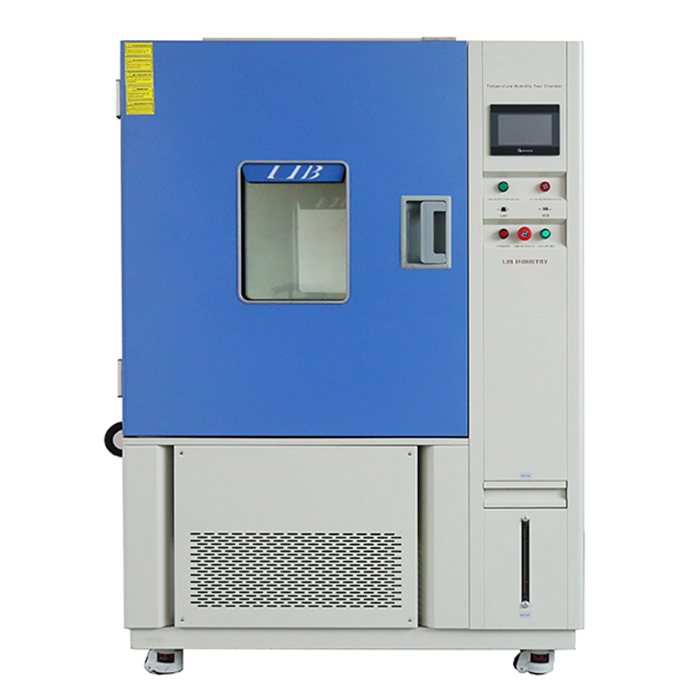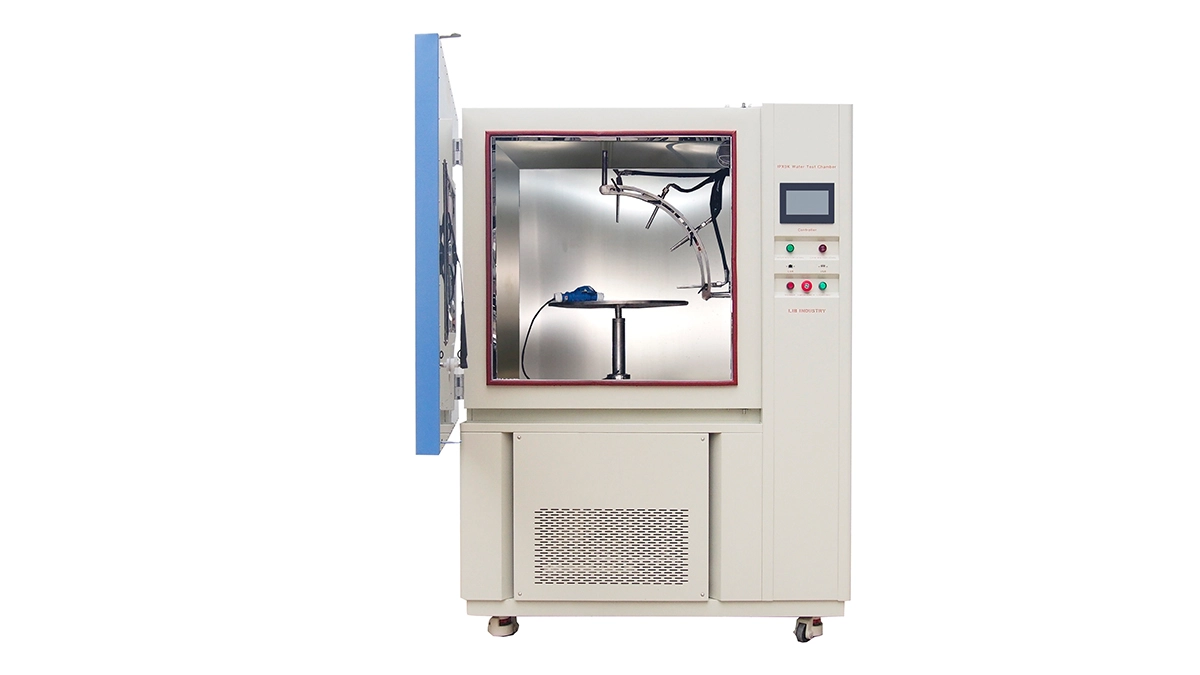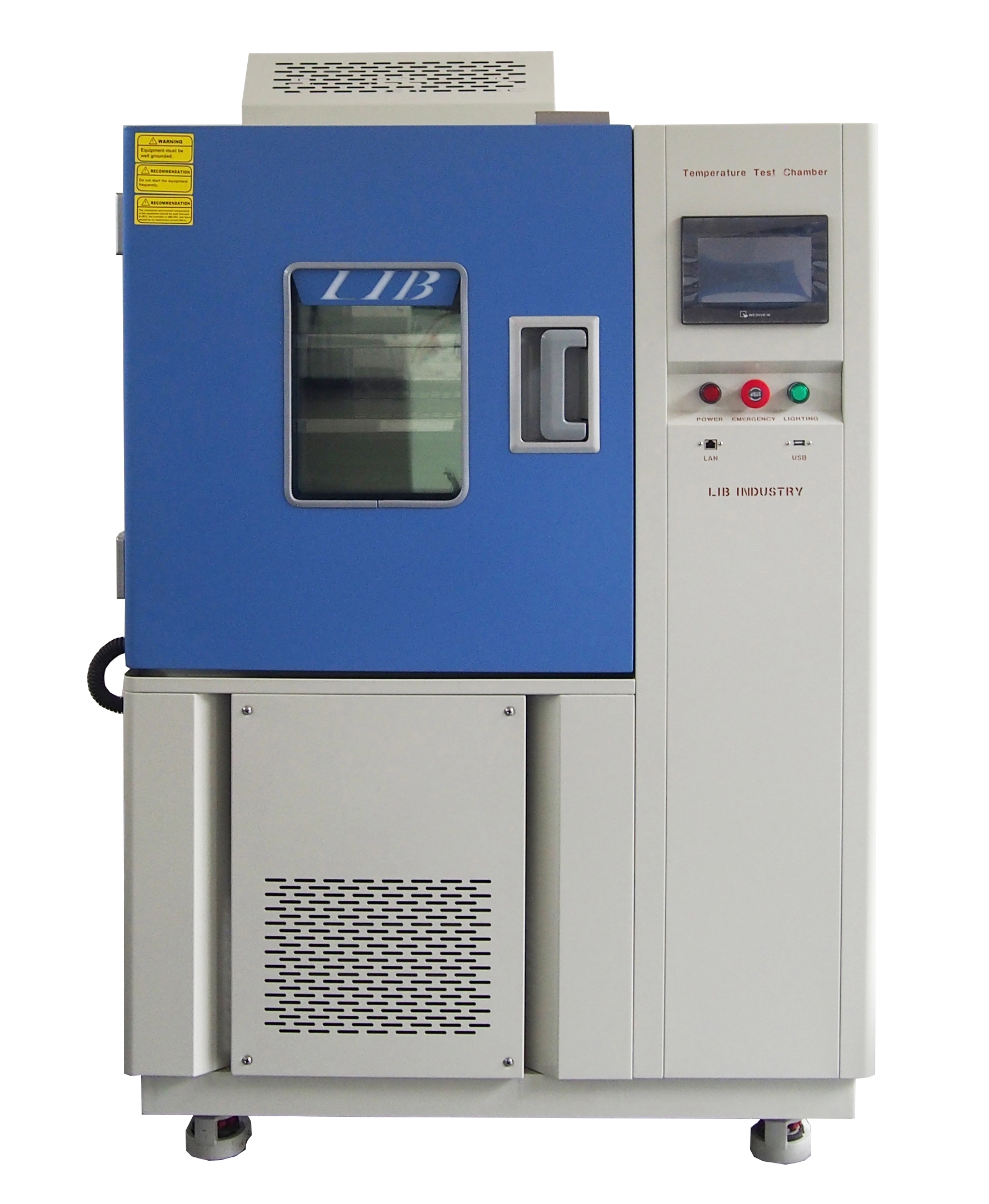
For MIL-STD-810H Method 506.6, equipment should be selected according to the required rain exposure: Procedure I for rain and blowing rain, Procedure II for exaggerated rain, or Procedure III for drip testing. A military rain test chamber is preferable when the product must be evaluated under wind-driven rainfall because it combines controlled water delivery with airflow. Procedure I is particularly demanding because the facility should reproduce rain droplets predominantly between 500 and 4,500 μm together with wind velocities up to 18 m/s. The most important selection factors are rainfall rate, wind speed, droplet distribution, specimen size, exposure orientation, water temperature and whether the product must remain operational during testing.
MIL-STD-810H Method 506.6 evaluates the ability of equipment to withstand rain and water exposure that may occur during outdoor deployment, transportation, storage or operation.
Unlike a simple waterproof screening test, Method 506.6 is designed around the actual environmental exposure expected by the equipment. The standard therefore provides three different procedures:
Procedure I – Rain and Blowing Rain
Procedure II – Exaggerated
Procedure III – Drip
Procedure I is generally the most representative choice for equipment exposed to outdoor rainfall accompanied by wind. Wind changes how water reaches an enclosure. Instead of falling vertically, droplets can strike doors, seams, connectors, vents and other vulnerable surfaces at an angle.
The purpose is not only to determine whether water enters the enclosure. Engineers can also evaluate whether water intrusion affects electrical insulation, mechanical components, controls, sensors, communications or other operating functions.
Typical applications include military electronics, communication equipment, field instruments, outdoor power systems, vehicle-mounted equipment, aerospace support equipment and other products expected to operate in severe weather.
LIB identifies military, aerospace, automotive, communication and electronics applications for its rain testing solutions. Its rain chamber range includes dedicated MIL-STD-810 rain test chambers as well as other water spray and ingress protection systems.
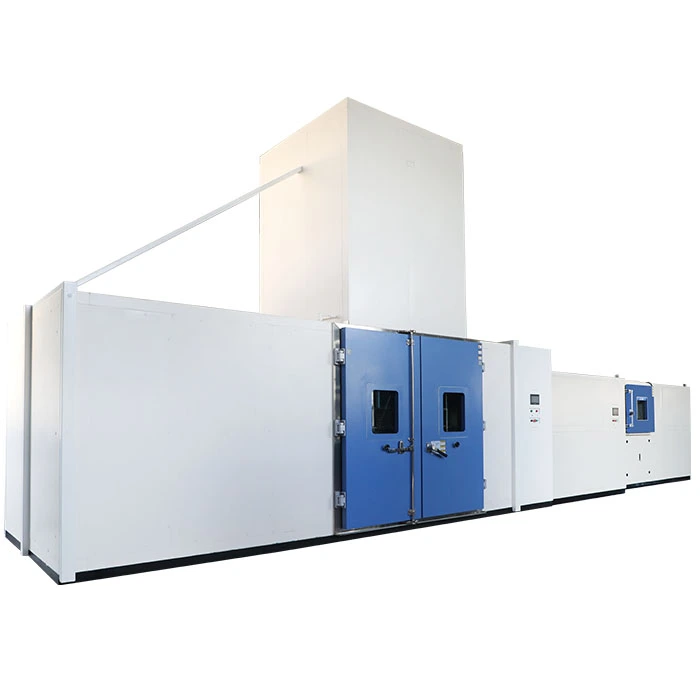
Method 506.6 does not prescribe one universal test profile for every product. The appropriate procedure and severity should be selected according to the equipment's expected environment and intended use.
Test procedure | Main purpose | Rain / water condition | Wind / spray condition | Typical exposure |
Procedure I – Rain and Blowing Rain | Outdoor equipment exposed to natural rain and wind | Rainfall about 1.7 mm/min when the default condition is selected | Wind up to 18 m/s | Minimum 30 min per face |
Procedure II – Exaggerated | More severe water exposure for vulnerable equipment | High-volume spray; LIB configuration uses 20.8 L/min per nozzle | No wind requirement | Test duration defined by test plan |
Procedure III – Drip | Equipment protected from direct rainfall but exposed to dripping water | At least 280 L/m²/h in the LIB configuration | No wind requirement | Defined by test plan |
For Procedure I, the standard specifies water droplets predominantly between 500 and 4,500 μm and calls for horizontal wind velocities equal to or exceeding 18 m/s when the default wind condition is used. The rain should be distributed over the test item while the wind drives it against the exposed surface.
The standard also requires attention to the temperature relationship between the test item and rainwater. At the start of each exposure period, the stabilized test-item temperature should be at least 10°C above the rainwater temperature under the applicable Procedure I condition.
LIB's MIL-STD-810 rain chamber lists a rainfall rate of ≥1.7 mm/min, droplet size of 0.5–4.5 mm, wind speed up to 18 m/s, and a test-item heating condition in which the specimen temperature is controlled relative to the water temperature. Its RM-1000 configuration provides a 1,000 L working volume.
Selection Factor | Wind-Driven Rain Chamber | Exaggerated / Drip Rain Equipment |
Temperature range | Test-item and water temperature must be coordinated | Mainly water/test-item condition |
Humidity range | Normally not the primary controlled parameter | Normally secondary |
Chamber volume | Medium to large depending on specimen | Small to large |
Ramp rate | Not the primary requirement | Not normally the primary requirement |
Airflow | Critical; up to 18 m/s for Procedure I | Usually not required for Procedure III |
Sample heat load | Important because operating equipment may generate heat | Depends on test item |
Water system | Rain distribution + wind system | Spray, nozzle or drip system |
Safety configuration | Electrical protection, drainage, water containment and high-speed airflow protection | Water containment, drainage and electrical protection |
Applicable standards | MIL-STD-810H Method 506.6 | MIL-STD-810H Method 506.6 and selected product standards |
The most significant equipment difference is therefore airflow.
A conventional rain or IP spray chamber may reproduce water exposure, but a Procedure I system must also reproduce the aerodynamic component of the environment. LIB's MIL-STD-810 chamber incorporates an axial fan and air circulation system to combine airflow with rainfall. Its controller can adjust rainfall time, rainfall intensity, wind speed, temperature and turntable speed.
This is particularly important for large products. The test item should not block the airflow or create a large shadow zone that prevents uniform exposure. The chamber should therefore be sized around the actual specimen geometry rather than simply its external dimensions.
A water spray alone cannot reproduce the aerodynamic effects of Procedure I. Wind speed and direction can determine where water reaches the enclosure.
The three procedures represent different environmental scenarios. Procedure III drip testing should not be presented as equivalent to wind-driven rain.
Rainfall intensity is important, but droplet size, wind velocity, spray distribution and exposure angle also influence the result.
Wind-driven rain can affect vertical surfaces differently from horizontal surfaces. The standard calls for exposing vulnerable surfaces and rotating the test item when necessary.
For Procedure I, the test-item temperature and rainwater temperature relationship can be important to water-ingress behavior. The standard specifies a minimum 10°C difference at the start of exposure under the applicable condition.
The specimen, fixture, turntable and required spray distance must all be considered. A compact chamber can produce unrealistic airflow obstruction around a large enclosure.
Method 506.6 can include functional checks before, during and after exposure. If the equipment is intended to operate in rain, the chamber should provide suitable electrical connections and test access.
An IP rating primarily addresses enclosure ingress protection. Method 506.6 is an environmental test method that can incorporate wind, rain dynamics, temperature effects and operational verification.
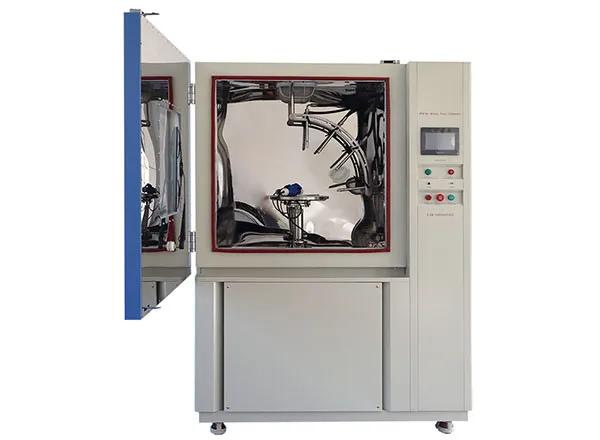
The correct LIB configuration depends on specimen size and the required Method 506.6 procedure.
Benchtop: Suitable for small electronic assemblies or components when the test plan calls for controlled water exposure without large airflow requirements.
Reach-In: A practical choice for medium-sized military electronics, communication equipment and field instruments requiring repeatable rain exposure.
Walk-In: Better for large equipment, vehicle components or assemblies that cannot be accommodated in a conventional enclosure. LIB also offers walk-in rain systems for larger products.
Thermal Shock: Appropriate when the primary requirement is rapid temperature transition. It should not replace a dedicated rain chamber when water exposure is the qualification objective.
Salt Spray: Intended for corrosion testing rather than rain ingress. It should be selected separately when salt contamination and corrosion are the primary concerns.
IP: Suitable when the requirement is specifically an IEC 60529 ingress protection rating. LIB's rain equipment portfolio covers IPX1 through IPX9K in addition to military rain testing.
Special Custom Chamber: Recommended when the test involves large equipment, customized wind profiles, operating power, temperature differentials or multiple environmental stresses.
For dedicated military testing, LIB's MIL-STD-810 Rain Test Chamber is designed to conduct Procedure I, Procedure II and Procedure III. The published RM-1000 system includes rainfall control, wind simulation, adjustable turntable movement, water circulation and programmable test conditions.
For broader applications, LIB's Rain Test Chamber category includes water spray, jetting, immersion and military rain systems, allowing laboratories to select equipment according to the actual water-exposure method rather than using one chamber for every application.
For aerospace programs, LIB's Environmental Test Chambers for Aerospace Industry page identifies MIL-STD-810 Method 506 rain testing alongside other waterproofness methods used for aerospace equipment.
A suitable same-topic article for internal linking is Understanding 3 Procedures in MIL-STD-810H Rain Standard. It is an existing LIB article specifically covering Procedure I, Procedure II and Procedure III and therefore provides a natural technical follow-up to this equipment-selection guide.
For Procedure I, select a dedicated rain chamber capable of controlling both rainfall and wind. If Procedure II or III is required, the equipment must reproduce the specified spray or drip conditions instead.
Wind-driven rain combines water with controlled airflow. The wind changes the impact direction and velocity of droplets and can force water toward seams, openings and other vulnerable enclosure locations.
The duration depends on the selected procedure and tailored test plan. For Procedure I, the standard specifies maintaining the selected wind and rain conditions for a minimum of 30 minutes for an exposure period. Individual faces may be tested separately.
Choose a chamber based on specimen dimensions, fixture requirements, exposure surfaces, nozzle distance and airflow requirements. Large equipment may require a walk-in or customized chamber to prevent the specimen from disturbing the wind and rain field.
Yes. A properly configured system can combine rain and blowing rain, exaggerated spray and drip functions. LIB's MIL-STD-810 rain chamber is specifically designed for Procedures I, II and III.
No. IP testing and MIL-STD-810H address different qualification objectives. MIL-STD-810H Method 506.6 can include wind-driven rain, operational checks and environmental tailoring that are not represented by a simple IP water test.
An RFQ should specify the MIL-STD-810H revision and Method 506.6 procedure, specimen dimensions and weight, rainfall rate, wind speed, droplet requirements, water temperature, exposure duration, specimen orientation, operational status and required electrical connections.
A walk-in system becomes useful when the test item is too large for a standard chamber or when complete assemblies, vehicle components or multiple specimens must be tested without disassembly. LIB offers walk-in rain testing solutions for large products.

 English
 русский
 français
 العربية
 Deutsch
 Español
 한국어
한국어 italiano
 tiếng việt
 ไทย
ไทย Indonesia
.webp "IPX5 IPX6 High Pressure Water Flow Tester")